
Rotorua Review, Tuesday, July 18, 1995 — ‘Lu’s dream sound.
Lu Quin has a dream. The sprightly 76-year-old, known throughout Rotorua for taking handbells and happiness to homes and hospitals, has a vision that someday people will come to Rotorua from all over New Zealand for sound therapy treatment.
Her goal was recently reinforced by a 12-day trip to Paris which she undertook specifically to meet Dr Alfred Tomatis, world authority on sound treatment and head of over 200 Tomatis Centres throughout the world. There she sat in on 20 interviews over three days, witnessing the change in people after sessions using an ‘electronic ear’ developed by the former ear, nose and throat surgeon.
She saw a hyperactive six-year-old boy, already expelled from three schools, calmed and able to resume normal schooling.
A Polish woman living in Russia, in danger of losing her job as a Greek interpreter because her French wasn’t good enough, was soon able to speak French, Dr Tomatis observed, ‘like a Frenchwoman.’ And she witnessed a 72-year-old woman who lacked confidence, after a few sessions able to summon the courage to re-enter the workforce. Mrs Quin, too, was helped. A telephone phobia which led to a stutter disappeared completely after sessions using high-frequency sound. Dr Tomatis uses combinations of upper-frequency music by Mozart as well as Tibetan and Gregorian chants to retune frequencies of the brain.
Lu Quin is keen to see the same sound therapy techniques available here in Rotorua. She has someone in mind to run the centre and only needs sponsorship to enable him to travel to Paris and be trained by Dr Tomatis. The nearest Tomatis Centre is presently in Tahiti though this looks likely to move to Sydney in the coming year. Another five operate in Japan. Mrs Quin’s trip to Paris began almost with a miracle. As a pensioner, she knew she could not afford the $2,500 airfare needed to get there. So her amazement was total when, after checking airfares, she returned home to find a cheque in her letter box from Aorangi Kaupapa Trust for the exact amount. Lu Quin, who was also the founder of St Chad’s, will speak about her dream for a sound therapy centre in Rotorua at St Chad’s Annual General Meeting, at 7.30pm this Thursday, July 20. All interested persons are cordially invited to attend.
St Chad’s — Devon Street Hall
| 1925, St. Chad’s Anglican Church opened, but was known as the Devon Street Hall. Many adult and children’s groups have used it. It has, and still does, serve the community in a worthy cause. | 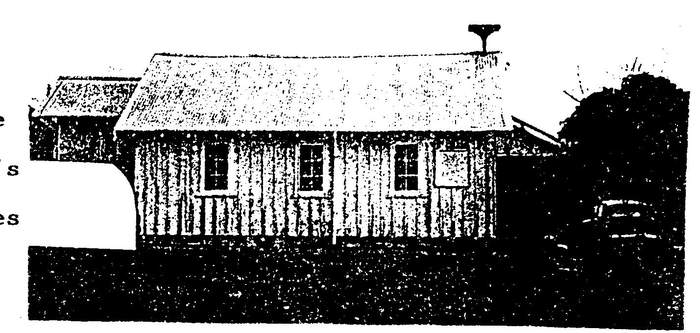 |
|---|
|
‘St Chad’s seeks community support.’ Daily Post, 1995 |
 |
|---|
|
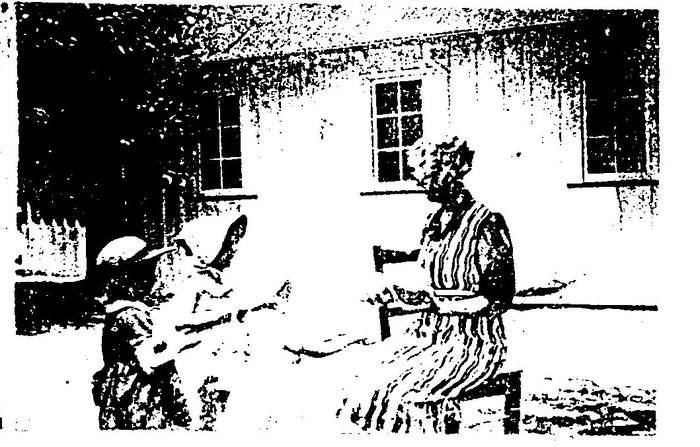
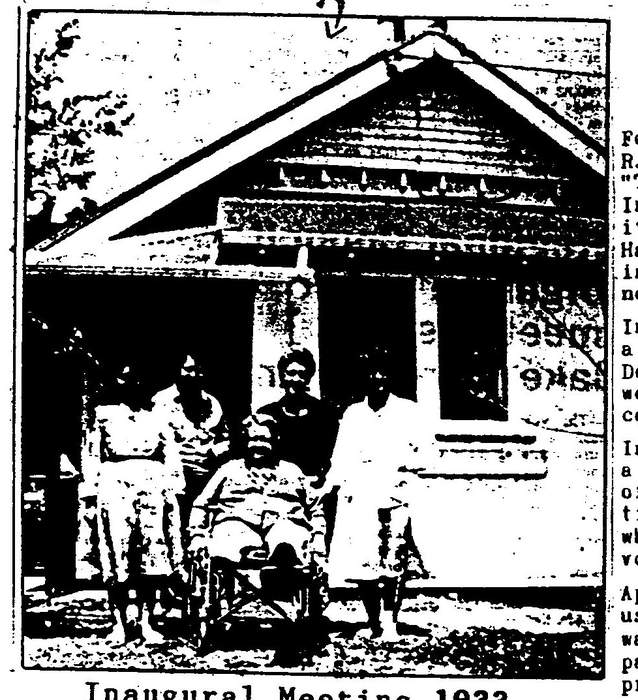
Photos — Lu Quin. St Chad’s — little known but much appreciated. From left, Champa Bhana, Maurice Topia, Bella Arthur, centre co-ordinator, Jean Hedley and Trust member, Peggy Shanks. Inaugural Meeting 1933, Rotorua Mothers’ Union. Mr. Corbin opened with prayer and an address to Mesdames Butler, Miss Robinson, Postlewaite, Bieleski, Plummer, Young, Knowles, Lilley, Orsler, Stewart, Beamsley, Phipps, Kingsland, Harwood, Rush, Mansfield, Oakes. |
A Brief Early History of St. Chad’s Article by Lu Quin In 1923 — through the generosity of Mr. A.G. Christopher a site was secured in Devon St., and in 1925 the Devon St. Hall was opened. Regular Sunday Services were held from then on and by 1929 there were 364 communicants, with 60 attending the Sunday School. Apart from religious services the Devon St. Hall was used as an extension of the Whakarewarewa School which was almost a neighbour at the time as it was sited on part of the Golf Links (about the third tee and the practice fairway, I think.) |
|---|
.
Kusabs Family — Very Early Rotorua Identities
Ernest Kusabs owned the first timber mill at Mamaku in the 1880s, later opening in Rotorua, 1895, Kusabs Bros. Timber Yards, near the present day Pak-‘n’-Save, on northern Amohau St. between Fenton and Hinemaru Streets. Two of his sons later owned blocks of land south of these yards.
 Roger Kusabs owned land at the corner of Marguerita–Fenton Streets, building two homes where the present Cedar Lodge Motel stands. He also owned the land where the Presbyterian St. John’s now stands, bounded by Ranolf, Victoria and Ruihi Streets. Lucy was Victoria’s (Wikitoria) daughter and became the wife of Ernest Kusabs, her Maori name for Lucy being Ruihi.
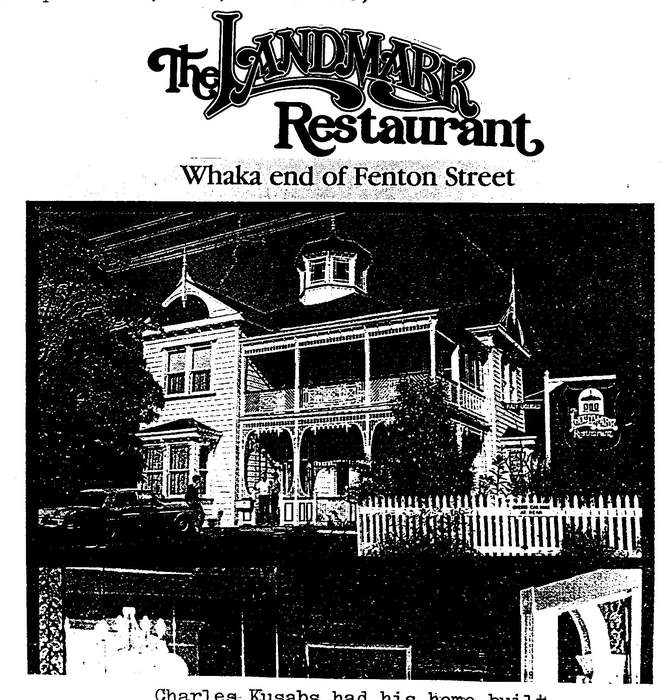
Charles Edmund Kusabs owned the land stretching from Victoria St. along Whaka Rd., now called Fenton St., up to Malfroy Rd. The side street ‘Toko’ is the Maori nick-name for Roger Delemere Dansey, related by marriage to the Kusabs, who was held in high regard and was Rotorua’s first Post Master in 1875. In 1886 he managed with great difficulty, by morse code, to tell the outside world of the terrifying disaster occurring in Rotorua with the eruption of Mt. Tarawera. He lived in Whaka Rd. Charles Kusabs liked style. He built his beautiful big home at his smaller block of land up at the top end of (Whaka) Fenton St., now the Landmark Restaurant.
Charles Kusabs sold this beautiful Whakarewarewa home, building another lovely big house by the Utahina River at the western end of Devon St. Unfortunately, while absent for several days, a couple of young relatives, boys, accidentally caused it to be totally burnt down, with all his family documents, photos and his many sporting trophies, especially for his golf which was a passion to him.
|
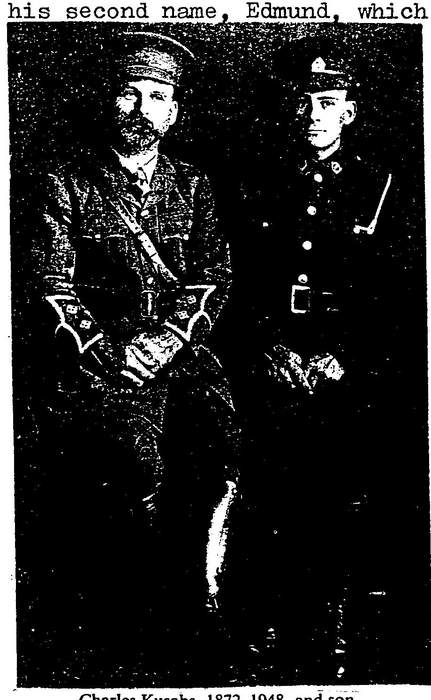
Charles Kusabs, 1872–1948, and son Arthur (Stafford Coll./R. Kusabs). Charles in 1908 imported a Sunbeam car, competing with horse-drawn vehicles, and was first to carry passengers by car on the ‘Round Trip’. Arthur drove for Charles. 1918, Arthur, with Eric Roe, were Rotorua’s first pilots. |
Kusabs and Steele Bros. landholdings near Victoria St., Malfroy Rd., Fenton St. and the Arikikapakapa Reserve, showing Rotorua’s first aerodrome, 1930, and Whakarewarewa |
|---|
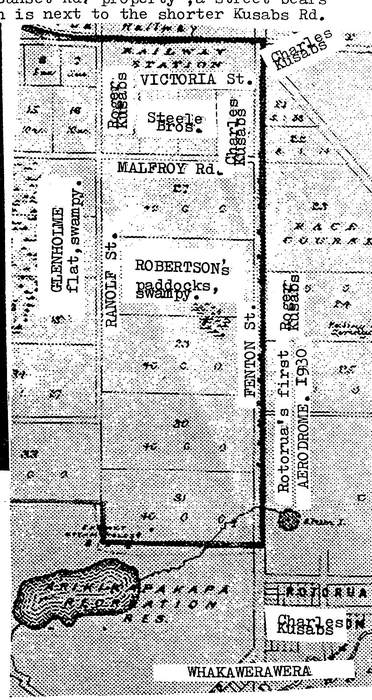
In 1908, he with other enthusiasts made an agreement with David Sherrif to form a golf course on his land which ran from the Utahina River on Malfroy Rd. to near Old Taupo Rd. This was a very successful, happy arrangement until the lease ran out in 1911. They next attempted a temporary bit of rough scrub land known as Robertson’s Paddock opposite the Arawa Race Course in Fenton Street. Charles played a big part now in getting part of the Arikikapakapa Reserve about 1912 but because of manuka, bracken fern and hot fumaroles scattered throughout, the 18 holes were not completed till 1918.
Charles Kusabs was a far-sighted capable business man in his various projects with timber, land, boarding houses, tourist transport where he was a pioneer in the motor industry. In 1921 he won the contract for mail linking Rotorua with Whakatane and Frankton in Hamilton. On his Sunset Rd. property, a street bears his second name, Edmund, which is next to the shorter Kusabs Rd.