
ROTORUA PEOPLE
1880s TO 1940s
Living South of Old Railway
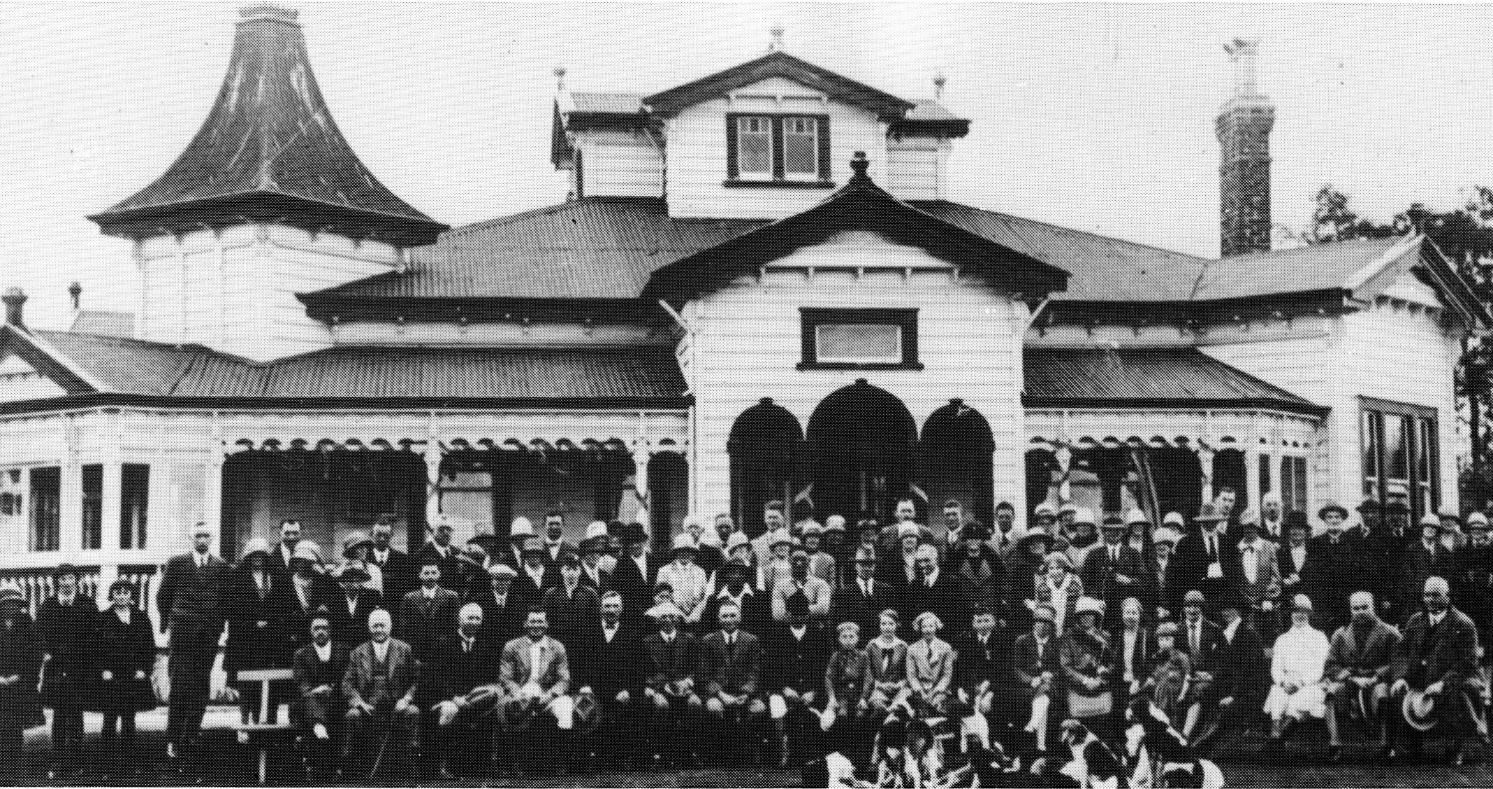
Photo from George Bertram. Late 1920s at Dr Bertram’s “Glenholme” Hunt Tea. Waikato Hunt Club visited Rotorua until Bay of Plenty Hunt Club formed 1932.
Glenholme Area to Whakarewarewa
Written by Peggy (Ford) Allen 1992, Daughter of H.P. Ford, an original settler 1992
First Printed ISBN ISBN 0-473-03821-8. 2nd Edition 2026 Amazon ISBN 9798171324643
Preface
Rotorua early residents resided near the heart of the town. As the town began to expand it spread on the south side of the Railway Reserve. The connecting streets gradually reached the hill country at Whakarewarewa and Tihiotonga with Old Taupo Rd. leading through the Hemo Gorge towards Taupo. It is this area south of the Railway that absorbed families wishing to settle as a result of the Auckland-Rotorua rail service, 1894, as well as other coach and car services from Tauranga, Te Puke and Maketu.
At first sections were mainly quite big for people to supply many of their basic needs such as vegetables, fruit, poultry and perhaps a cow. Much of it was swampland with scrub and manuka so settlement was scattered. The people came with hope of employment. These were difficult times financially in New Zealand – the Great Depression of the late 1800s, followed by another about mid-1920s to well into 1930s. Then, just as hope for a better future came with the discovery of cobalt to save the countryside farming ‘bush-sick’ problem, World War 2 broke out and a great number of Rotorua’s young men, Maori and European, left Rotorua to go into the Forces.
Amongst the town’s earliest citizens, there were men of vision who saw Rotorua as a very special and beautiful part of New Zealand. They had the foresight early on to protect these assets and possibilities, dedicating their lives to the task. We have much for which to thank them, as well as those fine Maori chiefs for their great generosity. Together they laid the foundation that has made our Rotorua a place of world renown.
It is this area, Victoria and Pererika Streets south of the Railway to Whakarewarewa and Tihiotonga hills, that this book is about, relating the tales of early life during the 1880s to late 1940s, as told by a few of the remaining original settlers or their descendants.
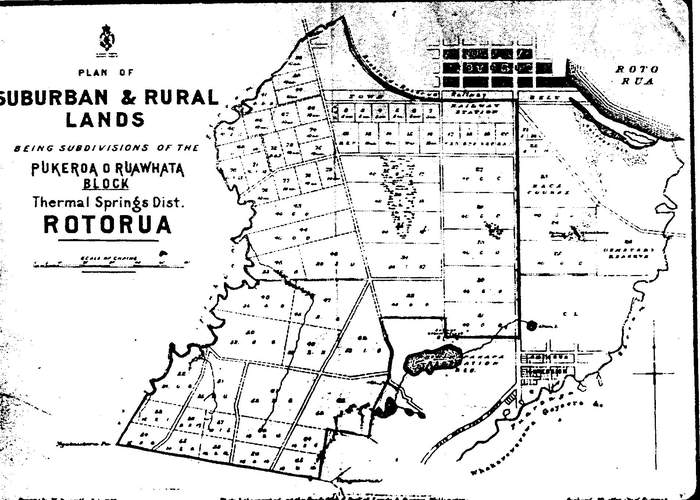
Plan of Suburban & Rural Lands, being subdivisions of the Pukeroa O Ruawhata Block, Thermal Springs District, Rotorua. Once the large suburban sections were subdivided, new roads had to be created by the new Borough Council in the 1920s. (photo – National Archives)
Dedication
To the wonderful people past and present who have been attached to Rotorua in its gradual development, making it the special place it has become today. To all those who have struggled against the odds and set such a courageous example for those who follow.
Acknowledgments
To all the people of Rotorua who have been so splendid in giving their support and information while showing a keen enthusiasm for the project. Without this stimulation I doubt if I could have completed such a long task. Even so, I realise and regret that there are many others whose stories would have been just as valuable. To all my supporters I give my deepest thanks.
Special thanks to Don Stafford, our Rotorua Historian for his two historical reference books, ‘The Founding Years In Rotorua” and ‘The New Century In Rotorua” His organisation of the Museum Reference Photograph Library, made material simpler to find.
Enid Tapsell’s ‘A History of Rotorua.’
The Rotorua and District Historical Society Inc. for their ‘Rotorua 1880–1980.’
Elaine Brewster’s ‘History of Early Law Firms in Rotorua.’
Rotorua District Council Official Handbook.
The Daily Post and the Rotorua Review, especially articles on the 1939–1945 ‘World War 2 Commemoration Years.’
To Claire Ford
My niece and Librarian at Rotorua Library and John Paul College, without whom this book would not even have started. It was her suggestion that I research this area to help with requests from both students and an interested public, as very little material was available. Claire suggested this to me as a result of the wide interest shown in my previous book about rural Rotorua.
By the same author:
Rural Community, Rotorua – 1920, Just Before and During 1920s. 1990. (On Amazon)
This new book, Rotorua People 1880s to 1950, living south of the old railway, Glenholme area to Whakarewarewa. 1996. Private Publication.
The author is not responsible for the accuracy of the facts or the opinions expressed by the contributors to this book.
ISBN 0-473-03821-8
Contents
Generalisation of era is shown but articles may be placed out of this order due to other factors such as events, occupations or area. Use the table of contents and the index to names at the back.
| Names of People in Articles and Biographies | ||
|---|---|---|
| 1870 to 1920. | Development from Ohinemutu to Rotorua township after Act of 1881 Robertson, Judge Fenton, Wlm. Kelly, Maoris and York Royal Visits, MacDonald & Boord, Kate Shaw & Corbetts, Steel, Wrigley, Hampson, Wylie, Sumner, Tisley, McLean, Gov. Grey, Verna White’s lists of people in & off Fenton St., Lloyds, Neil & Rua, Malfroy, Seddon, Hill, Tew, Lewis, Spence, Tucker, Naaman, Bailey, Worrall, Nixon, Ryan, Brown, Gleeson, Anderson, Dr. Bertram, La Trobe Hill, Jackson, Edwards | |
| 1910 to 1920 | Goodson, Galbraith, Price, Hardie, Farren, Brown, Mulligan, Pritchard, Parsons, Smith, Holderway, Wilson & Morris, Muirs. Les O’Connor names many Golf Caddies including Relph & Deadman, Gunsons, Smallbone, drovers & tramps, Gee, Worthington, Nealie the caricaturist, Richards, Urquhart, Graffe, Johnson, Woolliams | |
| 1920 to 1930 | After WW1, more scattered housing on big sections near scrub land Judge Holland, Nairns, Mason-Cresswell, de Lacy Collins née Smith, Myrtle & Bert Brown – Rua, Allison, Wilson. (From Mamaku timber lands came – Taylors, Hemming, Clark, Fugill, Roe, Clinkard – 1st Mayor of Rotorua, Pachoud.) 1920s into 1930s housing increases – Kinglands, Gainsford, East, Lapwood, King, Haggart, Langguth, McGinley, Parlane-Gammon, Allen, Linton, Spurdle. Aviation mainly 1930s – Roe, Kusabs, Bolt, McGregor, Sir Charles Kingsford Smith, Ulm, Rotorua Aero Club, Stan Blackmore, Rush | |
| 1914 to 1945 | Mainly Wars – WW1 1914–1918, WW2 1939–1945 Bellingham’s Gallipoli Diary extracts. Ray Smith, Military OBE, also CBE, Newspaper Honours; Ewerts-Doug, a Major, Burma, MC; Don Stafford, Rotorua Historian, MBE and CBE; Jack Stafford, Flight Commander, DFC; Brian Quinlan, Squadron-Leader, DSC; Rex Norman in Desert Campaign; Reg Henderson, Fire Service, Pacific War zone; Ted Atkinson with crew, honoured to fly top British Parliamentary Delegation to German Buchenwald Camp |
|
| 1870 to 1930 | People and Occupations. Edith Stafford – ‘Plantation’ — page 179. Ella & Ben Shaw, Newmarch, naming people in the Streets of Toko, Eason, Union, Herewini, Ruhi, then in Ranolf St., Aubertin, Roberts. Local news articles: Forestry, Waipa Mill, Tree Nursery, Fentons. |
|
| 1911–1930 | Glenholme, schools and associates – Bassett, Civils – Don & Joan, McDowells, Wedding & Dobsons, Catholic Schools, Clem Ludgate, Mr. & Mrs. Harwood, Bill Evans, Doreen McAdam & Peggy Ford (Allen) | |
| 1920 to 1940 | Mainly towards outskirts of the town. McKenzie-Bryce-Bishop, Phipps family, Khans. Along Old Taupo Rd. on V formed with Springfield & Otonga Rds – Goodwin, Buckthought, Miss Boord, Welch, Williamson, Miller, Heaton, McKenzie, Carruthers, Giltrap, Tonkins, Con, Young, Dodds, Reid, Garland, Avery, Hopkins, Carswell, Bond. Malfroy Rd. cycle shops – Beckett, also Adolph. Te Wairoa – Dudley Smith |
|
| 1900 to 1940s | Hemo Gorge, Tihiotonga. Sloane owned subdivision — page 224. Willmott – this land became Wychwood Nursery of Les & June Hadley & Noel Pachoud as partner, in Willmott Pl. next Foley Dr. (once Willmott.) Tihi-O-Tonga Station, Ngati-Whakau Tribal Lands Inc. now, but had Managers previously – 1912 Bill Scott, then Mort Jolly, Charlie Doggett and Mark Flood round 1940s–50s — |
|
| Note: Other people living in Ranolf St. and its side streets are named in various parts of the book | ||