
Appendix 1 Jean Batton Garbo of the Skies (2000)
The Daily Post, Tuesday, May 23, 2000 — Post Today. “Important day for ‘Garbo of the skies'”, by Lisa Wilde.
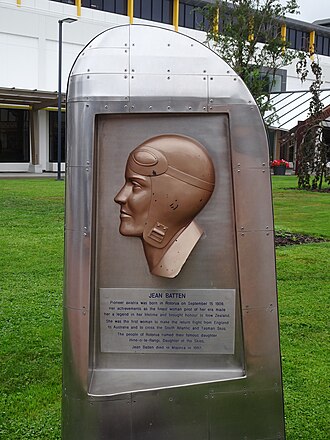
She’s Rotorua’s daughter of the skies — Hine o te Rangi. And 66 years ago today, she flew into the record books.
On May 23, 1934, the glamorous 25-year-old Jean Batten landed her De Havilland Gipsy Moth in Darwin, earning herself a place in aviation history as the fastest woman in the world, and the first to fly solo from England to Australia. It took her 14 days, 22 hours and 30 minutes.
A triumphant tour of New Zealand followed, including a trip to Rotorua, the small tourist town where the pioneer aviatrix was born and spent her early years. There, she was named Hine o te Rangi by the Te Arawa people.
At a time when New Zealanders were in the grip of the Great Depression and the dark clouds of war loomed on the horizon, Jean’s soaring spirit gave them hope.
Slim and stylish, as beautiful in overalls and goggles as in an evening gown and fur coat, Jean was the darling of the world’s press — chic, daring and oh-so-mysterious, they called her the Garbo of the skies.
 She and her domineering mother made the most of it, crafting a glossy myth for Jean’s adoring public. The reality was somewhat different, revealing an often sad and lonely life as well as a burning desire to fly.
The romantic version would have us believe the talented young pianist sold her instrument to pay for flying lessons. In fact, it only paid for the boat fare to England for the ambitious pair.
History records that Jean was ruthless when extracting money from benefactors and refused to acknowledge them later, leaving a string of broken hearts behind each of her record breaking flights.
They span just four years of her life — the two potentially fatal crashes which earned her the title Try It Again Girl before the 1934 success which placed her on the world stage; the return flight to England in 1935 making her the first woman to fly the round-trip solo; the first woman to fly the South Atlantic to South America; the first person, man or woman, to fly from England to New Zealand.
That flight in a tiny Percival Gull aeroplane, covering 14,224 miles in 11 days, 45 minutes, set a world solo speed record which was to stand for 44 years — long after man had abandoned single-engine open-cockpit planes for Concorde, conquered space travel and landed on the moon.
This time, when she arrived back in England again in 1937, the newspaper headlines shouted ‘the girl who has beaten all the men’.
It wasn’t to last. In the years that followed the Second World War, Jean went to ground, ending her days a recluse, alone and unloved.
Her life was impossibly glamorous. Her death was more prosaic. The woman whose courage and determination had captured the imagination of nations died of an infection caused by a dog bite, Majorca in 1982, her body buried in an unmarked communal grave shared by 150 others.
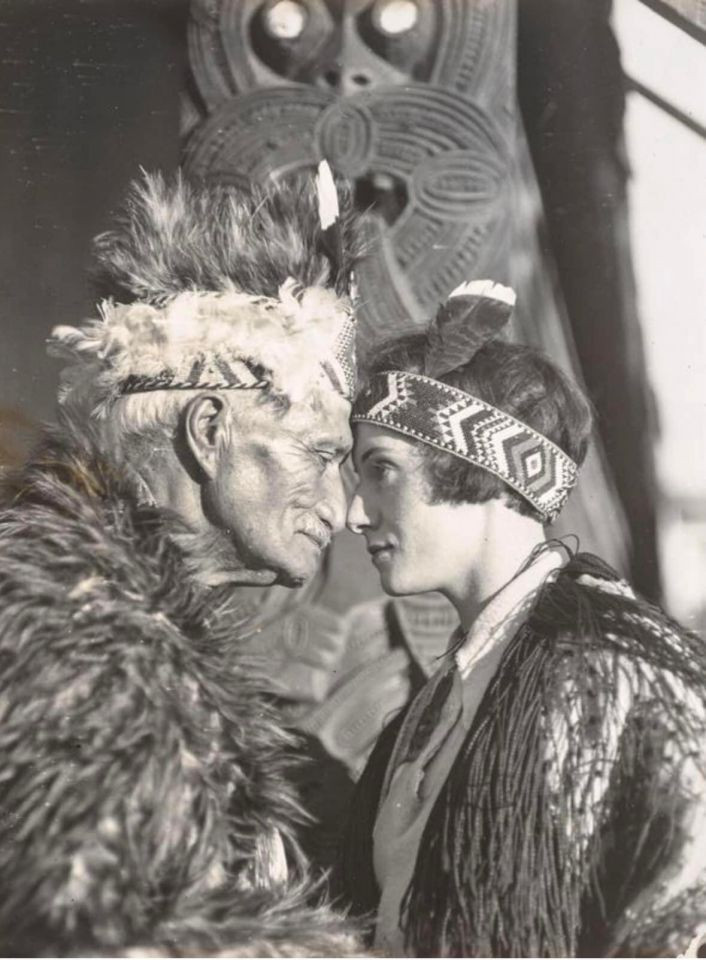
Above: Chief Mita Taupopoki greets Jean Batten, Rotorua 1934 (Photo: C. Troughton Clarke, courtesy Jean-Marie Sauzier.
Appendix 2 Author’s Earlier Book
Rotorua Review, August 24 1990 — “Otonga resident writes first history of rural Rotorua”
Tribute is paid to Rotorua’s old timers in a new booklet by Peggy (Ford) Allen. ‘I want to pay tribute to the old identities and help ensure they are not forgotten,’ Mrs Allen, of Otonga, says. Her booklet, Rural Community, Rotorua, tells the stories of Maori and European settlers round Rotorua, concentrating mainly on the period 1890 to 1920. It is the first written history of rural Rotorua.
 Mrs Allen researched the material with the help of descendants of the pioneers. ‘The making of this book has been like a reunion round the community, it has been exciting remembering old times and old acquaintances,’ she says. She began work on the booklet in April as a research project for the Tihiotonga Country Women’s Institute. Local people quickly showed a great deal of interest and came up with a mass of information. Not all the people she has written about were farmers, but all lived extraordinary hard lives. ‘They lived through two wars and the devastating influenza epidemic,’ Mrs Allen says. ‘Clearing bush and scrub to start farming was back-breaking.’
Settlers battled ragwort and cobalt deficiency in the pumice soil. Because there was no community school or hall, research was not helped by written records or jubilee accounts. Included in the booklet is a brief history of the blocks of land belonging to the Ngati Whakaue Tribal Lands Incorporated.
Peggy says she was fortunate to be able to talk with identities like 89 year old Hira Tapsell. He told of early European settlers and shared something of his friendship with Te Arawa paramount chief Raharuhi Pururu and with Ngati Porou statesman and scholar, Sir Apirana Ngata. Peggy (Ford) Allen is the daughter of Harry Ford, the first European to farm west of the Utuhina Stream. Mr Ford was chairman of the Rotorua County Council between 1925 and 1947. He was also Government representative on the South Auckland Land Board for 18 years.
Peggy Ford completed her schooling in Rotorua then trained as a teacher. In 1960 she returned to live in Otonga with her husband Gerry Allen. They were foundation staff of Otonga Primary School, Mr Allen as headmaster and Mrs Allen as infant mistress. Both remained at the school until 1975, retiring within a few months of each other. Completing Rural Community, Rotorua, is the fulfilment of a dream for Mrs Allen. The booklet was typed by Connie Dittmer and has been photocopied and bound. Photographs are included as are maps showing the first main rural roads and the names of people who lived in Rotorua before 1920.
Copies of the booklet may be purchased from Mrs Allen, 125 Otonga Road, Rotorua (phone 3483-742).
Appendix 3 Letter from Don Stafford, 1996
D.M. Stafford, P.O. Box 973, Rotorua, N.Z. (07) 348-2291
11 June 1996
Mrs Peggy Allen,
125 Otonga Road,
Rotorua
 Dear Peggy,
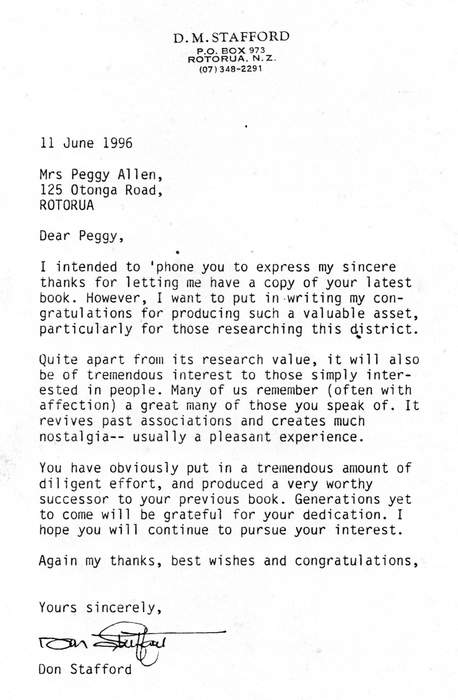
I intended to ‘phone you to express my sincere thanks for letting me have a copy of your latest book. However, I want to put in writing my congratulations for producing such a valuable asset, particularly for those researching this district.
Quite apart from its research value, it will also be of tremendous interest to those simply interested in people. Many of us remember (often with affection) a great many of those you speak of. It revives past associations and creates much nostalgia — usually a pleasant experience.
You have obviously put in a tremendous amount of diligent effort, and produced a very worthy successor to your previous book. Generations yet to come will be grateful for your dedication. I hope you will continue to pursue your interest.
Again my thanks, best wishes and congratulations,
Yours sincerely,
Don Stafford
Letter of congratulation to Peggy Allen from fellow historian Don Stafford, 11 June 1996, on the publication of this book.
Appendix 4 Newspaper Feature: ‘Deep Love Shows With Book’ (1996)
Rotorua Review, Tuesday, 25th June 1996 — “Deep love shows with book”, by Lisa Wilde.
A deep love of Rotorua, a family life that lives and breathed the young town, is behind the latest work of historian Peggy Allen.
In her second volume, the first was about the people of rural Rotorua and appeared five years ago, Peg Allen looks at the people of Rotorua from the 1880s to the 1940s, Living South of Old Railway.
This is grassroots history, the stuff of research for future historians, some maybe many centuries hence.
It grew from talking to people, who referred her to more people and took her, in five years of research, for a gentle tour of the neighbourhood.
From the railway land, up Pererika Street to the old High School, up Old Taupo Road to Otonga Road, to Hemo Gorge and back to Whakarewarewa, and through the old established flat areas running off Fenton Street.
Fellow historian Don Stafford praises her for her obvious diligent effort in producing a worthy successor to her previous book and he said generations yet to come will be grateful for her effort.
‘Quite apart from the research value it will be of tremendous interest to those simply interested in people.’
She speaks of a Rotorua few modern residents would recognise. Much of the land in question, subdivisions of the Pukeroa O Ruawhata block, was swampland with scrub and manuka, so settlement was scattered.
Mrs Allen says that just as hope for a better future was coming with the discovery of cobalt to cure the bush-sickness problems of the surrounding farmland, World War II broke out and a great number of the town’s young men went away.
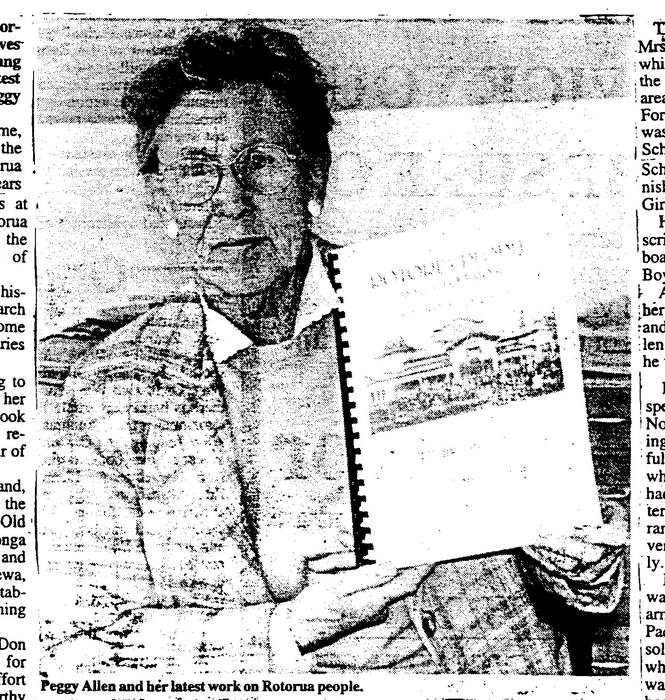
Rotorua has much to thank for the generosity of the fine Maori chiefs and the men of vision in the early days of the settlement, she says.
To them and the wonderful people of the district, she dedicates her book, printed by Dudfield Printing and published privately. And she reserves a special thanks for the encouragement of her niece Claire Ford, a librarian.
Each page, or pages, contains a story in its own right, the story of a family or an individual and often newspaper articles are included in full to add more interest to the subject.
Few pages go by without the inclusion of some photograph or caricature that maintains the fascination for all to read.
Each page contains little gems, the story of World War I veterans who captured the imagination of school children like Mrs Allen, then Margaret Ford.
Tucked away are references to an English solicitor who remained shell-shocked and living in a hut Ranolf Street near Holland Street.
People, always people, are put first in this absorbing book. Mrs Allen found the inclusion of an index too complicated and preferred to offer the whole as a picture of pioneer Rotorua, at least the southern part.
She saw the bigger picture, not just around Glenholme where her first instinct led her. That would have been like just two or three paddocks on the farm. She decided to do the whole farm.
Life work. Much of her life has prepared her for the work of the last five years, and the many years that went into her first book.
Now at home with an invalid husband, former Otonga Primary principal Gerry Allen, she worked hard in the evenings and is now more than a little relieved to see it completed.
The daughter of Mr and Mrs Harry Ford, the first white man to farm across the Utuhina Stream, in the area now called Fordlands, her education was at Rotorua Primary School and Rotorua High School, where she finished in 1936 as Dux for Girls. Her name is now enscribed on the honours board at the now Rotorua Boys’ High School.
A teacher career took her north to Whangarei and she married Gerry Allen of Paeroa just before he went overseas, in 1940.
Her war years were spent in a number of Northland schools, including sole charge at beautiful Matapouri Beach — where the school house had no electricity, hot water, a cracked cooking range. The people were very few but very friendly.
In 1945 husband Gerry was released from the army, after service in the Pacific, and took over the sole charge position, while their daughter Judy was born that year but home was still here in Rotorua.
Even 40 years ago she tells stories that make rural New Zealand look almost third world.
From 1946 to 1950 they had a two-teacher school at Waiotemarama, five miles from Opononi and their son John was born at Rawene, under the famous Dr Smith. They had no car until the last year, no electricity, the store was a mile down the gorge and they loved it.
Not until 1960 did the Allens return to Rotorua, when Gerry became founding principal of Otonga School and Peg was junior department supervisor and established the basis for the parklike grounds, done mainly at playtimes and lunchtimes.
Appendix 5 Back Cover — Author’s Note and Earlier Book
“Pioneering people tell Peggy their stories”
This is a book that catches the spirit of a people in a new and promising land. They searched for a way of survival, with hope and courage but also found much excitement through pioneering endeavours.
To be involved in writing such a searching account of people and their background history through tales of their past, and often tales of their parents as well, has been highly rewarding to the author.
How can one help but admire characters of such fortitude, such endurance, often such simplicity of living yet able to look back with a light in their eyes, laughing about the good times they can remember! They are an inspiration!
It was not what they had or did not have but making the most of whatever they could, that really counted. They learned to become independent, turning their hands to any task, and face any situation.
They had their dreams of a better future for their children and followed that path. Rotorua has produced some amazing men & women who have been outstanding in their fields of endeavour even against world competition, especially in leadership. They have had initiative, ingenuity, determination, without being too bound by inhibiting traditions of an older country.
Surely we must be proud of being New Zealanders, and continue to be!
By author.