
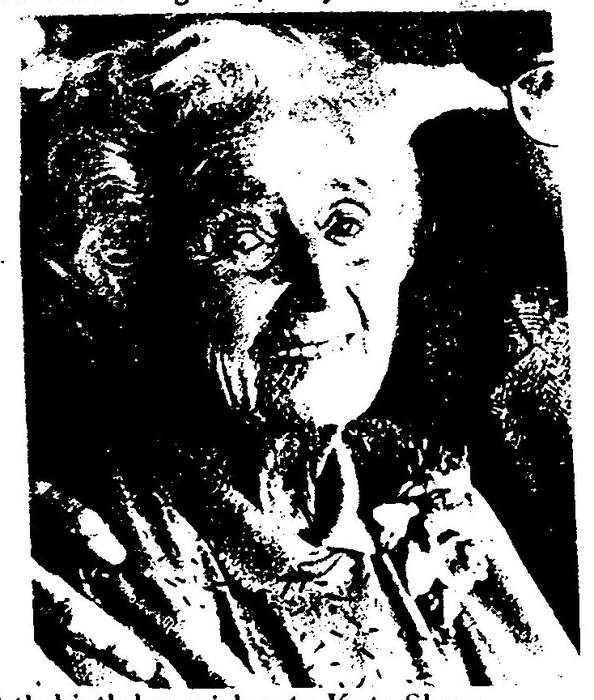
Kate Shaw, in 1962, after 16 years of marriage away from Rotorua, returned to the Glenholme area, firstly to Totara St., then Malfroy near Fenton St., happily settled in her front unit, still able to fascinate an audience with her reminiscences of early days. She says it feels good to be back. Kate was born in Rotorua, 1896.
A most touching memory is of a time when she went camping with friends on Mokoia Is. and which she recorded in her book — ‘I wandered at dusk and alone into a grove of trees feeling as I entered that I was no longer alone. All round, encompassing me was a presence. It was comforting and friendly. I knew, I could tell, it was family, the spirits of my ancestors making me welcome. My link with those ancestors is as far back as my great grandmother, but they accepted me and that was good. I was happy to be with them. I have never felt this in any other place, or time, only on Mokoia.’
It was from her mother that Kate heard about Hongi Hika’s raid on Mokoia Is. and the awful slaughter of their people resulting. In 1823, Kate’s great grandmother Te Ngakauiti was a young girl when Hongi Hika made his raid and she was one of those taken back to Kororareka — Russell, Northland. Somehow later, she married a European man and lived in Auckland, then the Bay of Plenty.
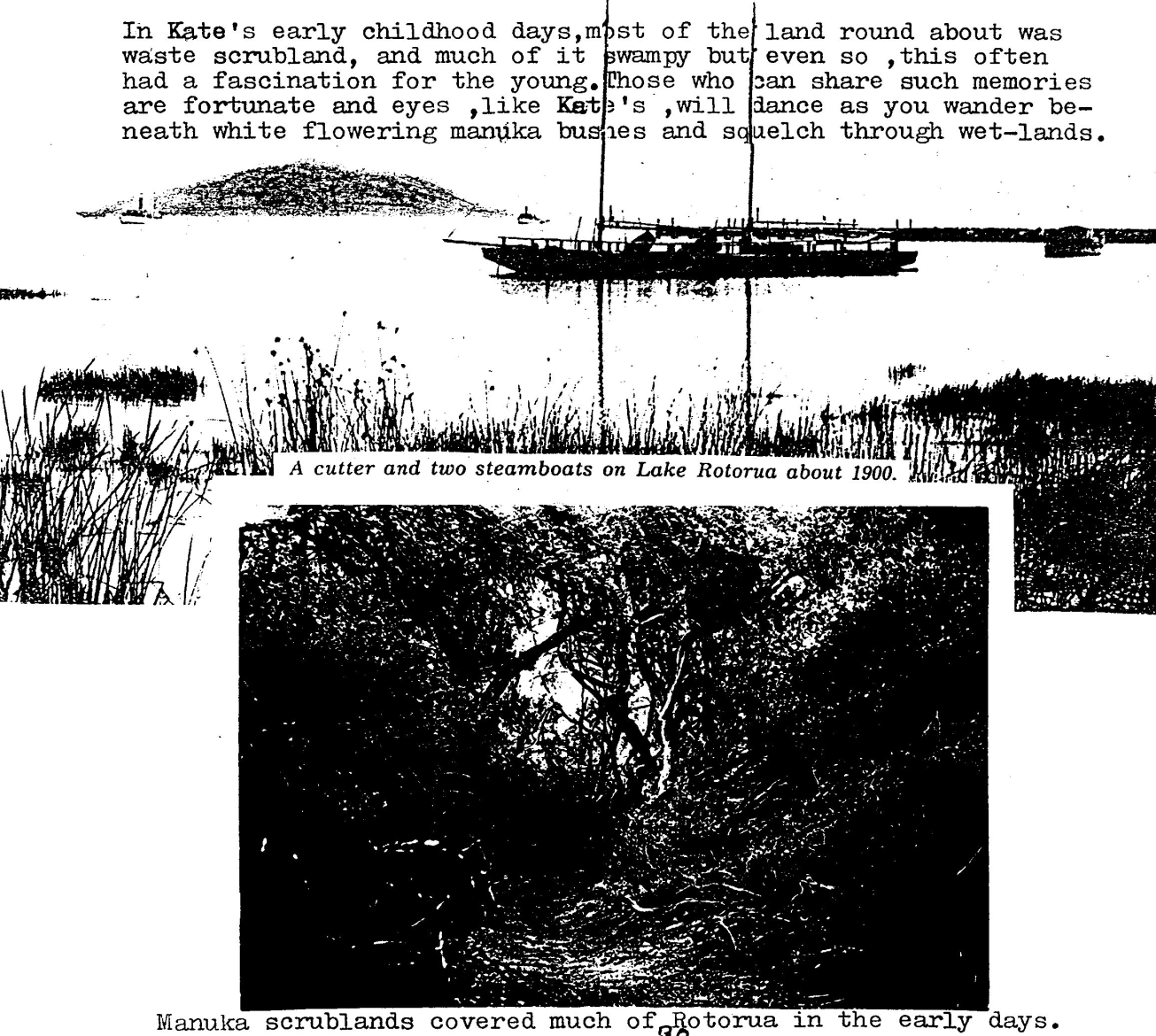
Endless hours were idled away in these natural habitats. If there were not tadpoles to catch then frogs for leaping races caused much hilarity. Tree climbing and hut making was great fun, or bird nesting for egg collections. Older boys used shanghais (forked sticks with rubber connecting band and stone missiles) in rather fruitless attempts to shoot birds, or bows and arrows but mainly against each other playing ‘Cowboys and Indians’. Koura — fresh water crayfish, in the drains and streams — were nimbly caught by hand or baited cotton, then carried home in the billy for cooking, with sometimes even a trout for those clever enough to ‘tickle’ one or spear it.
In these wastelands were blackberries as well as tiny wild red berries, little white flowers almost hidden by the mosses and overshadowed by low umbrella ferns, and also the busy humming of insects where waiting spiders stretched wide their webs.
On a fine sunny day there was magic there — all around! Kate Shaw captures this in her poem of those lovely childhood days.
| ON A SUMMER’S DAY On a summer’s day, a summer’s day We walked along the Scented Way. The air was sweet with new-mown hay, The manuka held fragrant sway, The honeysuckle trailed a spray. The briar rose all pink and gay Breathed welcome to the Scented Way. On a summer’s day, a summer’s day, On a summer’s day, a summer’s day, 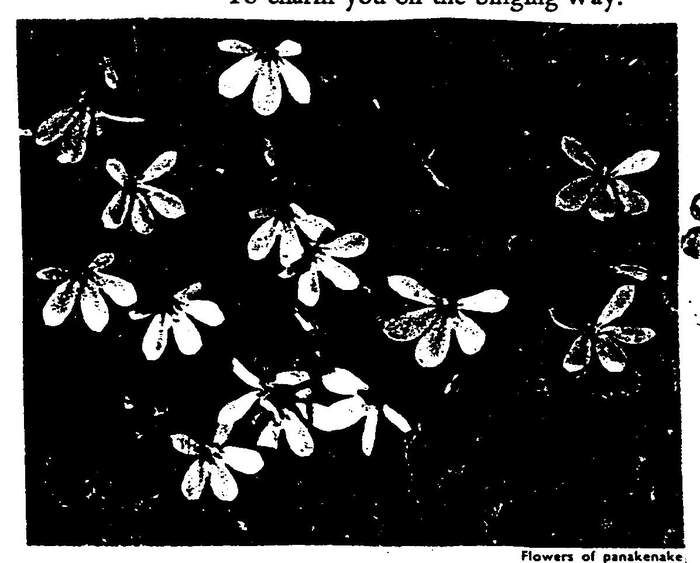 |
by Kate Shaw |
Lake Rotorua Steam Launches and the Corbett and Boord Families
Trout fishing was a major attraction by the turn of the century, with favourite spots being the streams flowing into Rotorua and Rotoiti. Cook’s 1905 guidebook reports that over 28 tons of trout were caught by rod and line in the 1905 season.
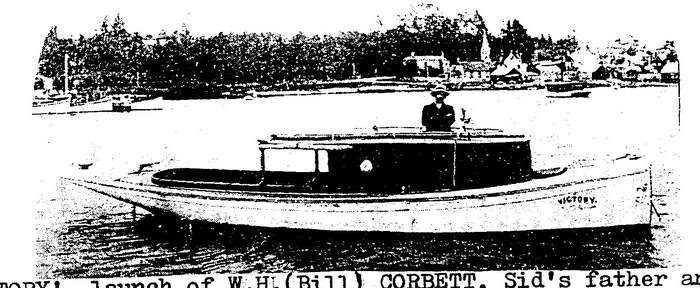
‘Victory’, launch of W.H. (Bill) Corbett, Sid’s father and brother-in-law of Kate Shaw, a tourist fishing launch which was also for hire, early 1900s, before the hospital started to be built in 1916 on Pukeroa Hill in the background.
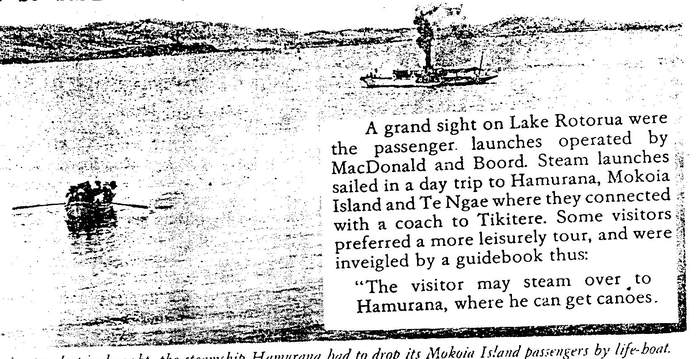
Having too deep a draught, the steamship Hamurana had to drop its Mokoia Island passengers by life-boat.
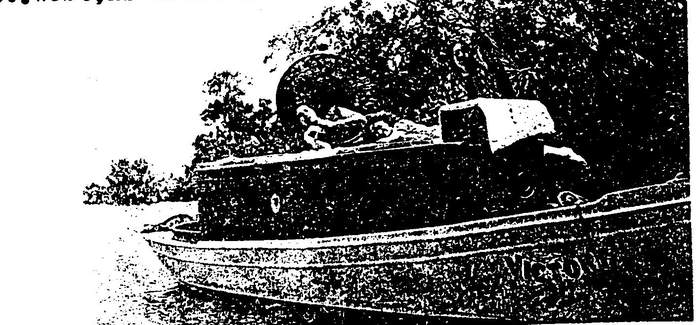 F.M. Boord (Mossy), before the 1920s, owned a big block of land opposite Dr. Bertram’s ‘Glenholme’ property, across Old Taupo Rd. from about Hillcrest to St. Andrews Church corner on Devon St.. Mossy and his son F.J. Boord were in steam-ship launch ventures on the lakes. Ray Boord, son of F.J., was Mayor of Rotorua 1966–1971; Boord Park, Devon St. West, is named after him.
Rato Butt, part Maori, married Mr. Lyons. He had their home built at the corner of Ranolf and Malfroy Rds., diagonally opposite the Hampson’s property, probably early 1920s. He was Choir Conductor for St. Faith’s popular Anglican Church at Ohinemutu. This celebrated choir and the popular Rev. Fred Bennet drew large congregations, including many tourists. When Mr. Lyons extended his musical career by moving to Sydney in Australia, Rato’s sister, Tirita Butt, a grand singer who married Rotorua’s commercial artist Mr. Bonnington, visited Rato in Sydney where she was able to take formal training.
Mrs. Moroney, who came to N.Z. in 1919, next occupied this house across from Hampson’s, where she was their house-keeper. Mr. Hampson procured this for her when her brother John McCarthy came from Ireland to stay and there was not enough room for both at Hampson’s.
Constable Moroney was probably a family connection. He was appointed in Nov. 1886 as the first police officer to be stationed in the new town of Rotorua — not the old town site at Ohinemutu — this request having been made to check rowdyism, gambling, drunkenness, and to assist in the arrest of cattle and horses and other criminals moving inland from Tauranga and Maketu. This quote is from Enid Tapsell’s history ‘Rotorua.’
Mrs. Fox Maule Carnachan bought Mrs. Moroney’s house about the late 1930s. She had lived in Rotorua from 1894, was part Maori, and brought up her big family in the Koutu area near the Utahina River. She also brought up her daughter Elizabeth’s baby son Sid Corbett and his little sister. When Sid left school he did a milk run for Ray Spence on Malfroy Rd. before he left N.Z. in the army for World War 2. During W.W.2, Sid’s mother’s sister Kate (Carnachan) Shaw lived with her mother in this corner Ranolf-Malfroy Rd. home while her own husband was in camp. (World War 2, 1939–1945.)
Sid Corbett’s mother died when he was three days old, from the influenza epidemic of 1918. This disastrous flu killed many people. Emergency hospitals were set up round Rotorua, such as Rotorua Prim. School and Presbyterian St. John’s Church.
After the war, Sid gradually changed this house, which became his own home with his wife Sylvia, until he developed what became the well situated ‘Sequoia Motel.’
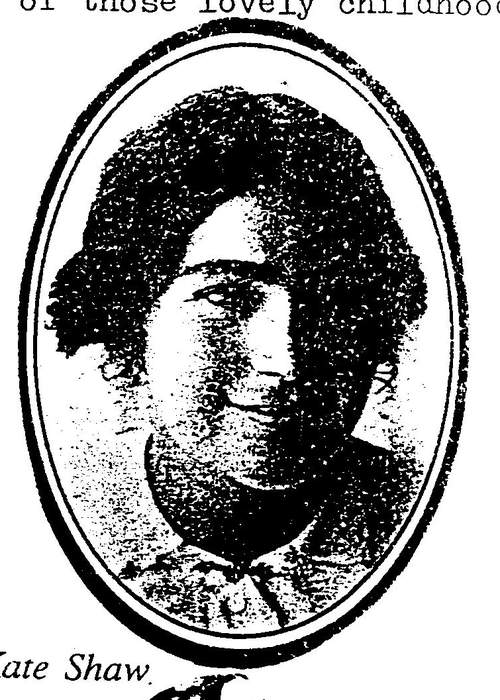
Kate Shaw, after the World War Two years, left her mother, Sarah Carnachan, and Rotorua, once more to take up life again with her husband, who was in the Forestry Service, later becoming Chief Clerk, Wellington, of Conservancy. They also spent a number of happy years in Nelson and Palmerston North, where Kate was very much in demand as a public speaker for a number of functions like Rotary Clubs, Travel Clubs, Country Womens’ Institutes. Kate was a very talented and charming speaker, and still is, now in her mid-nineties (born 1896 in Rotorua). With her background life in such an interesting area as Rotorua, and being part Maori herself with all their legends, meeting so many of the old identities through her work, her sport groups and her passion for golf, Kate has a wealth of knowledge to share. Fortunately she has recorded this in her delightful book, ‘Just Ordinary People’, by Kate Shaw. She has also had a short book of poems printed.
|
Ninety years old and still swinging a club. Review, March 30, 1993. Percy Lloydd, Sophia St., many years. When Percy Lloydd applied to join the Rotorua Golf Club 46 years ago he had to wait three years before becoming a member. “My wife, Ursula, and I lived just an eight iron away from the seventh tee in Sophia Street but the club had limited membership in those days,” Percy explains. Percy and Ursula played at the club each Saturday and Sunday. “We loved playing golf together,” Percy says, and adds proudly, “Kate Shaw encouraged my wife to go on the committee and she ended up Club Captain for 1970 and 1971.” Sadly, 18 months ago Ursula passed away. Since that time Percy has had to adjust, first to living alone, then to living at his new home, Glenbrae House. Having been there only a week, Percy is still getting used to the change. One of the highlights of Percy’s golf career was when he won the Open Veterans’ Championship in 1972. An earlier thrill was when he and Ursula were top qualifiers and won the Labour Weekend Championships in 1965. Percy had a handicap of nine in those days. When Percy wasn’t organising his drivers on the golf course he was organising drivers on the road. He had his own carrying business, P E Lloydd Ltd., and owned about a dozen trucks. After one of his trucks went over a bank and a second threw a trailer, Percy decided the time had come to sell his business and concentrate on his golf. He is still playing to this day. Last week the Rotorua Golf Club honoured Percy by putting on an afternoon tea to celebrate his 90th birthday. The only thing Percy sliced that day was his birthday cake.
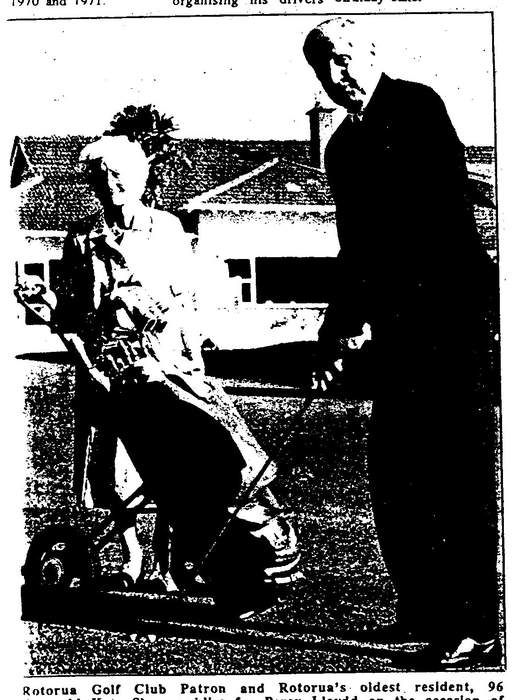
Rotorua Golf Club Patron and Rotorua’s oldest resident, 96-year-old Kate Shaw caddies for Percy Lloydd on the occasion of his 90th birthday at Arikikapakapa Golf Course. |
Kate Has Sights Set on Century By Jill Nicholas. Kate Shaw is becoming pretty good at having birthdays. So far she has had 98 of them and her sights are firmly set on the century mark. Yesterday a small group of family and friends were at the Rotorua Golf Club to celebrate its patron’s latest milestone — among them a grand nephew, Gary Corbett, who Kate Shaw fondly calls a “great mate”. Never having children of her own is probably Kate Shaw’s only regret, she reflected before yesterday’s festivities. “I would never change my life. I have enjoyed it all. I have had wonderful friends, much happiness especially from children. They are so imaginative.” Kate Shaw (nee Carnachan) has catered to that imagination with a string of stories written especially for children. She is also a published poet and author with her book Just Ordinary People, a reflective view of Rotorua, her home for all but 16 of her 98 years. As one who frowns upon idleness whatever one’s vintage, she is working on a yet-to-be-named sequel. And then there are the countless articles she has penned and radio talks given, recalling days when Rotorua was but a village and her Tarewa Road birthplace was classified as part of the “old town”. She and her family moved into the “new town” when a sister died during the flu epidemic of 1918. Kate Shaw’s Scottish-born father arrived in New Zealand at the age of seven — the same year as the signing of the Treaty of Waitangi. He came to Rotorua, via Cambridge and Maketu, as a land purchasing officer for the then Native Department. With such roots and a lifetime’s involvement in a host of local sporting organisations, Kate Shaw’s wealth of knowledge has long been the toast of the town. Yesterday the toast was to her continuing excellent health and very many more birthdays to come, for the woman decreed to have lived in Rotorua longer than any other.
Happy 98th birthday to Kate Shaw, the grand old lady of Rotorua |
|---|---|
Kate Shaw Feels Like 39, Not 99Born, 1896, Rotorua. Daily Post, March, 1995. Rotorua’s grande dame Kate Shaw, who celebrated her 99th birthday today, says the secret to a long and happy life is simply having respect for your fellow man. Feeling “more like 39 than 99”, she held court at the Rotorua Golf Club yesterday while friends and family hovered around and showered her with early birthday kisses. In an age where many women try their best to conceal the passage of time, Kate Shaw revels in celebrating each passing year, and is looking forward to turning 100 one year from today. |
|
Bertha Lee and the Steele-Wrigley Family — Four Generations
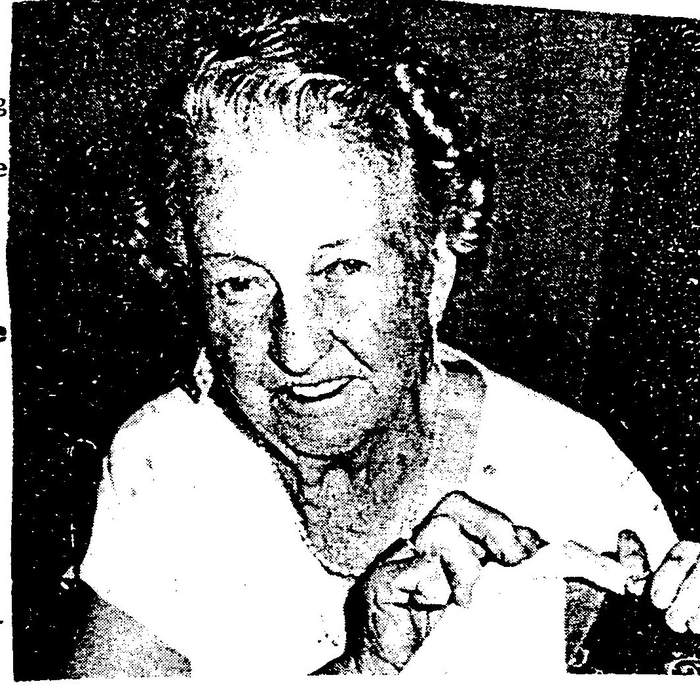 Born 1900, now in her 95th year, Bertha Lee, nee Wrigley, Samuel Steele’s granddaughter, has her Old Taupo Rd. home near cnr. Devon St. and is a well known historian of Rotorua. Recently she moved to ‘Masonic Village.’
Here, this dynamic personality is livening up others’ evenings by involving them in craft interests, and according to son John, wool is flying everywhere with all the carding. Her typewriter continues to tap out the family histories despite her left side disability. She had experience in a nursing career, then management practice in Lee Bros. Timber business, Koutu Rd., for builders. In 1936 she married James Lee, raising 3 children. Bertha has been deeply involved in church and community organizations.
When growing up, she worked hard on the farm, Malfroy Rd. between Fords & Hunts near Pukehangi Rd. Her mother, Annie — nee Steele, from Mamaku — was an interesting lady regards gardening. 1959, Bertha was widowed but continued to manage their general store in Karaka St. with its wide range of stock like gumboots, coal & grains. Bertha keenly supported Agric. Shows.
|
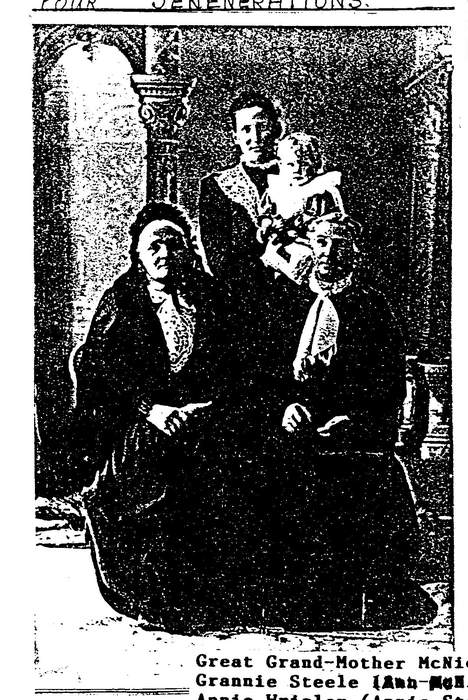
Four Generations: Great Grand-Mother McNicol, 1820–1903; Grannie Steele (Ann McNicol), 1845–1930; Annie Wrigley (Annie Steele), 1879–1959; Baby Bertha (Wrigley) Lee, born 1900. |
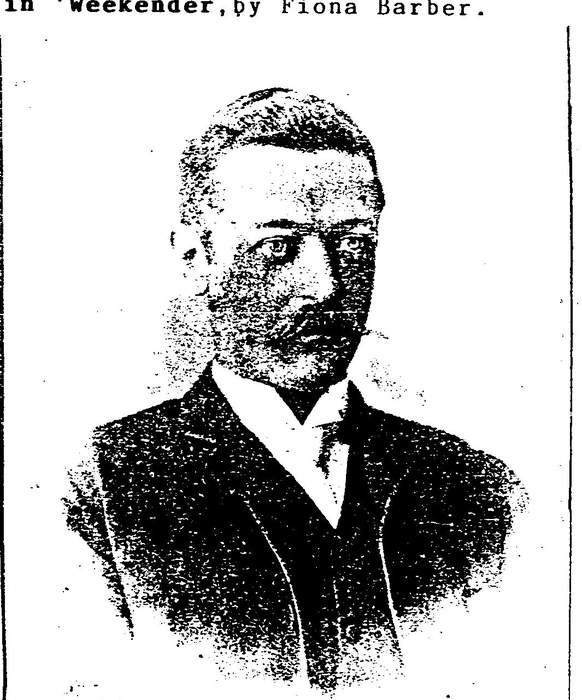
John Wm. Wrigley, Architect, married Annie Steele, 4 children including Mrs. Bertha Lee; County Council Clerk, Rotorua; farmed Mamaku-Rotorua, 1893–1936; Organist, St. John’s Presbyterian Church. |
|---|
The Steele Family Land Blocks
Early Rotorua, as told by Bertha (Wrigley) Lee and her son John Lee.
1880, Rotorua was established. 1882, the first sale of leasehold land took place in Auckland. Mr. Samuel Steele (Bertha’s grandfather) acquired several blocks at this sale. He was from Rukuhia.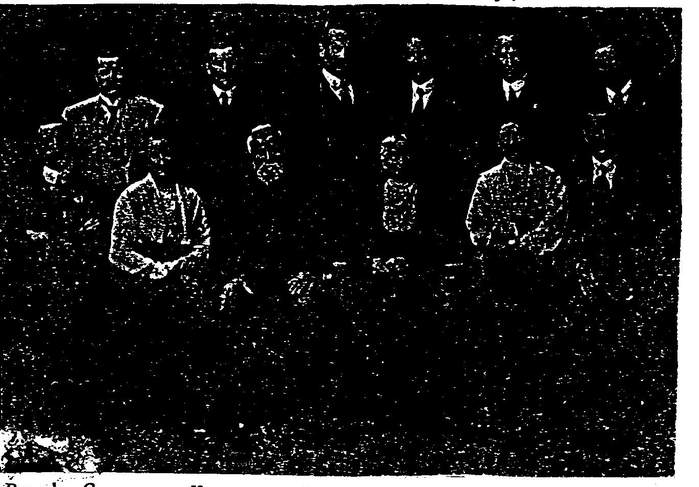
One 40-acre block, Ranolf St. east, Sophia St. to south, Old Taupo Rd. to west and Devon St. north. This block was fenced in and pine trees planted. The lot was surveyed, streets shown. The Town Council acquired a quarter of this block for the 1st. Town Camp site.
Samuel Steele divided the rest up amongst his children, but these went to his grandchildren as parents were settled; his daughter Annie Wrigley kept hers and about 1947 divided it between her 4 children — the sons sold, but Bertha kept hers on Old Taupo Road. Finally the Council took over all sections except one granddaughter’s freehold half acre, on which she and her husband James Burnett Lee built their retirement home, later adding a unit for tourists. There were trees & paddock area.
1902. In the middle of this block, a house was built and occupied by Dr. Wohlmann until a house was built for him in the Govt. Gardens in 1908. (Now called ‘Wohlmann House’, the Rotorua Arts & Crafts Centre.) Dr. Wohlmann, in 1902, was appointed Superintendent of the Rotorua Sanatorium.
|
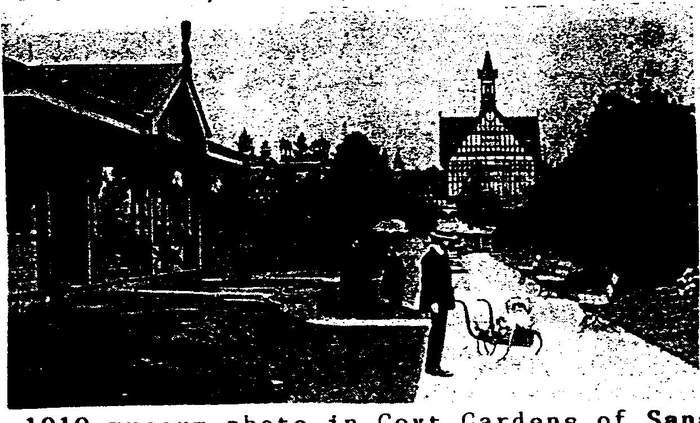
1910 museum photo in Govt Gardens of the Sanatorium and Bath House — then called ‘Tudor Towers’ — in keeping with the original conception by Dr. Wohlmann and Rotorua architect J.W. Wrigley. It opened in 1908. |
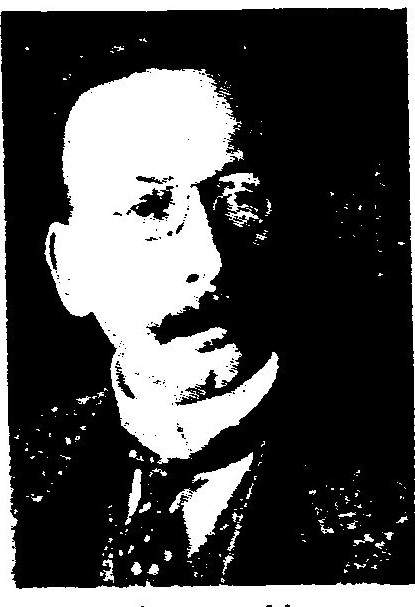
Dr. Arthur Stanley Wohlmann, M.D. (Lond.), L.R.C.P., B.Sc., M.R.C.S. (Eng.) — photo, Alexander Turnbull Library. |
|---|
Dr. Wohlmann’s Sanatorium
1916, Jan., Dr. Wohlmann became principal medical officer of the new wartime King George V Hospital. In Aug. 1916, he became known as Doctor Herbert because of the Germanic origin of his name and people’s attitudes towards our war with the Germans. Dr. Wohlmann’s family had lived in England for 200 years. In 1919 he returned to private practice in England.Even today, vague memories arise of a tale about a German living in seclusion in a big house right in the middle of all those pines. Later Mr. & Mrs. Boyes, who had 3 unmarried daughters, lived here, alongside the ‘Boyes Park’ of today.
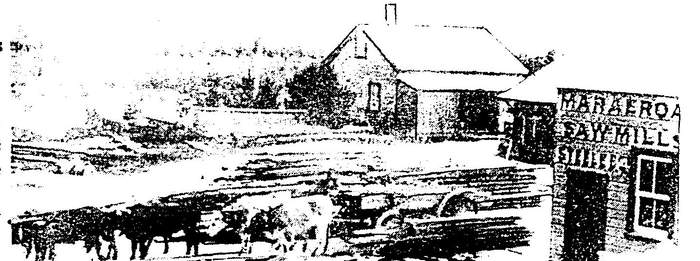 1882, Anne Steele, wife of Samuel, Mamaku, at the 1st sale of leasehold land for Rotorua, also acquired several other blocks, on Tutanekai & Eruera Sts. It was there, on that big corner area, that the Steeles established their timber yard & drying shed, shop and residence for Duncan, eldest son.
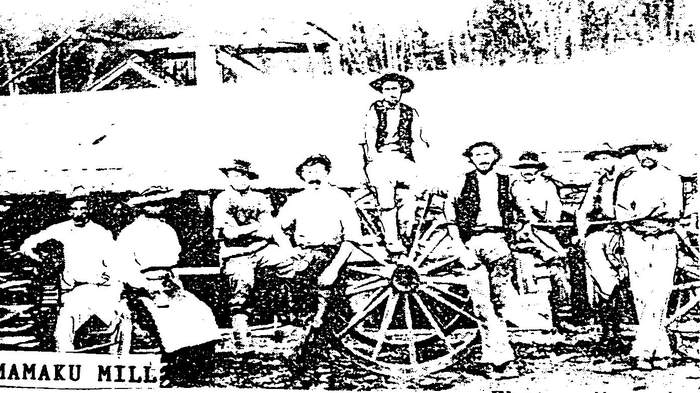 1888, important Rotorua land sales of Crown sections in the Maraeroa-Oturoa Block, lease by auction. Samuel Steele purchased a 1,500 acre property. The sons began clearing the bush for later farming, selling the sawn timber. This timber was carted by bullock wagon into Steeles’ Rotorua yards.
Duncan Steele, eldest son, was in charge. He gradually increased this block till it covered half the area bounded by Tutanekai, Hinemoa, Amohia & Eruera Sts. The old drying timber sheds still stood till shortly after W.W.2, behind Steeles’ local Hall built on the Tutanekai frontage. The Steele family had 3 mills over a period of 60 years, Mamaku-Rotorua.
Walter Steele had another section in Eruera St. for his family home. This meant going by train daily to work up at their Mamaku mill.
 George Steele had a block of land in Victoria-Herewini Sts., just behind the Railway Station with its big area of yards.
Alfred Steele built and lived on Toko St., near his twin brother, George. Annie (Steele) Wrigley & family had half an acre at the Eruera & Ranolf Sts. corner.
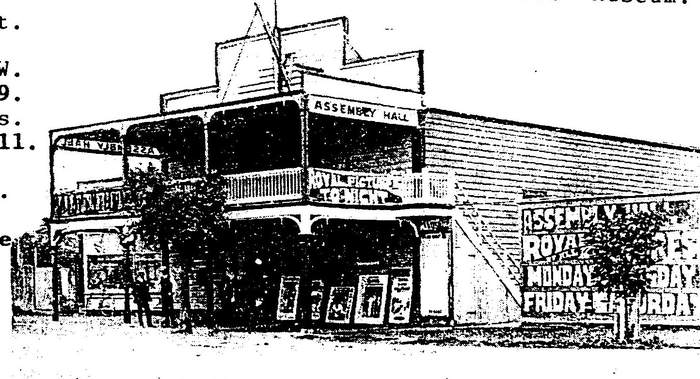
Beside the timber yard, on Tutanekai St., Steeles had built a Hall, designed by J.W. Wrigley, opened 1899. It had several names — Steeles’ Assembly Hall, The Royal Pictures, The King’s Theatre, Majestic Ballroom. The Majestic Theatre was built alongside in 1912. Silent pictures with an orchestra! This Hall gave tremendous value to Rotorua as a centre of entertainment.
Martin Hampson — Lawyer, Community Leader, and Champion of Maori Rights
 1908, Martin Heywood Hampson, lawyer, at 22 yrs., began his very active commitment to the Rotorua community when he went into partnership with Rotorua’s first resident lawyer of 1898, the elderly Frank Rhodes, who retired in 1916. The firm was then joined by J.D. Davys.
1912, when Martin married Katherine Rogan, daughter of the first judge of the Maori Land Court, they developed their country home area of 3 acres, self sufficient in many ways with gardens and a big orchard, but milk was delivered in a billy by one of the Lewis sons, their farm on Malfroy Rd. bordering the Hampson’s property. Hedges and trees were planted right round to protect them from the clouds of pumice dust that rose when big mobs of animals were passing by from the Hemo Gorge, via Ranolf St. or from Old Taupo Rd. along Malfroy Rd. to Te Ngae Rd. Lu remembers hanging over the gate, watching all the excitement caused by the stock, the barking dogs, drovers and horses.
Martin Hampson was prominent in the Chamber of Commerce. He worked extremely hard towards getting the Rotorua Town Lands Act of 1920 passed, so that Crown Land could be freeholded to help businesses and settlers. As a result of him stopping the Auck. Educ. Bd. from diverting Ngati Whakaue educational endowment money, Rotorua had its 1st. Secondary Sch. in 1922. Also, through his court work, he helped the Mill Hill Fathers to purchase all that land in Ranolf St. for their development of the Catholic Church, School, and Convent. In England during W.W.2, when he was stranded there, the Mill Hill Fathers looked after him while a six week search was made in the rubble of his bombed hotel during the Blitz, for his important papers for his stand to uphold the rights of Maori according to the Treaty of Waitangi, before the Privy Council.
Due to obstructions by the N.Z. Govt. he was delayed until during W.W.2, so his long sea journey of about 2 months was hazardous because of the German U-boats. He left N.Z. in July 1940, returning in May 1941. During his absence, his daughter Judith Hampson took care of his business.
Martin Hampson died within 6 weeks of his return, from a heart attack, while — quote from Elaine Brewster’s “A History of the Early Law Firms in Rotorua” — ‘he was working on a Memorandum to the Privy Council requesting a Royal Commission of Enquiry into Maori rights under the Treaty of Waitangi.