
In this part:
- Recollections of Life at 'Glenholme'
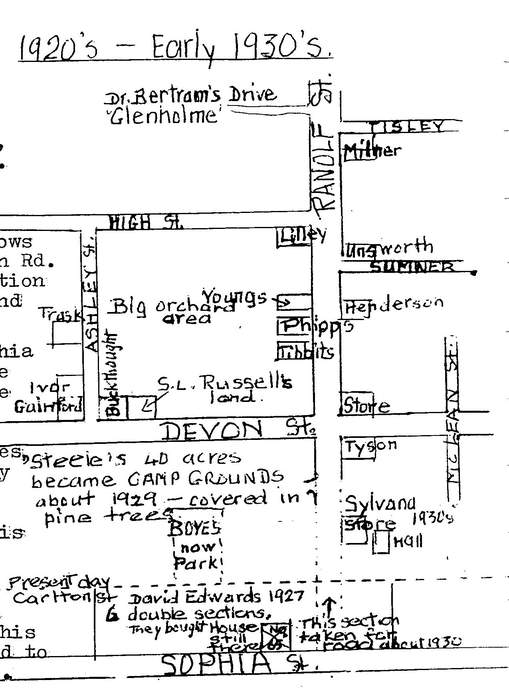
- David Edwards, Sophia Street, and the Ranolf–Sophia Streets Area, 1920s–Early 1930s
Recollections of Life at ‘Glenholme’
Dr Bertram’s Son George writes
In 1066, when William the Conqueror invaded England, one of his knights was a man called Roger Bertram. After the conquest he was given land in Scotland, in Peepleshire at a place called Midford. Little else is known of the Bertrams in Scotland, but when my parents were on holiday in the U.S.A. and Canada in 1925 they stayed at a place called Dundas in Ontario. They were told by the manager of their hotel that there was a family of Bertrams in the city; they got in touch with them and were invited to lunch at their home. The head of the house was Henry Bertram who had migrated from Scotland and set up an engineering business which had grown into one of the biggest works of its kind in the country. One of the lathes was so big that the operator sat on the toolpost as he turned gun barrels for the Navy. Their home was called Glenholme and when my father returned to Rotorua he named his home Glenholme. When the school was built many years later they called it Glenholme.
The Glenholme property was originally part of a block stretching from Whaka Road, now Fenton Street, to beyond Old Taupo Road, and was owned by a man called Robertson who — Edwin — parcelled up the area between Ranolf Street and Whaka Road into quarter acre sections which are now covered in houses. When I first saw it it was mostly swamp, covered in blackberry and manuka. We rode ponies to the old primary school and a haircut at Mr Musgrave’s shop cost the equivalent of five cents; a pie for lunch was the same price and a packet of chewing gum was one cent. At about that time a new motor car could be had for $350 and a man’s suit was $4.
In the mid to late twenties Glenholme was out in the country, as there were few houses between our place and the railway line, with farm land all around. The municipal camping ground was up at the top end of Ranolf Street, between Sophia Street and Wylie Street, under huge pine trees, and looked like a fairyland at night with the lights strung through the trees and the glow of lanterns in the tents.
In the early mornings Tommy Jackson could be seen delivering milk in a horse-drawn float which looked very like an oversized Roman chariot. The old horse needed no driving as he stopped at and started again from one house to the next with only a word from Tommy. Mr Jackson was at one time Mayor of Rotorua and one of the foundation members of the Rotorua Hunt Club. He kept the first pack of hounds at his farm at the top of Otonga Road. Tihiotonga was then called Sloane’s Hill, and was a mass of gorse and lupin, and the only access to the trig was by horse track. Nobody at that time thought that one day it would be covered in houses.
Across Old Taupo Road from our place, about where Manuka Crescent is now, a man called Mossy Board had a farm with a large orchard which he never seemed to do anything with. Along with my sisters and friends, I helped him out by chomping on the very good apples going to waste.
Another character living in the area was Mr Worthington who had a house in Sophia Street, bordering on the golf links and one of the first houses in that street. He was well known for his home-made wine. Later on an Australian woman, Ino Stennet, built further down the street. She donated, and had built, the first veterinary clinic as such, although there had of course been vets in the town for many years, notably Mr MacConnell who I knew well.
The 1920s was a great time to be growing up in Rotorua. For a boy it was a fascinating place, with the transition from horse-drawn vehicles to motorcars. There was a horse trough and hitching rail in front of the Grand Hotel, and big stables across the road where teams of horses were hitched up to coaches to take tourists on tours to Whaka, Waimungu and the lakes. There was an old chap called Musgrave who had a horse taxi to take people to Whaka and other places around the town. I often rode with him on the driver’s seat out to Whaka and back. When he died he left me his buggy whip.
As the horses were phased out and motorcars took over, the big stables became a garage, and to service them a pit was dug in the floor as there were no hydraulic hoists at that time. One day a boy was playing in the pit and was overcome with fumes. Our home in Hinemoa Street was just across the street and my aunt rushed over to try and revive him, but he was dead, killed by the deadly fumes of hydrogen sulphide. As far as I know that was the first fatality from that gas.
One of the big attractions for the boys of the town was the trains, one leaving at 10 am and the other coming in at 4 pm. One of my best friends at primary school was a Maori boy who was held in great esteem by us all because his father was an engine driver. The great thing was to watch the driver and engineer put that huge engine on the turntable and the two of them lean on the long poles and turn it around ready to take the morning train back to Auckland.
The Rotorua Motor Transport cars always met the train to take passengers to the hotels or boarding houses and to book them up for tourist trips for the next day. The drivers always looked very smart in white dust coats and caps. The cars were mostly straight eight Studibakers, but there were Hudsons, a Packard and a V8 Cadillac. The drivers were Sonny and Tommy Atkinson, Sam Peck, Dick Garlick, Dusty Neilson, Bill Hollis, Colin Castleton, Les Muir, Cliff Geeson, and others whose names I cannot remember. Some of these men had been driving in the coach days and Dick Garlick could tell some wild tales of driving the coaches over the old road to Tauranga.
One of the great events in the year was the arrival of Worths Circus, which came in by train as the roads would not take the heavy loads, and in any case there weren’t trucks big enough in those days. The circus always had two engines and stretched back over and blocked Ranolf Street until they shunted half of it onto another siding. All the shunting and unloading was done by elephants and then all the animal cages and gear were pulled down to the waterfront by them. One day I was watching them go past and there was an elephant towing the tigers cage with a baby elephant walking beside it. As it came past I threw a stone at the little one and it spun round and came for me. I escaped into McGinleys shoe repair shop where Mr McGinley really stripped me off. Worths was a much bigger circus than any that have come to the town since the last war.
Many of the visitors to the town were from overseas and one of the most interesting was Count Rene de Montague, who, with his wife, booked into the Grand Hotel and proceeded to entertain lavishly. The Countess could be seen riding a bicycle in the streets with a white cockatoo sitting on the handlebars. They were much sought after and they purchased extravagantly in the shops. As time went by the bills piled up and eventually the young bloods of the town had had enough of this arrogant foreigner. One night they got him full of liquor in the private bar at the Grand Hotel and then whipped him away to the Government Gardens and proceeded to tar and feather him. The Count and his supposed wife left on the morning train and were never heard of again.
Interest in hunting was aroused when Win Brown and his son Ned were persuaded to bring the Waikato pack of hounds through to Rotorua to show the locals what a great sport it was. After several visits, Win donated three pairs of hounds to Rotorua and the Rotorua and Bay of Plenty Hunt Club came into being. Later the club imported a big fox hound from England and so the pack was built up. The big hound was a handsome chap with clipped ears, which was a fashion in some of the packs in England. I doubt that it would be allowed today. He threw rather leggy hounds which were very fast on a run, but not nearly as good looking as the present pack which is outstanding in conformity and colour.
At the end of a day’s hunting the afternoon teas were greatly looked forward to by we youngsters. The hospitality of the Fords and Doggets in Rotorua and the Manahas, Hampsons, Dalbeths, Hintons, and many others at Ngongotaha, was really marvellous.
With the Bay to be catered for we often took the horses by road as there were no floats then, riding one and leading two and going down on Friday, hunting Saturday, going to the dance in the Paengaroa Hall that night and riding back on Sunday. With three horses you wouldn’t last long on that road today.
The Hunt Ball was one of THE events of the year with great music by Epi Shalfoon, and later, for many years, by the great Colin Castleton Band.
The first aeroplane I saw land at Rotorua disappeared behind the manuka when it landed as there was only a strip carved out of the scrub growing where the Quality Inn stands today. Later a very good aerodrome was developed and a hanger built. Stan Blackmore operated out from there for many years, doing tourist flights and charter work with a Desouter and an Avro Avian, the Avian being used to train pupil pilots up to private licence standard. There weren’t many of us, and the ones I mostly remember were Basil Smith, Poi Warbrick and Judith Hampson. Basil was in the Royal Air Force and was killed flying in England; Poi was a member of the famous Long Range Desert Group (L.R.D.G.) in the desert campaigns, and Judith had great difficulty judging height, making very good three pointers at twenty feet. However she was a very game flyer and as the Avian was very forgiving no harm was done.
The Avian was a delight to fly and it was a tragedy when it was destroyed in a barn fire years later. Converting to Tiger Moths in the Air Force at Whenuapai came as a shock to me as they were heavy, under-powered and cold, and when the crankshaft broke on my third solo flight, necessitating a forced landing in a cow paddock, my dislike for the D.H.82 was confirmed. Nonetheless it was a very rugged little aeroplane, and for that reason alone, a very good trainer.
During those early days horses and bikes were our main transport. In mixed parties we would ride bikes to the top of Mount Ngongotaha, and one summer several of the boys from school rode bikes to The Mount for a week under canvas at the beach. Often my sister Betty and I would strap shotguns to our handlebars for a Sunday’s rabbit shooting at Reporoa. Rabbits were in their thousands so we always came home with plenty for our mother to make one of her superb rabbit pies. Later there were pigs and deer.
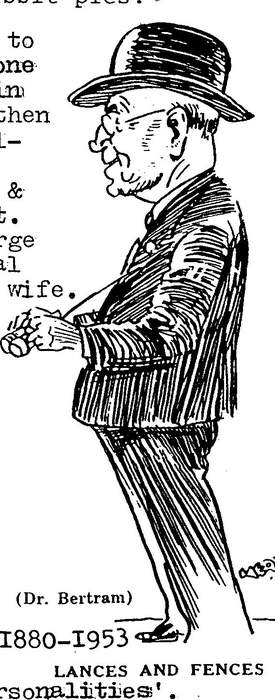
 George Bertram came of age to serve in the Pacific war zone W.W.2 as a pilot, training in N.Z. first in Hawkers, and then Harvards, going up to Guadalcanal in the 18th Fighter Squadron, later in the 19th & 21st as a Flight Lieutenant. George now lives on his large section next to the original ‘Glenholme’ with Olivia his wife.
— From ‘Post Personalities’.
David Edwards, Sophia Street, and the Ranolf–Sophia Streets Area, 1920s–Early 1930s
 1913, David Edwards, Rotorua. That year he met & married Prisilla, also from Sussex. They had two girls, Olwen and Dilys. Olwen was born 1914 in Kingstreet Hospital.
Mr. Edwards became milk vendor, moving location several times. 1921, they lived in Wallace’s 1st. house (Hillcrest), leasing land for a year or so, while building up a herd of dairy cows before moving to their Clayton Rd. farm. There Olwen, with trepidation, had to manage a tricky Shetland pony to get them to school.
1927, Mr. Edwards moved to Sophia St. buying from Steels 6 double sections, moving into the house now No. 65, to stay till 1942. Olwen remembers the house in the middle of all the pine trees, owned by a German who hid away there in World War I. Boyes later bought this. They had 3 unmarried daughters. This now is Boyes Park.
Campers, that first year, came asking for milk so Edwards extended the back porch for a little shop. Mrs. Edwards ran this for several years then decided to set up shop in town, Eruera St.
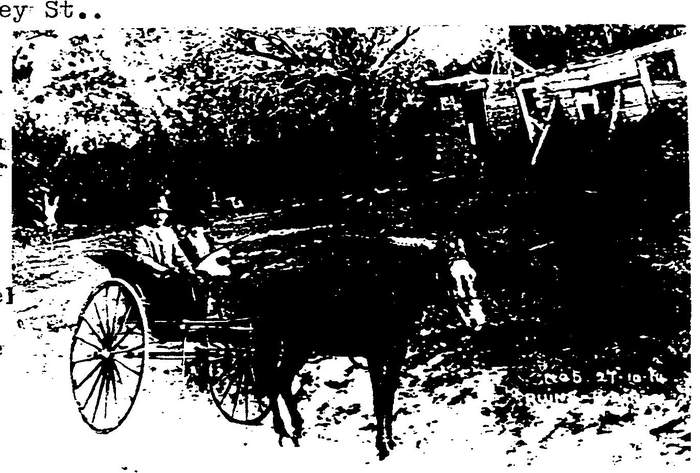 Olwen remembers that in the early days there were two streets off Devon St., Kowhai St. & McLean St. In 1923 W.A. McLean was Treasurer for Rotorua’s first Borough Council, Returning Officer & Rate Collector.
1943, Olwen married Frederick Rooke, leaving Rotorua for 23 years, to then return and live in Grey St.
Fred Rooke, W.W.2, in navy, trained at Flinders Naval Base, Sth. Melbourne, receiving his commission. He was gunnery officer 1943-44 in the Pacific on the cruiser ‘Achilles’, in action for two battles. He was then sent to England on convoy with ‘Compass Rose’. This was the same kind of vessel as Fred became second-in-command of — ‘Trondra’, minesweeper, on convoy between Iceland and Russia for 14 mths., then war ceased. Back in Rotorua, in the Tourist Dept., he finished as District Manager.
Handwritten annotation in original (shown in blue) — a hand-drawn sketch map titled ‘1920s – Early 1930s’ showing the block bounded by Ranolf St. (running north–south along the right), High St., Devon St. and Sophia St. (running east–west), with Ashley St. on the left. Labelled features include: Dr Bertram’s Drive / ‘Glenholme’ at the top; along Ranolf St. the names Tisley, Milner, Ainsworth, Sumner, Henderson, Store and Tyson; a ‘Big orchard area’ with the names Youngs, Phipps and Tibbits; Trask and Buckthought along Ashley St.; Ivor Gairford; ‘S.L. Russell’s land’; ‘Steele’s 40 acres became camp grounds about 1929 — covered in pine trees’; ‘Boyes — now Park’; ‘Sylvan Store, 1930s’ and ‘Hall’; ‘Present day Carlton St.’; ‘David Edwards 1927, 6 double sections, they bought house — still there’; and ‘This section taken for road about 1930’. A note by ‘Lytton St.’ reads ‘ended here, before the subdivision.’ A few of the smaller property-owner labels on the sketch are faint and are not transcribed with full confidence.