
In this part:
- The Kingsland Family of Grey Street
- Stanley and Margaret King
- The Railway Station
- Roy and Connie Haggart
- Leading Lady in Rotorua Operettas
- Kath Langguth (nee Kingon)
- Audrey Parlane (later Mrs Gamman)
The Kingsland Family of Grey Street
1927, Sydney M. Kingsland came with his wife and young family to Rotorua, No. 6 Grey St., having left England on the ‘Horoata’, a passenger-cargo boat. Mrs Kingsland’s uncle, Charlie Chirm, helped with arrangements, he himself having a Book Shop at cnr. Haupapa & Fenton Sts., and then ‘Chirm’s Hotel’. Charlie met them in Auckland, bringing the parents to Rotorua by car, which became stuck in the mud on the Mamaku hills, necessitating the use of car chains. Their five children travelled down by train. Joan (Gainsford) remembers how terribly tiring this trip was, from 10am till late afternoon with all the stops for mail, papers and passengers. Cecil remembers his last long train journey from Auck. to Rot. when returning after his six years’ absence, W.W.2.
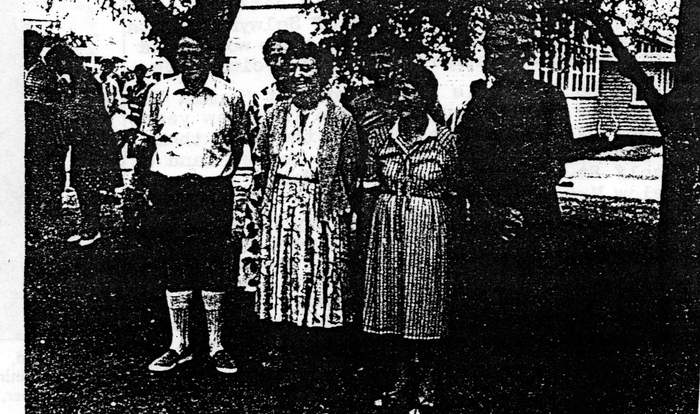
Kingsland family of Grey St. – Glenholme since 1927, at reunion. Lt. to Rt.: Ron, Joan Gainsford, Cath Brown, John, Betty Bellingham, Cecil.
Sydney Kingsland had work guaranteed before leaving England, with a Mr Stevenson, cnr. Fenton-Eruera Sts. in the Motor Body and Blacksmith business, opposite McHale’s Ford Motors garage. This was the notorious ‘Smelly Corner’ of sulphur fumes responsible for the death of a plumber. Cecil Kingsland has a boyhood memory of his father’s boss, Mr Stevenson, who would drive impressively into his yards in his trap pulled by a wild, spirited stallion. It did its best to bite anyone with its great bared teeth, or kick out when tied up in the big front area with the carts etc. When Mr Stevenson went bankrupt, the Borough Council engineer employed Syd. There he met Jim Morrison, grandfather of the famous singer Howard Morrison. Jim the blacksmith introduced Englishman Syd to Kiwis at the Palace Hotel who found he enjoyed this N.Z. lifestyle. One of his favourite stories was how, in England where he was trained to the high quality motor body work on Bentleys & Rolls Royces, the ultimate in vehicles, one of the first jobs the council wanted done was a serious repair. The nightcart, old and falling apart with rotten timber, had to be strengthened. It was a two-horse vehicle, which after its night rounds, finished up on the vacant section on the Te Ngae Rd. side of the cemetery.
Syd later bought out Worrall & Anderson’s business in Pukuatua St. Syd next worked for Langguth’s Truck Garage, Hinemoa St. opp. Farmers. Eventually he rented this whole section as S.M. Kingsland & Sons Ltd. Cecil Kingsland married Helen nee Ryan, Fennessy, 7 Carnot St.; before that, Tilsley St. R.S.A. executive 10 yrs. with Doug Hulton of Grey St. Joan married Percy Gainsford, surveyor, son of Rot. pioneer surveyor Francis A. Gainsford from 1909 to 1949 when Edward Robinson purchased the practice with Ron Phipps as cadet, on post-war development schemes. Joan Gainsford, after living in the Glenholme area, now Wychwood Cres.
Stanley and Margaret King
Stan, aged 98 years, died during 1992. They have lived for the last 35 years in Wylie Street. During their 65 years of married life, they changed homes several times, mainly in the Glenholme area. One of their first homes, 1930s, was next to Rev. Randerson in Pererika St., also by the corner of Malfroy-Ranolf Sts. alongside present-day ‘Sequoia Motel’. They were about 5 years in upper Ranolf St. opposite Green Meadows Dairy, which they built, £650.
In 1991, Stan finally became invalided from a crippling illness, necessitating nursing care to which Margaret devoted her time. Stan was still able to enjoy and share his great love of music with friends. His keen brain still continued to produce a natural flow of poems, many of which Margaret helped him to record. During 1992 he was hospitalized for a few weeks where he made poems of praise about the staff who greatly admired his spirit. He dictated a beautiful poem to Margaret, shortly before dying, aged 98 years.
Despite the blindness that overtook Stan, they enjoyed their last months together, envisaging the past as they imagined walking down memory lane, amongst the people and environment of days gone by. They had made a good team in their business venture, staying in it for 50 years. The population of the town had kept growing, babies kept arriving, pram demand kept increasing, so what better than a ‘Pram Shop’. This was an attractive feature of Eruera St. for years.
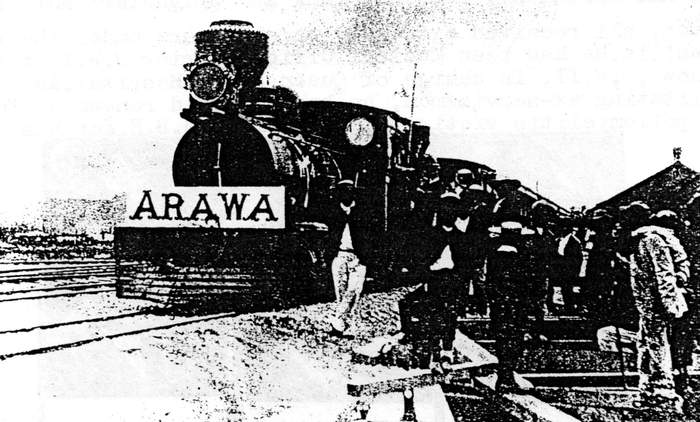 Their talent for music and drama engaged them in interesting events. There was the ‘Pageant of Nations’ to raise funds for a hall for the Presbyterian Church. Margaret King was producer of the junior play. Pageants were held in the Bay of Plenty, and competitions were held. Professor Shaw, Auckland University, for English, was the judge. He himself was an impressive dramatist and enjoyed the warm greeting as he alighted from the train – the normal transport of the day. The pageant was such a success that it was staged a second time. In senior best individual performer – male and female, Mr Shaw had pleasure in announcing that these had been won by Mrs Dr Bertram and Mr Harwood, Head of Rotorua High School, but commented that they had not actually needed to act their parts as they were natural for them. Mrs Bertram’s part was that of ‘A Lady’. Rotorua had been vitalized by the event and Mr Shaw departed happily at the station.
The Railway Station
The RAILWAY STATION played an important part in the events of the lives of the populous, some quite distressing, some most exhilarating. Until the mid-1900s, the main transport for Rotorua to Auckland was with the railway services, both passenger and freight trains. It seemed to be every boy’s dream to be an engine driver, to be in control of all that power! The steam engine itself seemed a living part of the people’s life dramas, like a great smoking, panting, puffing, hooting iron monster kept in its place only by the steel rails beneath it, which caused the resounding clackety-clack as wheels sped over the regular expansion gaps in these rails placed on wooden cross-ties (sleepers) set firmly in clinkers.
Cries of, “Here it comes! Here it comes!” with all the accompanying commotion. The long, haunting oo-oo-oo-oo made mournful sounds from far off as the train neared the crossing where clanking signals gave warning, then the screeching sounds of braking, hissing clouds of steam bursting from all round the engine, spitting hot drops to join the sparks of coal soot dropping from billowing smoke above the coal-stoker’s box. The uniformed Station Master’s shrill whistles, waving flag and warning shouts, “Stand back! Stand back!” to the jostling crowd wanting to get nearest the carriage doors.
What memories a railway station brings back to Rotorua’s elderly! Perhaps there is more than one veteran in his very late 90s who can connect in memory with the brave smiles, the heart-break and bravado songs of World War I, 1914-1918, troops leaving loved ones waving and fearful. But not so with World War II veterans, 1939-45, as there are still a number of them who take part in the Anzac Day Memorial Service, 25th April, to remember our lost war heroes. They can still picture the emotion-charged crowd welcoming their return at the station. There was, for instance, the returned soldier looking up from his joyful welcome home, to see the excited look of anticipation on the face of his dead mate’s mother, and knowing that it was his task to shock her with the fact of his recent death.
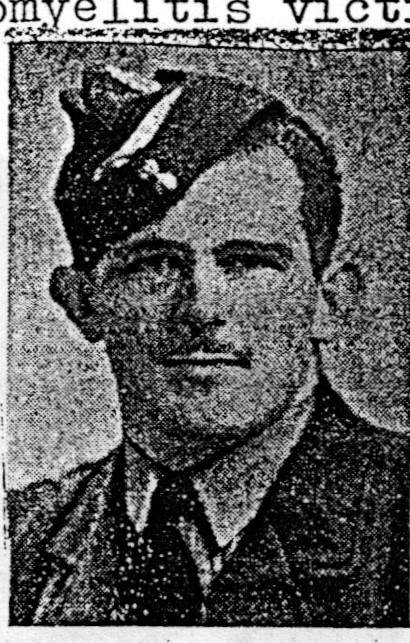
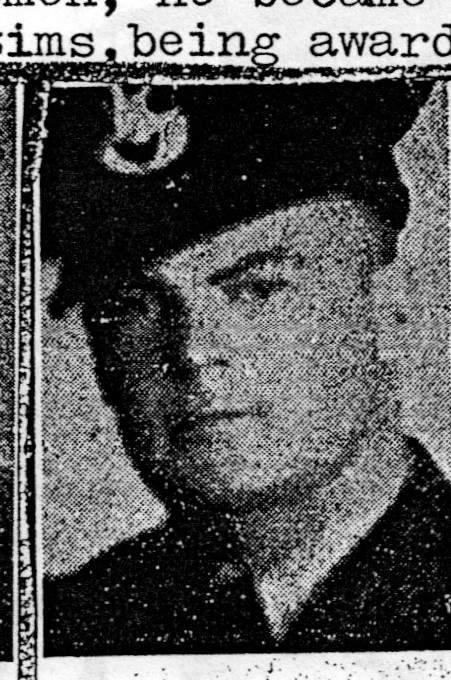
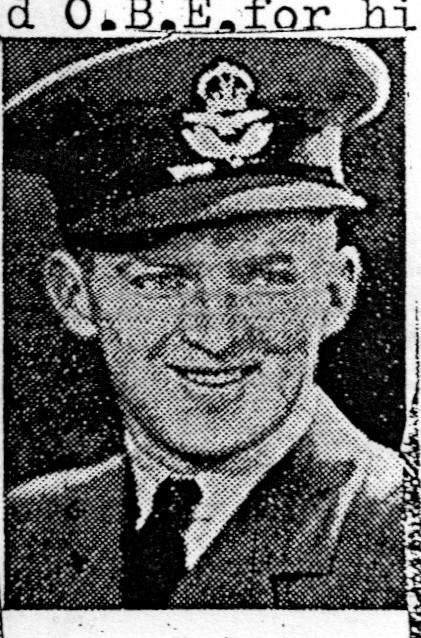
Flying-Officer B. Le B. Smith, of Rotorua, died of injuries suffered on active service. P.-O. R. L. Ewert, husband of Mrs L. F. Ewert, Rotorua, killed on active service. Pilot-Officer P. J. Farren, of Rotorua, killed on active service. Three of Rotorua’s many servicemen who did not return.
Some did not walk out of the carriage but were lifted on stretchers. In W.W.I these men were taken up to King George V Hospital on Pukeroa Hill for rehabilitation. During W.W.II, Queen Elizabeth Hospital was set up as a Military Hospital for the wounded and sick. Comradeship and humour hid much in those tragic days, like the story told of Geof Simm, one of the first patients, who had lost one eye and one arm, who was put in a room to himself and given the best V.I.P. treatment, flowers in room and so on. Next morning he found himself out in the ward laughing to his mates about how one of the staff had mistakenly read his rank as ‘Brigadier’ not ‘Bombardier’.
However, all received extremely capable care under the renowned Dr Wallis. He had been Medical Officer during W.W.I at King George V and now, W.W.II, in charge of Queen Eliz. Hospital. As well as rehabilitating ex-servicemen, he became world renowned for his work with poliomyelitis victims, being awarded O.B.E. for his services.
Roy and Connie Haggart
Roy and Connie Haggart, Grey St. residents of Rotorua for the last 46 yrs. They married in 1938 in Rotorua, now Connie’s home town for the past 51 years. Roy was assistant manager of McKenzies Dept. Store and at the conclusion of his W.W.2 service he became manager of the Bargain Stores, cnr. Fenton-Haupapa Sts., was a member of the Business Assoc. and the 30,000 Club as well as active involvement with the Operatic Society & Competition Soc. Roy, retired 16 yrs., now has a Sign Writing business, run from home.
Connie sums up her life: “You could say, at times my life was colourful and dramatic, rewarding and challenging. There have been lasting long friendships and wonderful memories. I have achieved my ambition both in theatre and business, believing one should focus on something and go after it.” Manpowered during the war into the Post Office, Connie experienced some rural life. After the war she ran tearooms at the Blue Baths, often catering for functions too. 1963, she opened ‘Connie’s Millinery’ shop, winning Nth. Is. awards. This became ‘Connie’s Pottery & Gifts’.
Leading Lady in Rotorua Operettas
Constance Haggart decided on a career on the stage when she was 16 years old. It was the night she sang Legion of the Lost, from The White Horse Inn, in a tiny theatre in Hastings.
Mrs Haggart was the youngest member of a theatrical troupe which performed various musical numbers. Although she had acted in various small school plays, she had not seriously considered the stage as a career until that night. “I felt I wanted to go on singing on that stage for ever,” she recalls.
Decision
Mrs Haggart received little encouragement from her family when she told them of her decision. Both her mother and grandmother had been singers, but confined performances to the family piano. In spite of her family aversion to acting, young Constance began taking elocution lessons from May McDonald in Napier, and travelled from her Hastings home several times a week. She progressed quickly and was soon a familiar figure at local competitions, where she won many awards. At 17, though she was still learning, Mrs Haggart had several pupils of her own, several of whom took up theatrical work as a career.
At 20, Mrs Haggart was in Wellington, hoping to take lessons from well-known teacher Helen Gardiner, who she had met at a speaking contest several years before. After some hesitation she was accepted, and for a year studied speech under her. Marriage disrupted Mrs Haggart’s plans for a theatrical career and, until the beginning of the war, she took little more than a passing interest in it.
First show
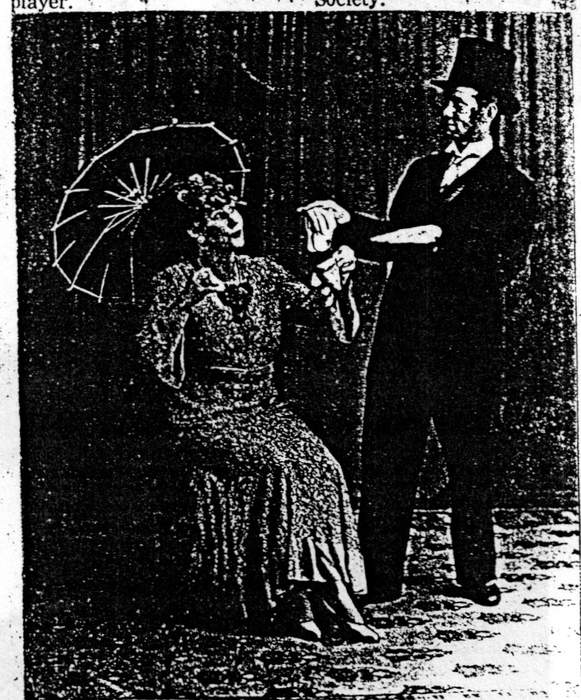 It was during a visit to Rotorua in 1940 that Mrs Haggart produced her first show. It was called Gypsy Gaietie Revue, the opening function of the Regent Theatre. Mrs Haggart still has an original programme in her scrapbook at her home in Grey Street, Rotorua, and several people named in the programme are still active in the Rotorua Operatic Society.
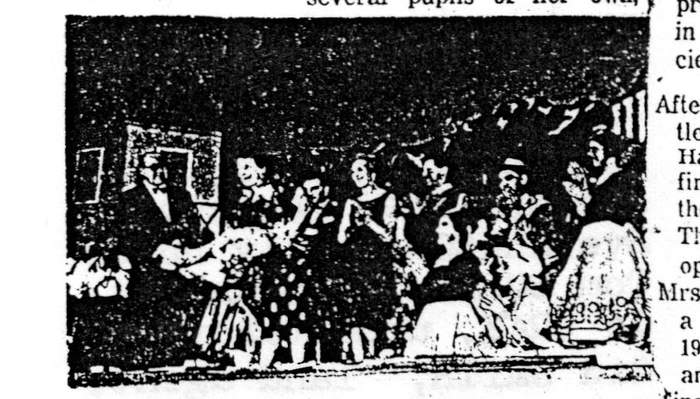 After the war, the family settled in Rotorua where Mrs Haggart appeared in her first major role. She took the part of Lady Coodle in The Runaway Girl, playing opposite Philip Steer. Mrs Haggart again produced a show for the society in 1953. It was called Floradora, and had a cast of about 70. Since then Mrs Haggart has produced many shows both in and away from Rotorua. She is at present studying the script for the society’s next production, Oklahoma.
Mrs Haggart names her part of Cora in the Belle of New York as her favourite. “I enjoyed it because it gave so much scope as a comedy player.” She said it was difficult to name what she most enjoyed staging, but felt that last year’s production of Rose Marie was her most satisfying. It was the second time she had produced the show. Mrs Haggart also finds time for a little writing. She is working on a children’s production called The Bamboo Princess. Two of her plays, The Emperor and the Nightingale and the Bright Falcon, have been staged by the Rotorua Junior Operatic Society.
Judging Talent For 15 Years
An old hand in stage work who believes in “thinking modern” has continued to practice what she preaches in spite of a revolution in the meaning of the word entertainment.
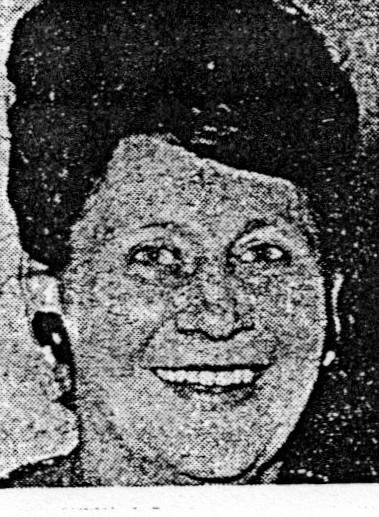 For Mrs R. M. (Connie) Haggart, a judge at talent quests during Rotorua’s Christmas-New Year carnivals for the past 15 years, the fare on display these days is a far cry from what it used to be. Though she is not always impressed with the standard of some performances, Mrs Haggart has no dislike of the type of entertainment offered at quests in more recent years. “I believe we have to think ‘mod’ – to try and look at things a bit like the young ones,” Mrs Haggart says, and means it.
Pop fan
She is a fan of Elvis Presley and Gene Pitney – and the Beatles, too – who are “far ahead of any of the other groups” in Mrs Haggart’s estimation. And so it’s in this frame of mind that she goes back to her talent quest judging job year after year. “I love it,” she declares. “I’m always going to give it up, but when the time comes round again I can’t.” Mrs Haggart’s long association with the Soundshell talent quests began 18 years ago when she herself was a competitor – and a highly successful one. She won the quest for three years running with her comedy sketch act. Then she took up judging and has been at it ever since.
The early talent quests differed from the present ones in that they were judged solely on audience acclamation, Mrs Haggart recalls. These days, audience appeal, stage presentation, deportment, appearance and choice of items are all taken into consideration.
Increases
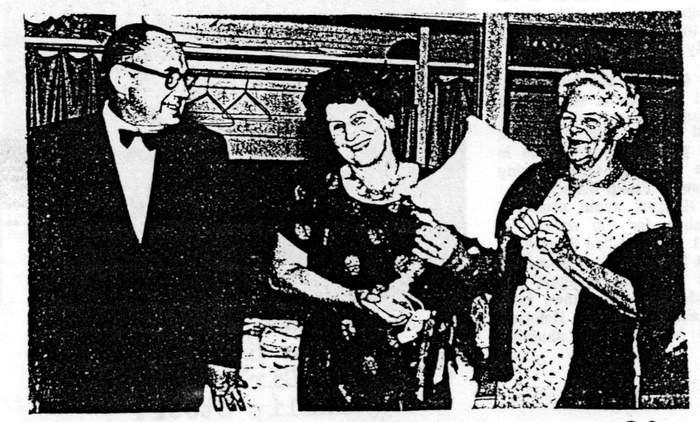 The prizemoney was rather different too – £25 for the winner, compared with the £100 at stake in today’s sponsored quests. Judging the talent quests is only a part of Mrs Haggart’s devotion to the stage. She is an experienced actress and producer, a teacher of speech and drama for some years, and a life member of the Rotorua Operatic Society. In addition, Mrs Haggart still finds time to run a hat shop in the city, and to be a mother of three.
Connie recalls 1930s, hard times when some women, to help, took in washing, ironing, sewing. Many children couldn’t complete their education. Men were the breadwinners of the family.
1945-49. Fund raising for the war effort often gave enjoyment with Queen Carnivals, fashion shows and concert parties.
1950s, the 30,000 Club organised festivities for promotion of business and tourism with entertainment, Christmas carnivals, talent quests at the newly built Council Soundshell, with Dick Spurdle as organiser. The Haggarts were both active participants. The Club organised the lakefront New Year Eve bonfires for thousands of revellers who awaited the lighting of the fire, the excitement of fireworks, then the joining of hands for the singing of Auld Lang Syne at midnight.
1963, Proclamation of Rotorua becoming a city. The script for the celebrations was written and produced by Connie Haggart.
Neighbourhood
1920s-30s the most populated urban area became Victoria to Malfroy on to Seddon, Carnot & Grey Sts. Houses were small with a verandah in front, near to the footpath, leaving a good back garden space.
Citizens near Grey St. that Connie recalls: – Doug & Eve Sheaf, both accomplished musicians. Eve Manson, family home. Tom Burnett, accountant. Jo Gray, undertaker. Sid Smith, land agent. Doug Hulton, Pres. R.S.A. Hector Steel, dentist. Ryan family, R.M. Motors. Judge Holland & family. Harry Lapwood, M.P.
Kath Langguth (nee Kingon)
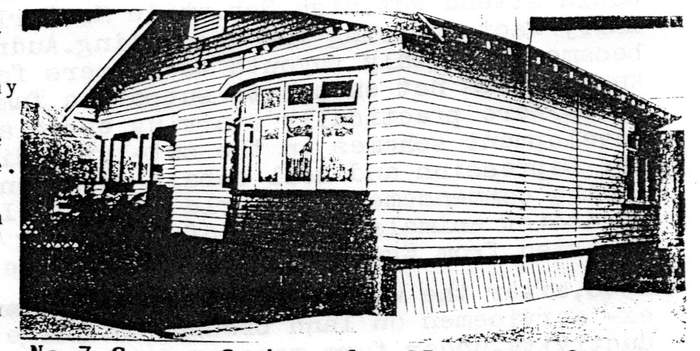 1920, 52 Sophia St., came to Rotorua from Australia with her parents and attended Rot. Prim. Sch. close to her Pukaki St. home. Over her lifetime, Rotorua has greatly benefitted from her strong community support and sporting abilities. Like her mother, Mrs Kingon, Kath excelled at tennis, both of them becoming Life Members of their Rot. Tennis Club. Kath furthered her basketball career to become a coach and earned the N.Z. Referee Badge. Kath also excelled at golf, which became her next sporting challenge. Now, her Sophia St. home is separated from the Golf Course by only a short width of open lawn, making windows seem vulnerable. Before moving to Sophia St., Kath lived at No. 7 Carnot St. for 37 years after marrying in 1935, during the Depression years.
Her house was opposite Judge Holland, whose family were all great sports enthusiasts too. Kath has many family friends from round the Carnot St. area, just by the Convent and near Glenholme. Carnot St., Kath says, was named after the 1st. French President of France.
Kath had wanted to be a teacher but the Depression had made this impossible. Her father had bought a Boarding House when he arrived in Rotorua in 1920. This backed onto Waiwera House by the lake. Mr Kingon, a kind and generous man, often had guests staying who failed to pay their debts. Kath’s mother, brought up in South Africa with servants, began married life unable to cook. In the Depression she overcame this obstacle and helped support the family by opening a Tea-Room, the ‘Dolly Vaden’, in Fenton St. where the Whaka buses stop in town. This was near the present-day Police Station. Early shops clustered in this area round the corner of Arawa St. & Fenton Street.
Next door was a Dress Shop owned by Mrs Davidson, whose home was opposite the Race Course, a dynamic person & 2nd. Pres. of the Women’s Club. Opposite, near present-day Spences Appliances, was Howden’s Jewelry, Vaughn’s Butcher Shop, Smith’s Cycle Shop, Wickett’s Draper Shop, Jim Dabb the Hairdresser, and next to him the Grand Tearooms. There was Beal’s Grocer Shop and Iles Photography, also McGinley’s Shoe Shop. By the time Kath left school, Arawa St., opposite the Post Office, became the main shopping centre, where Kath once worked in French’s Draper Shop. Coleman’s Clothing Shop was on Tutanekai St. cnr. where the two beautiful Manson sisters of Grey St. worked. This elegant big shop was freezing in winter, having one meagre central coal-burner.
Kath’s early associates living in her Carnot St. and Glenholme area, to Fenton St., were McDowells by Lytton St., Brackebushes, Skene-Dixons, Buddles, Mrs Pearce & sister Miss Robertson, Whites, and nearer Whaka, Ray Smiths, McHales, O’Connells, Urquharts. Kath’s home upbringing was very important, close and secure, as was her friends and neighbours. They had a big section, as was the custom of those days towards self-sufficiency, with fruit trees, big vegetable garden and kept poultry. The rooster next door was a horror to all children, pecking viciously. McGinley the Shoe-maker owned this crowing cock. There were four McGinley children, Ted the eldest, June the teacher, then Rex who carried on this all-important shoe repairing business for those hard-up times. Marie, bright and attractive, office-trained, and working in Wellington; Marie finally left Wellington on the afternoon express 3pm train on Christmas Eve, 24th Dec. 1954, after the morning’s Wellington excitement of the arrival of the Queen of N.Z., Elizabeth II.
Rex went to meet the train and Marie, who was leaving after Xmas for overseas. Rex’s father heard on radio of the train’s disaster plunging into a raging river near Ohakune (Tangiwai Disaster), caused by an earthquake, and smashing the bridge. Kath was asked to go and tell Rex. Marie was never found.
Audrey Parlane (later Mrs Gamman)
1929-1935, Seddon Street. Audrey Parlane, now Mrs Gamman, living in McLean St. off Devon St., in the Glenholme area of her youth.
1929, the Parlanes moved into Seddon St. after spending 1928 on the farm, about 90 hect., which they took over from Hazlett (street named), which was where the Girls’ High Sch. now stands, down to Utahina River, behind Sherrif’s farm on Malfroy Rd. Mr Parlane came from a farming family having begun at Akaroa, Ch.Ch. in 1862, arriving in N.Z. by sailing ship when he was 3 years old.
Seddon St. became home area to Audrey in 1929 so she and her brothers could attend Rot. High Sch. while Mr Parlane worked at Ngongotaha Dairy Factory doing the accounting. Audrey remembers how upset he became at monthly payouts to farmers for their dairy produce. He knew it was not enough to support a family, and children in many cases were practically starving, especially in the new Government Development schemes in the out-lying districts during the 1930s. The Depression and soil cobalt deficiency caused these problems, and the commencement of World War 2 in 1939, so a lack of man-power. To assist animals, blocks of Lick Rock Salt – with other minerals, imported from Egypt, were made available, often in milking bails.
1948, after the war a Govt. Land Development Scheme for settling the ex-servicemen on land brought in large areas of wasteland to productivity, under farm managers, and farm staff now helped by tractors and heavy equipment, electricity, water supplies, new roads & buildings.
1935, Audrey Parlane left Rotorua for a nursing career, well equipped by her parents to face the world both culturally and practically. Her father had always read the classics to his children, they had a love of music, and Audrey knew from her mother the domestic side of life as well as sewing, and at the age of twelve insisted on making her own dresses to the style she liked and has continued to do so. Her mother gave a strong moral upbringing but was modern in outlook and freedom for women. Audrey’s independent spirit and life style is a natural result of home background and so, like many contemporaries, she left N.Z. to further her career overseas, in England, and travel. After losing her husband in England, she returned to nursing, spending twenty-one years in Sussex.
In England, included in a variety of positions, Audrey became a matron, later private nursing with a number of fine families, some taking her to Europe. As a talented musician, she was a great asset. Her interest in art caused her to join art holiday groups painting in such places as Scotland and Devon where accommodation was procured in Manor houses. She found English nurses seemed rather uncomprehending about her independent travel exploits, which is quite natural to so many New Zealanders, who, from isolation, want to explore the world. Audrey is happy to be back in Rotorua, enjoying her many interests.