In this part:
- Wallace Crescent and the Growth of State Housing
- Droving Through the Hemo Gorge
- Hemo Gorge — Road-Making, Water Supply and a Family Tragedy
- Droving to the Ngongotaha Sale Yards
- Whakarewarewa Forest — 'Trees and Forests '92' (Daily Post)
- Forestry in Rotorua — The Past 100 Years (Rotorua Review, 1993)
- James Fenton and the Fenton Family of Ohinemutu and Te Puke
- James Fenton and the Fenton Family of Ohinemutu and Te Puke
- The Rotorua Bay of Plenty Hunt Club
- The Rotorua Bay of Plenty Hunt Club (continued)
Wallace Crescent and the Growth of State Housing
Wallace Cres. off Ranolf St. by Glenholme School was developed for State Housing in 1941. These housing schemes, begun in the 1930s, practically stopped during the war, after which the population increased rapidly to about 10,000. To assist waiting families, transit houses, formally Air Force wartime huts, were erected at Amohau St., present site of Pak’n’Save. These were semi-prefabricated houses which became known as ‘Jungletown’. They had communal facilities, showers, baths, lavatories, laundry and drying rooms. Fortunately these were closed in 1957.
1949, Miller St. Transit Camp – on East side and bordering Wallace housing area with entrance off Malfroy Rd. This had 16 units.
1956, a further three blocks of four-unit pensioner flats were added. Before 1960, another twelve units were added in Kahikatea Street.
1948, Glenholme Sch. opened because of increasing school rolls.
1955 Malfroy Rd. Prim. Sch. opened.
1957 Malfroy Rd. Rot. Intermediate Sch. opened.
1958 Rot. Girls High Sch. after the restructuring of the co-educ. sch.
1959 Boys High Sch. Headmaster Mr. Harwood retired, no longer co-educ.
1960 Otonga Sch. opened. 1955, under the Group Housing Scheme, 77 sections became available in Hetherington Block, Otonga–Springfield Rds.
1951 First Free Kindergarten, Malfroy Rd. in Baptist Hall.
1954 (Mrs) Helen Downer Free Kindergarten in Pretoria St. opened.
1961 Helen Downer awarded MBE and became founder president, B.O.P. Ass.
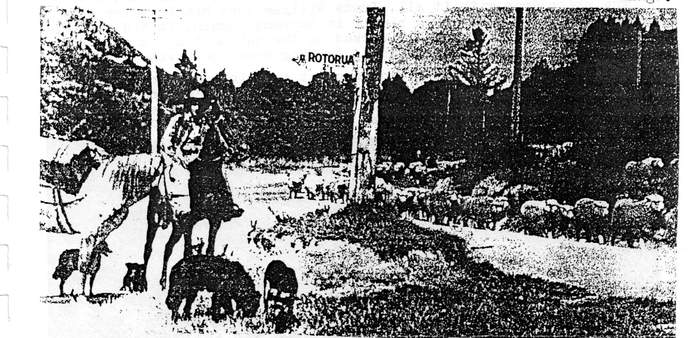
Figure Hemo Gorge, nth. end, on Taupo Rd. Drovers often brought mobs through.
Droving Through the Hemo Gorge
School children from Waipa village, just south of the Hemo Gorge, went to Glenholme Sch. by bus in 1950s, then Otonga Sch. in 1960. 1940, Waipa Timber Mill was constructed and is now the biggest sawmill in Australasia. Forestry Research personnel lived there but later moved to town and mill workers lived in the village.
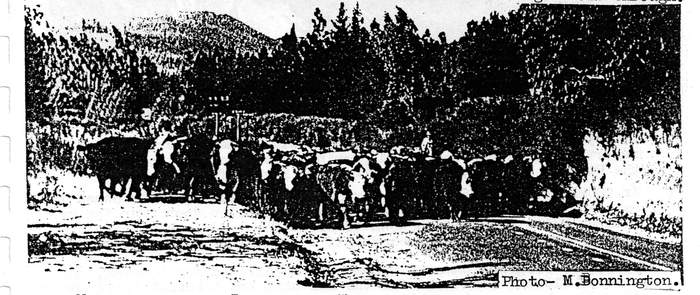
mob of cattle on Taupo Rd. at Waipa, to enter Rotorua at Hemo Gorge. Photo – M. Bonnington.
Mobs of sheep or cattle entering Rotorua via the Hemo Gorge sometimes came from as far away as Wairoa on the East Coast, through Waikaremoana, taking three weeks. There were holding paddocks available and often a whare for drovers. With mobs of sheep, drovers could use horse and gig, often with pack-horse or riding horse tied to it. With cattle, drovers had to ride, working the dogs to keep control. Mobs were taken straight out through Old Taupo Rd. to Ngongotaha Sale. Buyers from the Waikato often bought the young store cattle to put on their good farmlands, older cows for breeding and the steers from coastal hill country to fatten for beef.
Rotorua had mobs of sheep from Maori Affairs land at Owhata, Te Ngae, mainly pass along Malfroy Rd. then to Old Taupo Rd. for Ngongotaha. East Coast stock centred round Gisbourne area went via Opotiki over Kaimai Ranges as far as the sale yards at Morrinsville.
Hemo Gorge — Road-Making, Water Supply and a Family Tragedy
Wallace carting business involved also, earth moving from horse and cart days to trucking. Rotorua’s southern outlet to Taupo at the Hemo Gorge involved difficult heavy work. A new man employed by William Wallace (sen.) on horse and cart earth works went over the steep drop with it all. Irate William sent him back the next day saying he would sack him if it happened again. It did, the man was sacked. William himself worked on the job next day until he himself, horse and cart, ended up falling down the ravine!
The Hemo Gorge presented problems not only in road formation but in replacing open fluming with pipes for Rotorua’s water supply being taken from the spring at the back of Waipa, Puarenga Stream. A greater flow was required, as old system was constructed in 1906.
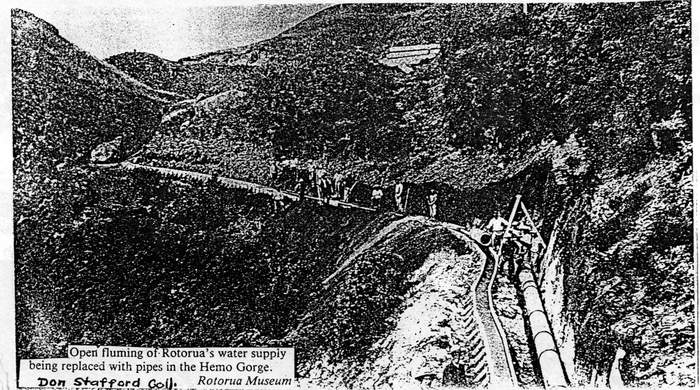
Open fluming of Rotorua’s water supply being replaced with pipes in the Hemo Gorge. Don Stafford Coll. / Rotorua Museum.
In 1955, with explosive population growth, a new water supply and reservoir scheme was completed, pumping water from the headwaters of the Utahina Stream to a reservoir up on Hunt’s farm.
Mr. Thomas Sloane, 1868–1954, a very early Rotorua identity, owned the land above Hemo Gorge, now Tihiotonga subdivision, down over the new Rotorua Motor Camp and on down to about Sophia St. where the old Camping Ground extended from Ranolf St. and along Devon St. to Old Taupo Rd.
1953, this original Camping Ground was subdivided for housing, and some of Sloan’s land sold for the new camp and Waiariki Polytechnic. Ground works preparing this took much time and heavy labour with the clearing, ploughing and levelling like Wallace did. Opened 1958.
William Wallace had been involved so much, for years, with the construction of a road through the dreadful Oropi Gorge leading to Tauranga and a main route in the early days, that he had almost a feeling of ownership for it. Driving to Tauranga over it one day, he was ordered by a bus driver coming round a narrow steep corner, to back out of his way. William adamantly refused, saying he built the road, it was his right of way. Furiously, the bus driver gave in. Tragedy struck William before he was 50 years of age. Returning from Tauranga via the Oropi Gorge one night with his great friend Walter Steele, the car went over the bank, leaving him paralysed, unable to sit up or do anything for himself. It was hard on the family as well. Thomas Jackson, the mayor and great friend, called in most days on his way home from his milk round, to Otonga Rd., to talk politics.
Droving to the Ngongotaha Sale Yards
Drovers on Sale Day along Old Taupo Rd. to Ngongotaha Sale Yards.
Sale days played an important part in the life of local farmers, even for the smallholders close by the township, so were well attended, thus serving as a social meeting ground also. Those droving their stock would gradually converge upon Old Taupo Rd. until there were often six to eight groups, for anxious drovers trying to keep a steady calm pace with also a practical distance between. Inevitably there was panic and a break away at times causing much shouting, cracking of whips, racing and barking of dogs, creating disturbance to other groups.
Pererika St. presented a special problem especially nearer the railway station end and small farmlets as this was a bad flood area with a very deep wide drain along the side. Sometimes a panic stricken big animal would fall in and have to be dug out, causing delay problems.
An incident long remembered occurred at Malfroy – Old Taupo Rd. cnr. at a little house just down a track, now Rutland St., where the housewife was so busy doing her washing that she forgot the rule, especially for Sale Days, of ‘SHUT the GATE’. A roaring terrified cow with a pack of yelping barking dogs on her heels came charging round the side of the house, there to be faced by the housewife at the clothes-line frantically flapping a white sheet. Cornered, the desperate cow charged through the back door into the kitchen, causing mayhem as it circled round and round in the confined space, smashing everything and mucking the whole place up in uncontrolled terror!
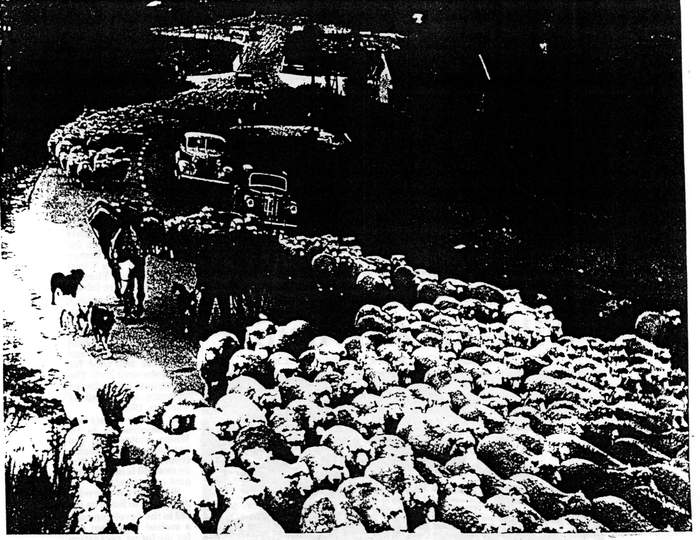
Droving. Part of mob of 45,000 sheep. Cars created difficulties. Photo; Bonnington col. – Museum.
Whakarewarewa Forest — ‘Trees and Forests ’92’ (Daily Post)
The following is a reprinted newspaper feature, ‘Trees and Forests ’92’, Daily Post, pasted into the original scrapbook.
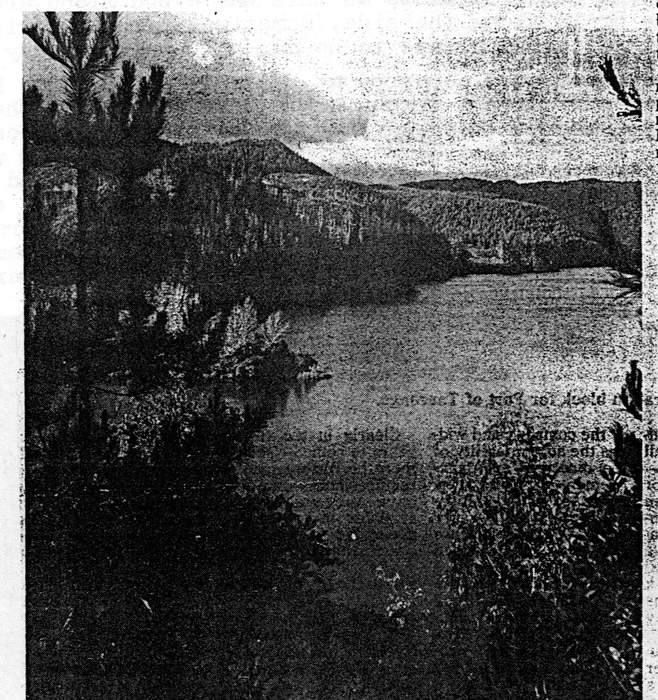 Whakarewarewa Forest provides a magnificent backdrop to Rotorua city yet it is hard to believe that this mixed species forest unrivalled in the North Island has existed for less than 100 years.
When the first tree was planted on the Whakarewarewa hills the southern skyline looked very different from the way it does today. The hills then were covered in flax, fern, tussock and scrub.
Maori people have lived in the district for five or six hundred years. Over the centuries there may have been many Maori villages spread among the hills where the forest now stands, but only one, the fortified pa called Tokorangi, remains.
Some of the hut sites, terraces and pits can still be seen along with the double ditch and bank of the earthwork fortifications.
Several villages lay just outside the forest boundary. One of these, Kaitariria, was on the southern shores of Lake Rotokakahi, the Green Lake, and was for a time used by Captain Gilbert Mair and his Te Arawa constabulary.
When the first European settlers arrived, New Zealand was well covered in lush native forest but the settlers wanting the land for farming took to their saws and by the 1890s it was obvious that new forests had to be planted immediately. If not for this replanting New Zealand would have run out of timber by the 1960s.
The forestry branch of the then Crown Lands Department was set up in 1896 to create new forests on land unsuitable for farming, and Whakarewarewa is one of those forests.
Instead of using native trees that would take two or three hundred years to mature, the forest planners imported seed from all over the world. More than 170 varieties were introduced in the search for the most suitable species for New Zealand conditions.
Planting of the forest began in 1899 and continued for the next 17 years. From 1904 most of the planting was achieved with the assistance of prisoners. Their camp near the Green Lake is now a picnic area.
Between 1908 and 1910 tuberculosis patients joined the prisoners for some outdoor therapy but working in a forest was not easy. Planting was a much more laborious task than it is today, and other work methods have changed too.
When logging began horses were used to haul logs from the forest and they were still used for some jobs until 1969. The mechanical hauler began replacing the horses as early as 1939.
In 1940 a timber mill was constructed in the Waipa Valley, and processed the first timber from the forest. The Waipa sawmill is now the biggest in Australasia.
Whakarewarewa’s proximity to Rotorua has led to the development of a second important role for the forest, recreation. The many tree species including the magnificent Californian redwoods, the walking tracks and birdlife attract thousands of visitors every year.
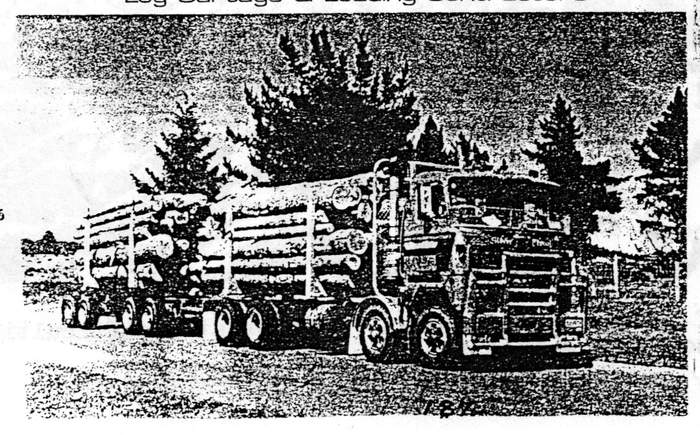
1990 advertisement for Williams & Wilshier, Log Cartage & Loading Contractors.
Forestry in Rotorua — The Past 100 Years (Rotorua Review, 1993)
The following is a reprinted newspaper feature from the Rotorua Review, Tuesday, February 23, 1993 — ‘A Rotorua Review special liftout feature. Forestry – a booming industry moving into the next century.’
The first faltering steps which led to Rotorua becoming the forestry town it is today began over a century ago.
Before then, native timbers had been felled and milled but the establishment of nurseries and efforts to plant new forests began in earnest in 1886.
In that year the Department of Lands and Survey sent a small experimental consignment of 12,000 ash, larch, spruce, chestnut and pine trees to Rotorua to see how they thrived compared with those planted in other promising parts of the country.
Land was cleared on the hills behind Whakarewarewa.
It soon became apparent that the region’s volcanic soil suited pinus radiata perfectly. Pines grew at an amazing rate in the hills around Rotorua. They were so successful that a further area of almost 4000 hectares was planted between Whakarewarewa and the Green Lake, and more at Waiotapu.
This was the beginning of Rotorua’s forestry industry as it is today.
It wasn’t long before forestry became the biggest source of employment in the Rotorua district.
The planting and management of the forests around Whakarewarewa provided employment for many of the local Maori people and Rotorua soon became New Zealand’s foremost forestry centre.
In the depression of the 1930s thousands of unemployed men flocked to the district to gain employment planting an area which would become New Zealand’s largest forest.
Conditions were harsh out on the Kaingaroa plains where the men worked, often in inadequate clothing and footwear to earn 10 shillings a week to send home to their families. Food and a bunk were provided – often their only accommodation was in a tent.
By the end of the 1930s vast tracts of radiata began to reach maturity but extreme prejudice against the new product began to be felt from sawmills, building contractors and lending institutions. State Advances, which later became the Housing Corporation, refused to lend on a pine house.
Although pine was easier to work with than native timbers, many contractors did not know how to handle it properly.
In 1939 the government of the day stepped in and set up the Waipa sawmill. This became a training ground for graders, sawdoctors and those engaged in timber preservation.
As the Second World War ground on towards its conclusion, the huge earning potential in the vast pine forests could no longer be ignored. The country was going to need highly-trained forestry workers to manage the resource. In 1944 the Forestry Training Centre was set up to provide them. Since then the Forestry Training Centre has trained many thousands of personnel for the forestry industry. They gained employment in the Forest Service or private companies servicing the industry. The centre also attracts many trainees from overseas.
Five years ago the Forest Service was abolished and the Forestry Training Centre for a short time came under the umbrella of the Ministry of Forestry until 1988, when it became a part of Waiariki Polytechnic.
Forest Research Institute provides huge contribution to forestry industry
From its humble beginning in 1947 the New Zealand Forest Research Institute has expanded rapidly so that today it is the principal supplier of research and development to the forestry sector.
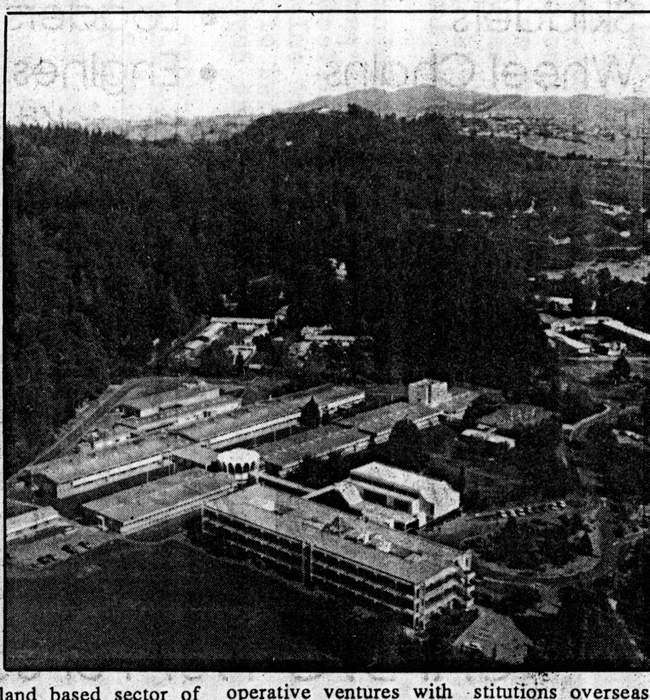 In those early years the Institute was part of the New Zealand Forest Service and was primarily involved with indigenous forestry.
However once recognition was given to the importance of protecting and improving the country’s plantation resources, the Institute’s scope was widened to encompass a comprehensive range of plantation, wood technology and environmental research.
After 40 years as part of the Forest Service the Institute was transferred to the Ministry of Forestry. This was to be short-lived, however, as in July 1992 it became a Crown Research Institute.
This meant the Institute was no longer part of a government department but an autonomous organisation with a company structure.
Like all research organisations in New Zealand it must focus on a land based sector of the economy, on people, or on a natural resource. In the case of FRI the focus is on forest and wood products research.
More than 500 people are employed by the Institute, either at the main campus in Rotorua or at South Island bases at the University of Canterbury or Rangiora.
Close links are also maintained with the New Zealand Universities as well as with institutions overseas.
With the Institute now organised into six divisions covering biotechnology, forest technology, logging industry, wood processing, wood products and pulp and paper, it’s easy to understand the contribution made to the forestry industry by the Forest Research Institute.
Approximately 60 per cent of the Institute’s revenue comes from government and the remainder coming from the commercial and co-operative ventures with the industry.
James Fenton and the Fenton Family of Ohinemutu and Te Puke
James Fenton, father of Tony Fenton. (Not related to Judge F. Fenton.) 1873, in first carrying businesses from Tauranga to Ohinemutu. In Sydney, Australia, he searched for horses and equipment, bringing back several fine teams of draught horses and a huge new waggon capable of carrying a huge quantity of goods for the Ohinemutu stores. He began carrying Dec. 1873 which he maintained with a splendid record until selling the plant eleven years later, in Oct. 1884.
 Earlier that year, 1884, the road had deteriorated so badly that it could take him three days from Tauranga to Rotorua as the Oropi Gorge was almost impassable, causing expensive damage to waggons. Once he had two waggons at the same time broken down in the Gorge when Thomas Wriggly had a broken axle, and Edwin Robertson found it necessary to increase passenger fares.
James Fenton spent about half his time living in Ohinemutu, the other half in Tauranga because of his work and so he was party to many of the decisions made by the settlers of Ohinemutu affecting welfare.
1876, James was one of four Europeans (practically only Europeans living there) who attended a race meeting with a crowd of Maoris, at the race course on the scrub covered flats of present day Pukuatua–Fenton–Amohau–Amohia Sts.
1882, James Fenton was interested in the new Tauranga to Ohinemutu route via Maketu, first by steamer to Maketu, then Maketu by bullocks to Taheke (at Okere) at Lake Rotoiti, at same time as Wlm. Kelly was. Taheke was sth. terminal for Rotorua – Maketu Rd. 1870s. There was a simple Maori restaurant-hotel managed by European Thomas J. Bennet.
James owned farmland in the Te Puke area, Papamoa on No. 1 Highway. His three sons were Antony, who came to Rotorua 1935 for Hunt Club, then Bob who continued with farming at Papamoa, John, killed in W.W.I.
A Fenton Reunion took place last year, the large gathering at Alice Gemmy’s home, Te Puke. The two Rotorua representatives were Rhys Fenton, a great grandson, a policeman here, and Lavinia Fenton – Mrs A. Kreegher, daughter of Rotorua Tony Fenton. Tony’s father James spent much time in Rotorua when Judge Fenton negotiated for the Crown with Te Arawas. Lavinia and one of Judge Fenton’s grand-daughters knew each other at Rot. High Sch. and enjoyed meeting again at the 1992 Reunion (came from Ak.)
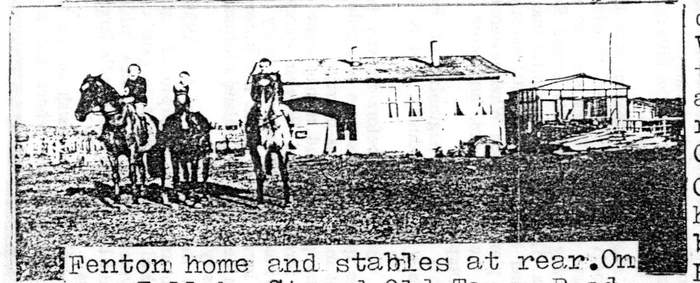 1935–36, King St. off Malfroy Rd. was 1st. home after Te Puke for Vini, Mattie, Una, and brother Hysie. (Some died, Te Puke.) A town section seemed impossibly tiny after country freedom so their roaming was objected to, especially by a next door neighbour. In retaliation for such restrictions, they sought freedom in a tall pine tree out front, waited for the complaining lady to come out and then pelted her with potatoes. Mother, outraged, gave each a good hiding and sent them separately to apologise. Vini had to be forced, then said, “I’m sorry, but you should not speak to us the way you do. I don’t like what you say!” Vini has remained forthright to this day, recalling farm life in area of Tallyho St. right back round Riri & Pururu Sts. back up Old Taupo Rd. They loved riding. Once monthly, Tony, after meeting his mates at Lake Hotel, would be brought home by his horse just as Elsie, his wife, finished milking the last cow, just like clockwork!
James Fenton and the Fenton Family of Ohinemutu and Te Puke
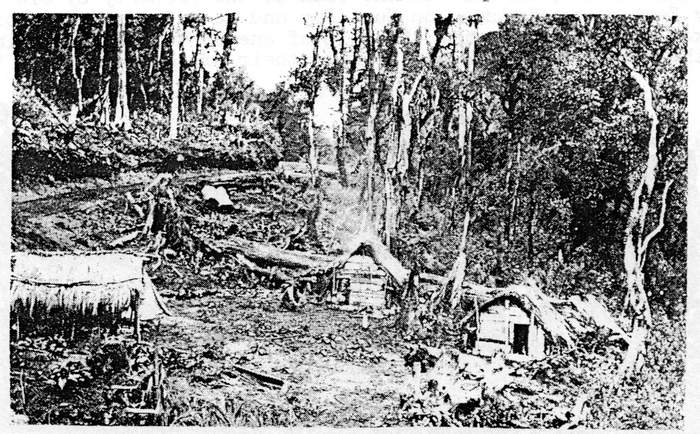 James Fenton, in 1873 when the original military route of 1869 was opened between Tauranga and Rotorua despite its shocking condition for coaches and waggons, began a transport business that first year. This Mangorewa or Oropi Gorge road opened up access to Rotorua.
Lavinia Fenton, now Mrs. A. Kreegher, lived by the railways, many years. James Fenton was her grandfather, Tony, Rotorua Huntsman, her father. Lavinia remembers once, as a young girl, her father telling her to mount his horse when he came back from a Hunt, and jump the fence! That rickety fence looked so frightening but she did manage to do it. Lavinia’s mother made a pet of a wee piglet despite Tony’s warning. One day, dressed nicely for town, she reached the shops up Pukuatua St. when her piglet caught up, to her horror! She returned home smartly.
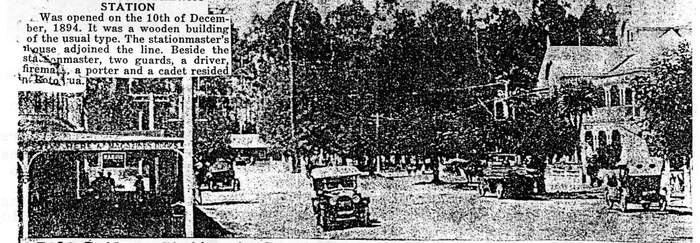
1930, Railway Station in Plantation, south end of Tutanekai Street. Empire Hotel is on the right, next down on cnr., ‘Australia Hotel’. The ‘Plantation’ was an attractive, enjoyable feature of the township
Inset newspaper item, ‘The Rotorua Railway Station’: Was opened on the 10th of December, 1894. It was a wooden building of the usual type. The stationmaster’s house adjoined the line. Beside the stationmaster, two guards, a driver, fireman, a porter and a cadet resided in Rotorua.
1945–46, Tony Fenton was given the work of being in charge of the Race Course. Mrs Fenton became supervisor for the catering for all the functions and George Bertram now remembers what a delightful lady she was – ‘a real sweetie’, so her dishes must have been very tasty!
1950s, Lavinia married and as her husband worked for the railways, they lived nearby. Of their 23 years, 11½ were in Victoria St. No. 6., retiring in 1979. The plantation of tall trees looked so attractive. There was the Fenton–Victoria one & Amohau–Ranolf St. one with the Station midway, facing Tutanekai St.
The Rotorua Bay of Plenty Hunt Club
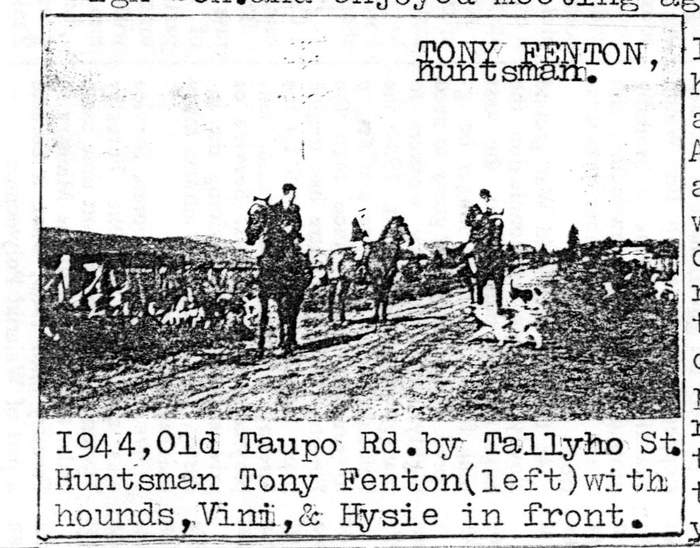
1935, Antony Fenton came from Te Puke farm to Dr. Bertram’s ‘Glenholme’ to take charge of the Hunt Club’s hounds – Dr. Bertram was Master of Hounds. The kennels were to the back of the property by Old Taupo Rd. Tony Fenton was Huntsman on Hunt Day and he and the Master of Hounds worked well together with the help of one or two Whips out in front of the other riders who had to keep their distance from the ‘Red Coats’.
1932 was the first hunt of the Rotorua Bay of Plenty Hunt Club. Most hunts in early 1930s were bordering the west side of Utahina R. off Malfroy Rd. where Harry Ford and family were keen hunters. Ford’s barberry hedges had gaps cut low for jumping, hurdles were placed in fences and those not jumping used the gates, their rule – ‘Shut the Gate’. Harry’s wife Rene often followed in her Ford car, then gave ‘Hunt Tea’. About mid 1930s, Doggett’s farm opposite across Malfroy Rd. was also hunted over and the Utahina R. area now Rotorua International Stadium. Ngongotaha held occasional hunts at first but now, all the gatherings.
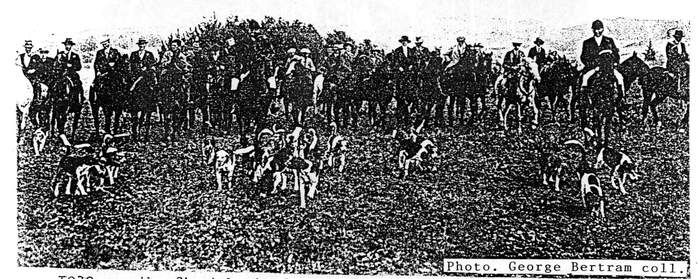
The exhilaration of galloping horses, jumping, leaping drains & streams, following the full-throated baying of hounds as the hare raced and twisted through the most difficult terrain, had the horses in an even greater state of excitement than the riders who often had trouble in holding them in. Some families followed as much as they could in cars, some hiring a car and driver from R.M. Motors. When the hounds lost the scent, riders often had to wait, watching from a vantage point.
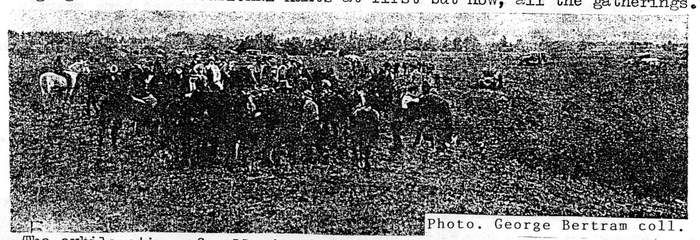
Photo, George Bertram coll. (both photographs on this page).
At such times, often in chilling windy weather, some riders would pull out a pocket flask for a warming nip. Dr. Bertram’s was a special slender glass tapered knee flask about 30 cms. long, readily available in leather holder, with rum and port wine mix. As soon as the hounds picked up the scent again, they’d be off at a gallop to the Huntsman’s call of ‘Tally-ho’. Tony Fenton and family lived off Old Taupo Rd. on land that Tony sold to the Hunt Club. This is now called Tally-ho St.
The Rotorua Bay of Plenty Hunt Club (continued)
Late 1930s – 1940s. Dr. Bertram, family, and Tony Fenton.
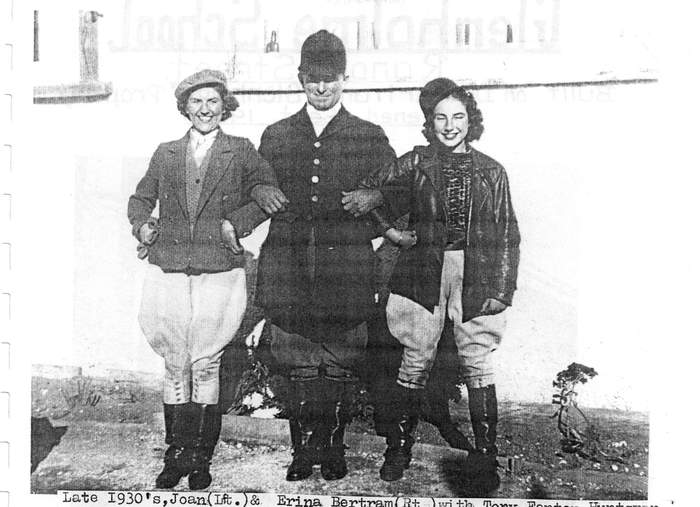
Late 1930s, Joan (Lft.) & Erina Bertram (Rt.) with Tony Fenton, Huntsman, on his Tallyho property, about to leave for a Hunt, taking his hounds.
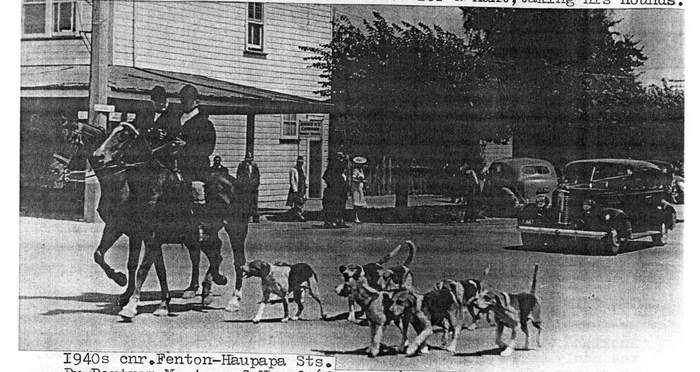
Below: 1940s cnr. Fenton–Haupapa Sts. Dr. Bertram, Master of Hounds (far side), and Tony Fenton, Huntsman, escorting Joan (Bertram) from St. Luke’s Anglican Church after marriage ceremony to Mathew Caudwell, a prominent Anglican Minister