
J.M. CAMILLE MALFROY, served Rotorua 1886-1896. Rotorua’s Resident Engineer
Some of the following information comes from Enid Tapsell’s book ‘A History of Rotorua’ and Don Stafford’s ‘Founding Years in Rotorua.’
1886, following the Tarawera Eruption, CAMILLE MALFROY was appointed Rotorua Resident Engineer by the Govt., reporting on changes that might take place in the hot springs and geysers.
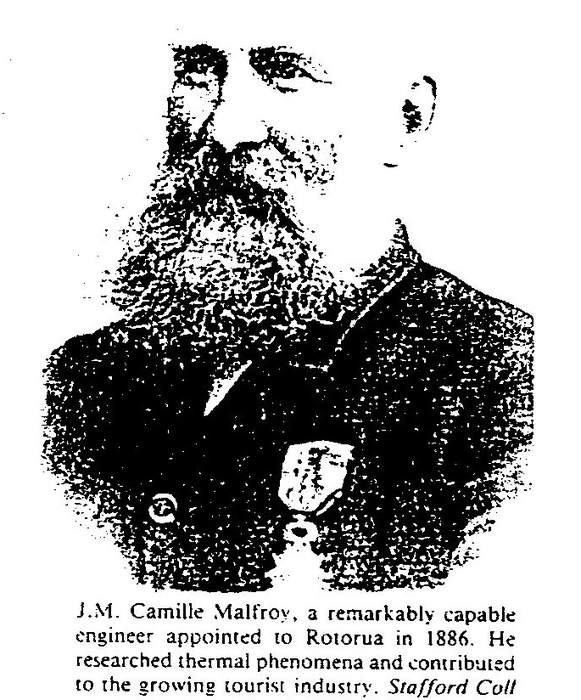 France was his birthplace. In 1850s he and his father both left for Victoria, Australia, for gold mining. In 1860s, Camille moved to the West Coast, New Zealand, during the ‘Gold Rush Days’. Here he became involved in politics, becoming Mayor of Ross for some time.
In Rotorua, Malfroy was progressive and greatly respected by both Europeans and Maoris who were working towards the future of this new town. Malfroy, after Dr. Ginders, became chairman of the Town Board 1891-95, followed by R.D. Dansey. Malfroy was also appointed Govt. Agent of the Native Land Court when Dunbar Johnson retired.
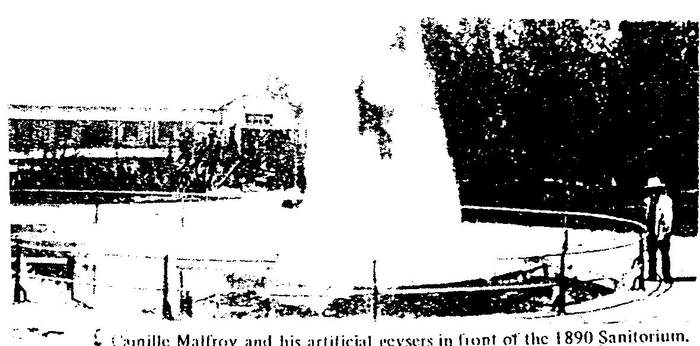
As engineer, he made exhaustive examinations of geysers. He converted two hot pools near the Blue Baths into active geysers — one named Malfroy. There were extreme difficulties and exposure to heat & cold. In 1889 he represented the colony at the Paris Exhibition, where he received the distinction of Chevalier de la Legion d’Honneur.
1895, when Malfroy was Chairman of the Town Board, demands were made to have Ranolf St. extended south of the railway, (which opened 1894, stretching from Fenton to Ranolf Sts. along south side of Amohau St.) as more properties for homes were required to cater for the growing population of the town.
 To extend Ranolf St. meant draining a huge swamp area between the present Pereriki St. and Victoria St.. The extension went to MALFROY Rd. which became the main road from Fenton St. up to Pukehangi Rd. in the west. Ranolf St. was then extended as a pumice rough road to Devon St. and later cut through to Sophia St..
In 1895 also, now that the railway was operating, bringing more tourists, demands were made to improve the town water supply, drainage & sewerage. 1896, Premier RICHARD SEDDON requested parliament for £50,000 for this work which began in 1898. Malfroy died 1897. SEDDON St. is next past Malfroy Rd., named after?
WILLIAM SEDDON, 1874 came to Rotorua for thermal treatment after gold-mining, stayed at Ohinemutu, opening Seddon’s Comet Store, then with funds from supplying railway workers up to 1894, bought valuable land in New Town Rotorua, now municipal buildings’ land. He stayed on at Ohinemutu as proprietor of Lake View Boarding House.
Malfroy had much of the land along Malfroy Rd. frontage, between Ranolf St. and Old Taupo Rd. — leasehold. The house was well set back off the dusty pumice road. This land was later sold to Mr. Harry Hill, then to Mr. Lewin Lewis.
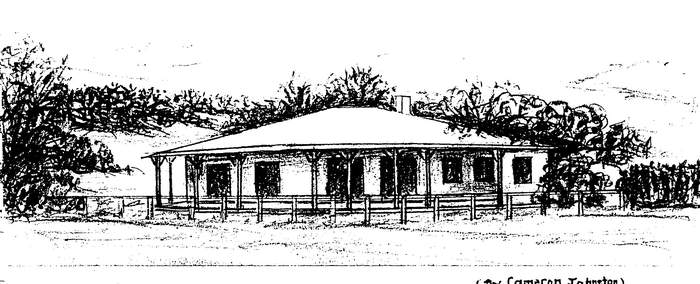
Figure Pencil drawing of the Malfroy homestead, based on an old oil painting belonging to the Lewin Lewis family
This Malfroy house drawing is taken from an old oil painting by Cameron Johnston belonging to Lewin Lewis’s family, the sketch done by Peggy Allen.
The house was set well back in the paddocks off Malfroy Rd., about opposite the present-day Intermediate School and on the flats below Dr. Bertram’s ‘Glenholme’ home up on the rise.
Camille Malfroy died in sheer exhaustion in 1897 after a number of years of severe ill health, during which time he took a health rest in both N.S.W. Australia, also Hanmer Springs in Canterbury where he was to make a report on the Springs. He did not benefit from all this and his health deteriorated but he continued in his duties, refusing a retirement offered by the Government, dying early 1897.
He was survived by his wife and several children. He had married Ellen Jones of Hobart, Tasmania in 1874. A descendant of a Rotorua contemporary of Mrs. Malfroy, remembers her mother saying that Mrs. Malfroy had that house built Australian style, which she liked, with big sun verandahs most of the way round. The hot water cupboard was like a small room with shelves all round for airing clothes. It was a wet low-lying area, with deep drains either side of the long drive in across paddocks, the house out of reach of the clouds of pumice dust that could blow in from the road.
It is thought that this property lay vacant for sometime before being bought about 1919 by Harry Hill. It was leasehold land.
Lewin Lewis, next owner, bought from Hill round about 1928, but wanting freehold land, Lewis and family later moved to Lynmore area. The big home was then occupied by a big Cochrane family and the land was gradually subdivided for housing.
In this part:
- J. Harry Hill — Musician and Restaurateur
- The Tew Family Grandparents of the Hill Children
- Mr. & Mrs. Lewin Lewis — Malfroy Road Farm
- Lewis's Tarawera Rd. Property
- Ray Spence and the Malfroy Road Dairy Farms
- King Street Hospital and Nurse Naumann
J. Harry Hill — Musician and Restaurateur
J. HARRY HILL, in 1912-1913, settled in Rotorua.
He came out from England, first settling in Hamilton before visiting Rotorua. Here he was impressed by the orchestra and music opportunities. Packing his bags, he settled in the town of Rotorua which greatly gained from his musical talents. He was trained in England where he belonged to the English Military Band, playing brass and wind instruments. Rotorua Band at that time, did not have his instruments so he did not join but was prominent in the orchestra work, able to play both piano and violin, but particularly he enjoyed the clarinet. He was offered a place in the N.Z. orchestra, but having a young family he was unable to travel. Concerts and choirs benefited also from his singing voice.
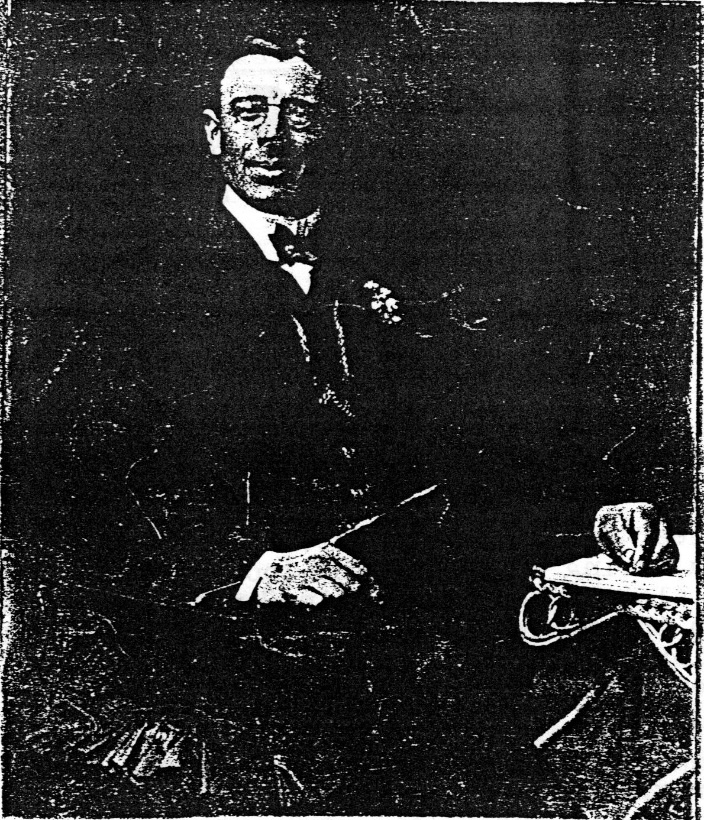 He lived for his world of music and enriched his family life with this joy. His daughter Alice’s earliest memory is of being on stage in a concert when there was much laughter because her bloomer legs began to show slipping down as waist elastic came undone – a real problem of those days!
Mr. Hill willingly played for any concerts, including schools, but was particularly skilled when playing and improvising the musical affects for the ‘Silent Pictures’ in theatres.
Although music was his life, he had to earn a living to support his family, so he looked round for an opportunity, resulting in owning a restaurant opposite the Grand Hotel in Hinemoa St.. As a side-line he sold fish, delivering them by horse and cart to Whakawerawera where he became popular with the Maoris.
Mr. Harry Hill was ably assisted in his restaurant business by his wife Maude—nee Tew, despite her having a young family to care for. This was for her, mainly through the war years of 1914 – 1918.
1919, Harry Hill bought the leasehold property of the Malfroys; this seems to have been unoccupied for some time. They were delighted with the lovely home with all the verandahs, set well back off the Malfroy Rd. and below Dr. Bertram’s home ‘Glenholme’. Before this they lived in Pukuatua St. but due to severe migraine head aches, Harry wanted to get into the country atmosphere. The year before, he had suffered the deadly 1918 ‘Black Flu’ epidemic, caught also by his two small children born by then, Ted and Alice. Harry drank bitter quinine to combat it.
The family now grew in number to five, Ted, Alice, Bill, Eric, Jim.
A dairy herd and milkrun were established. To assist with this, he employed a Scottish lad, Jimmy Martin who had a brother Dave working for Ewerts delivering shop goods. The Hills enjoyed farm life. 1928, the hardships of the Depression forced them to sell to L. LEWIS.
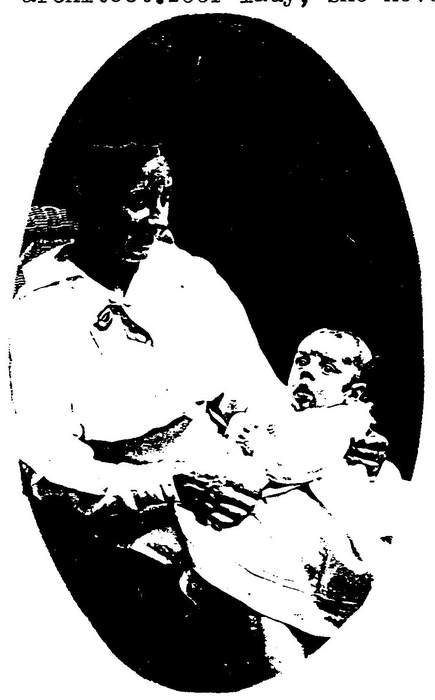 Hills moved to 30 Malfroy Rd., having a little convenience dairy shop at the back, and they also kept on with the milkrun as before. Also, with the boys growing up, they went into a Fish-shop venture, and Billiard room in the town.
Alice Hill, now in her 70s, has many fond memories of early days. She is now Mrs. O’Loughlin living in Whitworth Rd. close to the very old Whitworth home which backs onto the John Paul College. The Whitworths bought out the McLean’s property, Austral Hotel and the farm with access from Malfroy Rd. and reaching the Utahina River, this providing all hotel fruit, vegetables and meat, established before 1920s. Alice has many happy school-day memories amongst the children of these old Rotorua families, and about her brothers. When Ted, her older brother was able to take the horse and cart to deliver the fish from their shop out to Whakawerawera, he would endeavour to fit in time at that Golf Club to chat with his other caddy mates, often forgetting time. One such day his father, waiting for the cart to do the milk deliveries, stormed at his wife who was a really lovely lady, to hurry that Ted up. She, quite upset, rang the Golf Club passing on Harry’s forcible message directly to Ted as she thought, only to find it was one of the two Mr. Hill gentlemen either Govt. Resident Officer William Hill or Mr. La Trobe Hill the architect. Poor lady, she never overcame her chagrin!
Both Mr. & Mrs. Hill were kindly and hospitable folk. It was notable during the depression that there were people on their milkrun who, due to lack of money, did not have milk for their families which saddened the Hills who did what they could where they could.
Maori women would sometimes call at the farm and with great dignity, would barter, preferably for cloths. Sometimes they had water cress from streams or potatoes and occasionally kumaras which these women cultivated so well in their patches with much hard work. Their flat lake-side land was much easier than up at the bush-line on the Tihiotonga hills where they burnt the scrub to plant in the beneficial ashes. They also exchanged their very useful flax-woven kits which were especially appreciated by fishermen.
Tramps quite often called in those days, seeming to know which were the hospitable homes, by a sign at the gate. They would offer to chop wood, digging or odd jobs in exchange for a meal, this being always given on the verandah. They were however, never asked to sleep.
Mrs. Hill was a keen competitor in the annual Agricultural & Pastoral Show, specializing in cakes. One year she had a glowing feeling of satisfaction as she popped her pink, white and chocolate cake in the oven. When she took it out, to her consternation, there was a big fat potato plonk in the middle of her otherwise perfect rainbow cake! Young happy-go-lucky son Bill, hungry, had thrown one in to bake!
Her kitchen in this modern home, was long and narrow with an exceptionally big wood range for family cooking and the pantry was a walk-in roomy area with stone jars for keeping things cool, the hot water cupboard was walk-in with shelves, all ceilings exceptionally high, bedrooms with big built-in wardrobes and doors opening onto the spacious verandahs round three sides of the house, and a boys’ room enclosed on one side as shown in the drawing.
Later, after years of caddying, Ted and Bill became fine golfers.
The Tew Family Grandparents of the Hill Children
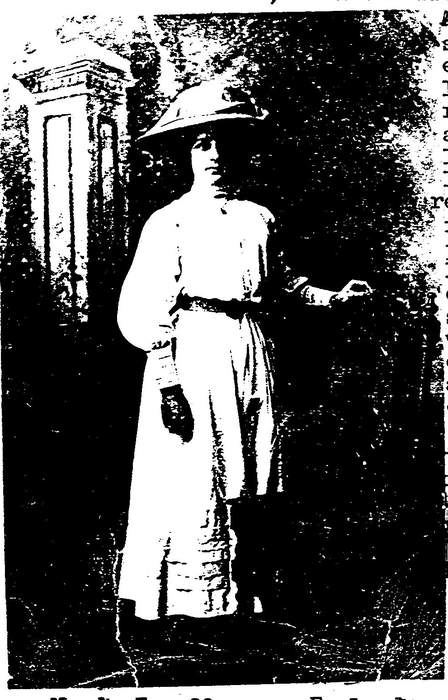 TEWS, GRAND PARENTS of H. HILL’s CHILDREN, before 1920 farmed in Rotorua, Pukehangi Rd. and their son Stan opposite Hills, Malfroy Rd… Their daughter MAUDE TEW married Harry Hill.
‘OLD TOM TEW’ as he was known around the district, was a character. Alice still remembers him clearly, hat on, arrogant, walking stick swinging. He came from a well-to-do family in England in which there were lawyers, a role he chose to play in N.Z. thus becoming so entangled in law cases that he ended up penniless. Although he bought land here, he was no farmer, ending up alone, living it rough on his Pukehangi strip of land which had been Chief Keho Katene’s and later Harry Neville’s, then finally N. Hunt’s. Years later Hunts rang Maude Hill to come and collect some of his belongings they found.
From England, he first came to Rotorua, living in a little house behind the Women’s Arawa Bowling Club by Fenton Devon Sts.. They soon moved to Opotiki but returned before long, buying the Rotorua farm. His wife was a gentle English lady who bore him six sons and three daughters whom she brought up strictly and well despite her hardships and working beyond her strength. When her children left home and married, she lived from one to another, having left ‘Old Tom’.
Mr. & Mrs. Lewin Lewis — Malfroy Road Farm
1927. Mr. & Mrs. LEWIN LEWIS – MALFROY Rd. FARM
Property and home originally belonged to Malfroy’s, then to Hill’s, the sketch of the wide veranda and house shown on Malfroy’s page.
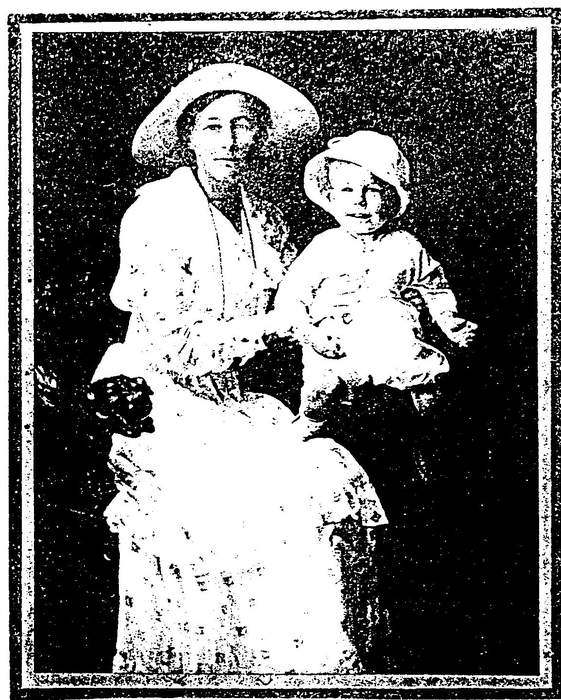 Written by Jessie Lewis who, in 1940 married Eric and came to live in Rotorua. Jessie is well known for skills in Embroidery Guild, Rot.
Mr. and Mrs. Lewin Lewis came to Rotorua from Otakiri about 1927 and took up land at Malfroy Rd., the large roomy house set on about eight to ten acres of flat ground which was subject to flooding.
This family with eight children no doubt made some impact as they were all lively individualists.
Lewin Lewis was a great follower of the races and his dutiful wife usually went with him to many meetings. This left Lorna, eldest daughter in charge and I think many tales could be told of high jinks. Lorna went nursing, training at Thames. Aubrey – Auck. with Bond and Bond.
The six others completed their schooling at Rotorua Primary and the High School which was co-ed from Form I in those days.
Rex was always interested in farms.
Eric left school early to help his mother run the Enterprise Grocery, in Tutanekai St., as this was Depression time. Eric used to rise early and milk cows for Ray Spence (who was managing Lewis’s dairy herd at that time), before work. Later Eric also took up farming, becoming very interested in droving cattle. He had a very good horse and dog, so necessary for this work. Winifred became a hairdresser, then Telephone Exchange during W.W.2. Edward (Ted) went to Auckland Training College, but sadly died while there at only 19 years of age in 1939. Selwyn was awarded a scholarship to Duntroon Military College in Australia and graduated from there, later serving in Italy W.W.2. and Korea. He continued life in the Army, finally retiring as Lieut. Colonel. Claude became a chemist, setting up in his own business at Te Ngae.
Aubrey joined the Airforce and after training in Canada, lost his life over Belgium in 1942, during W.W.2.
Eric and Claude both saw Home Service in the Army.
Lewis’s Tarawera Rd. Property
About 1930, Lewin Lewis purchased the big farm property on Tarawera Rd. from Mr. Thomas Dowling. With the help of his sons, he ran this farm from Malfroy home. When, about 1936, he suggested selling this farm, the two elder boys Aubrey and Rex with his wife Jan, moved into the cottage on the farm and took it over. Rex stayed here all his life.
In mid 1940s, Mr. and Mrs. Lewis built a new house on the highest section of their new Tarawera subdivision. They later sold a further five acres to Sir Ernest Davis, the area known now as ‘Highfields’.
This subdivision was known as LEWISHILL at first, but later with the establishment of the P.O., the farm name of LYNMORE became official. The street names here from the family echoes of their Welsh forbears.
STREET NAMES – LYNMORE:- Lynbert, Larcey, Hilton, Selwyn, Fairley, Graham, and Burn.
At this stage the Malfroy property was sold and later it was drained and subdivided.
Aug. 1992.
Unfortunately at this period none of the Lewis family live and I am a mere in-law, coming to Rotorua in 1940 after I married Eric so this is as far as I have been able to assess past history of the family. As so often we find ourselves saying, “Why didn’t I take more notice of things I was told years ago.”
Jessie Lewis,
2B Kowhai St., Rotorua.
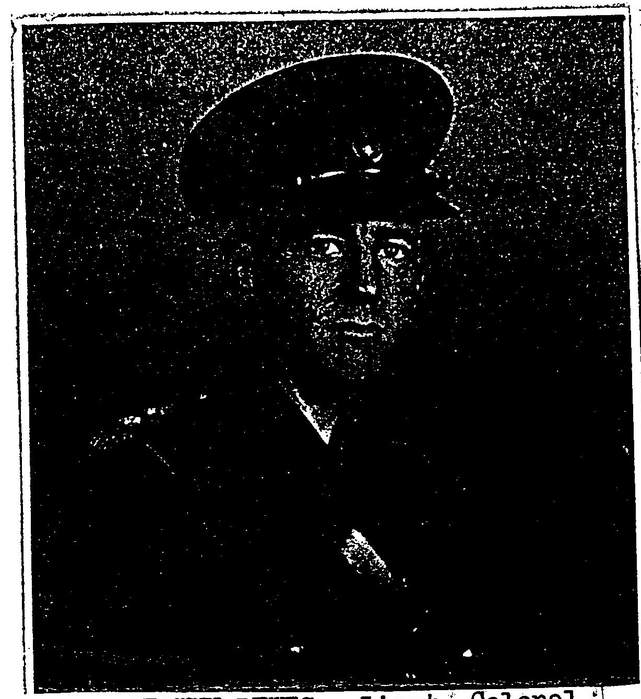
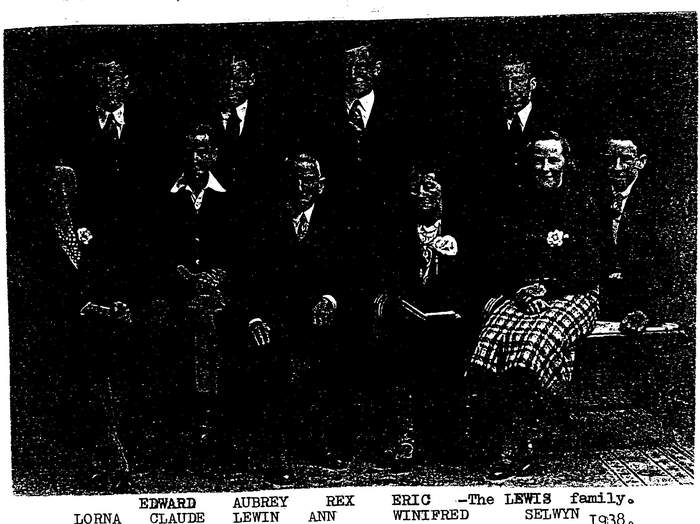
SELWYN LEWIS, Lieut. Colonel. The Lewis family, 1938 (as labelled in the photograph, left to right): Lorna, Claude, Edward, Aubrey, Lewin, Rex, Ann, Eric, Winifred, Selwyn.
Ray Spence and the Malfroy Road Dairy Farms
End 1920s, RAY SPENCE, manager of L. Lewis’s dairy herd, Malfroy Rd. Ray now 80 years, a J.P. of Rotorua is a well liked old identity.
At 17 years of age, Ray took on this arduous task, coming from a farming background, his father having a Wanganui dairy farm. Ray first did some scrub cutting in Waverly, then visited Australia. His earliest childhood memory in Wanganui was the tremendous excitement when the Armistice was signed, a Treaty to end the W.W.I, 1918.
At this time Mr. Lewin Lewis and his older sons started farming the Te Ngae ‘Lynmore’ farm while Mrs. Lewis stayed on in the Malfroy Rd. home to carry on the town grocery business, with some help from her two younger sons who were going to High School. Olwyn Edwards-now Rooke, when walking to primary school, used to marvel at Mrs. Lewis looking so smart in her car as she left her home. The children at that time called the Lewis home ‘The Merry-go-round’ with all the verandahs round it.
Ray, getting up at 2.30 a.m. to milk cows, found this a tough life, especially in cold wet weather on this low-lying land. The cows had to be milked early for the town delivery before breakfast. He made very little money out of this contract work with milk so cheap. Despite the long hours and tiring work, he was thankful to have any work during this long Depression. To help him with the milk-run, he employed a 12 year old High Sch. boy, Sid Corbett, a fine lad and friend to this day, owner of the ‘Sequoia Motel’, Malfroy-Ranolf cnr..
Later, Ray employed Sid off and on, as Sid wished, throughout the years. This was in Ray’s business venture, “HOME APPLIANCE STORE” Ray developed a fine friendly business, well patronised by the district, and still is. With the advent of the early radios, Ray biked all round the district, rough country roads and tracks, trying to sell a radio for cash so as to be able to pay for another. Slowly succeeding, he became the main radio shop. Those families who helped by paying cash – a hardship at that time, received special discount there-after as can be testified by Mrs. Graffe and the Fords.
Ray was keen on horse riding but had no horse. Thanks to the Tapsells, Te Ngae people of the horse world, he was able to borrow. Now his son Gary, who married Brenda Dalbeth, owns land and horses at Ngongotaha and has been Master of Hounds for the Hunt Club since 1974. Gary now runs the business, Ray continuing to spend time there.
 BILL TUCKER, friend of Ray Spence who milked for Bill at one time. Tucker’s farm was Te Ngae Rd, before the bridge, where the Rugby Club and Park are now. He was well liked and an enterprising chap. He sold his milk and cream from a van called the ‘Devonshire Dairy.’
NIXONS leased some of Lewis’s land, milking a small herd and selling milk even cheaper than Ray Spence making it tougher still for him. Nixon was also a butcher. Mrs. Nixon was a very sweet teacher. The property ran in from Malfroy Rd. where the Baptist Church now is.
ARMERS farm was opposite on the land where the Malfroy Rd. Intermediate Sch. now stands through to Pererika St. except that both road frontages were house sections, so the entrance to Armers farm was off Pretoria St.. Their house was set back in the paddock. They also had a dairy herd and supplied milk to the town. It was bordered by King Street Hospital between Malfroy Rd. and Pretoria St On the other side, in from Malfroy Rd. was Stan Tew’s dairy farm.
King Street Hospital and Nurse Naumann
KING ST. off MALFROY Rd., one block down from Ranolf St., linked with Pretoria St. one block away. The hospital was there in 1920.
KINGSTREET PRIVATE HOSPITAL dominated this short street on the side bordering Armers’ small dairy farm. This was functioning before 1914, under SISTER MITCHELL as Olwen Edwards born there on 2-7-1914, and ill family friend earlier. It became a Maori girls’ hostel.
The actual hospital organisation was then carried on as Kia Ora Hospital at the corner of Pukuatua and Hinemaru Sts. from shortly before W.W.2 broke out in 1939. The surgeons using the Kingstreet Hospital were Dr. Bertram and Dr. Wallis. Maternity practice was also carried out by the highly regarded Dr. Hay.
1928, PRIVATE MATERNITY HOME, strongly encouraged by Dr. Hay, in his advice to the owners Sisters Budd and Howard, opened in Fenton St. in Mr. F. Goodson’s house which he rented to them. Nurse Howard had previously worked, Nurse Naumann’s Private Nursing Maternity Home in Ranolf St.. Fred Goodson – carrier – later bought Nurse Naumann’s house with its big section. Goodson’s, Fenton St. was Opposite Lloyds.
NURSE NAUMANN, early 1920s, PLUNKET SOCIETY. Ranolf Street.
Her Home was bought from the pioneer William Wallace for £12, (pounds). This was the first of his three homes he had built for himself, was 2nd. down Ranolf St. from the Wallace Cres. nearest town, opposite the Convent. The section was big with fruit trees on it.
Early plunket work began in Rotorua Feb. 1914 but was curtailed due to the outbreak of war. In the early 1920s however, NURSE NAUMANN was appointed, using her home for this purpose. The Women’s Club in 1925 assisted by renting St. Luke’s Church hall, Wednesday afternoons and a Club Art-union raised sufficient funds for a nurse’s car.
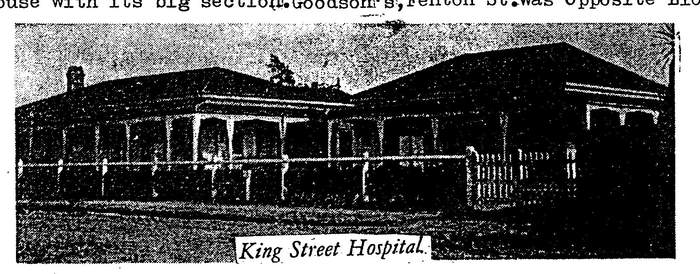
Figure King Street Hospital.
Nurse Naumann suggested a Plunket Room be added to the Council’s ladies’ rest room in Arawa St. and this opened in 1927. 1931, a Plunket Society was formed in Rotorua, a sub-branch of Whakatane.
King St. Hospital Olwyn Edwards (Rooke), Ford (Mildred), Hazel — Grey St. Both born 1914 at King St Hospital. As mid-wife, Nurse Naumann was often called out at night, all weathers.
ALISON BAILEY, nee WORRALL, went to school from the Pererika-Phillip Sts. area but later, when married moved to Ngongotaha, still living there. The Worrall Bros. had blacksmith business, Worrall & Andersons. Alison remembers Nurse Naumann coming for the birth of her third child. There had been a three month drought in Rotorua. Cattle were even dying along the roads. That night the drought broke and the heavens seemed to open. Rain teemed down and the storm raged. Alison’s baby was on its way, there were no phones to call Nurse Naumann. Alison and her husband were living at Ngongotaha towards the lake. He had to run three blocks up to the sub-power station where he was the man in charge of electricity and there he contacted Nurse to come and to hurry, hurry, hurry. Then, back home and despairing of her arrival, he raced back up the road, to find her little two-seater car in the ditch. He rushed her along to the house – too late for the delivery! Never-the-less, her services were greatly appreciated.