Prior to the erection of Geyser Hall shortly after World War 2, the old Druids Hall next to the Palace Hotel in Arawa St. was used. Stan Smith, after returning from war in 1945 would meet his mates there and recalls his disgust at the dilapidated old building with rats over-running everything they left about. One night he was talking to his mate Len Holderway about doing something about it and began discussing possibilities. Stan asked Len, a builder, if he knew anything about getting a long lease on a section, resulting in Len getting a small section on Malfroy Rd. near Miller St. in which the Borough Council transit camp was and where Len had permits to build real houses in that area during 1945-1946.
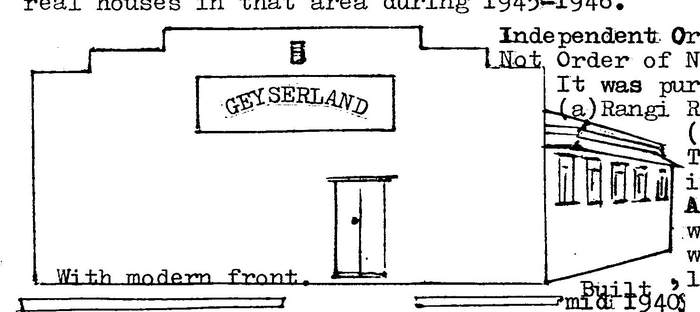 I.O.O.F. — Independent Order of Odd Fellows. Not Order of N.Z. Odd Fellows. It was purely local effort of: (a) Rangi Rebeka Lodge, with (b) Geyser Lodge. The Ladies’ Lodge came in on the fund raising. A loan-raising group was formed. All work was voluntary, working long hours at night.
Geyser Hall gave good service to the community, hiring out to Bowling club, public functions or private and a hire service for crockery etc. The early dances aroused bad feeling in the vicinity, particularly with one influential person. Petitions were sent to the Council regarding the noise of the bands. Age caught up with the originators of the Hall, and as the building needed renovating, it was sold towards the end of the 1980s.
Stan Smith, now in Holland St. since marrying, 1946, after the war. He recalls only three houses in that street then. Rex Norman’s home backed onto his. Sometimes when looking over at the spare section next door, Stan would see a hare hopping about, having crossed Ranolf St. from Wallace’s partly scrub farmland. He recalls with gusto a time when he did more than just hop about but swears he must have broken the 4 minute mile during the Middle East desert campaigns as he and his mates were being chased by about 20 German tanks and he still seems amazed that there was one other soldier who beat him!
Len Holderway, returned from W.W.2 and was one of the earliest to live in Arthur St. He was always a keen hunter in the district with the wild pigs and cattle in the bush areas but deer stalking was his favourite pursuit. On one of these South Island expeditions in wild mountain country, tragedy struck when he fell down into a ravine. His hunting mate wrapped him in the skin from a deer they had shot and left him there while he tramped out for help. When the helicopter arrived, Len was dead, having broken his back.
However this did not happen until Len had spent many years as a master builder round Rotorua and was very well liked.
Len Holderway, was the leading builder for the Geyser Lodge Hall, which was all voluntary work mainly by these returned servicemen. They all worked hard and long hours many nights, displeasing wives. About the 1950s, Len built the block of shops by Glenholme School. In the big building boom after the war, mainly to meet demands for the families of returned soldiers, State Housing was established as in the areas such as Wallace Cres. and Clinkard Ave. backing the Glenholme Sc. area between Ranolf St. and Old Taupo Rd., so many builders were involved in that as well as private building. During the 1950s and 1960s, Len Holderway was kept very busy, as were those whose work was associated with the building trade such as—
1945 Returned Servicemen sought ways and means for a livelihood. Entrepreneurs sprang up to serve the increased supply and demand. Near Geyser Hall, Malfroy Rd. at Millar St cnr., two factories appeared, small industries which were removed when this declared housing area.
Pritchards set up their ‘Joinery Factory’ until about 1950.
Parsons from Ngakura area, set up depot for supplies to ‘Plasterers’. They owned land where they had a Fullers Earth quarry. W.J. Parsons, about 1913, took up about 22,000 acres of Govt. Land at Atiamuri by Ngakura, later called Guthrie after the Minister of Lands. Parsons proved it suitable for land settlement, later giving up a big area of this Govt. lease land for the Govt.’s Farm Development Scheme, land which the Govt. bought from the Maoris. Settlers’s sections, 1927, were won by ballot. Stan Parsons won a ballot (son of W.J.).
Bob Muir, a plasterer, bought from Parsons depot and knew many trades people and others through being in the N.Z. Odd Fellows Lodge. When he married 1948, and having his house built near the Boys’ High Sch., he was amazed to see the bricks for his chimney arriving through the ‘Lightning Delivery Service’ in the ‘Side-car of their Motor-cycle’!
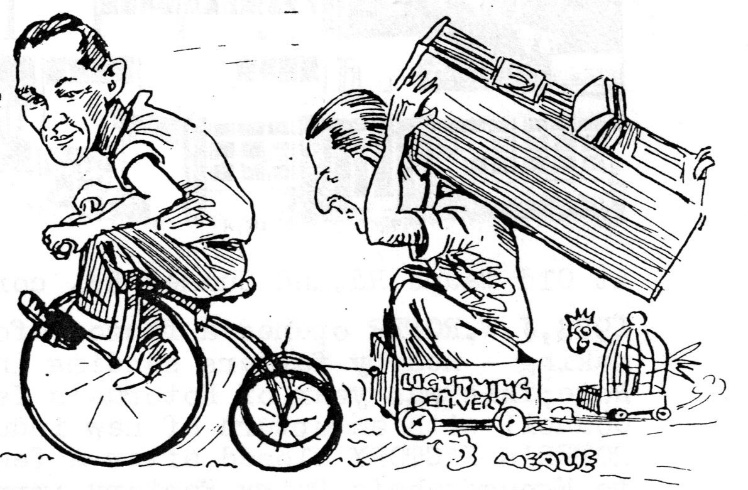 Bert Wilcox and Digger Morris, General Carriers. Later became Wilcox Transport.
MIDDLE YEAST
They’ve carried Ammo and Bombs by the Medd’s dusty shore,
Mountains of Bully and Kiwis galore.
And now these two veterans are home from the fray,
The goods are still carried whatever the day.
Be it Pianos or Parcels from Station or Store,
It’s bound to arrive by three-wheeler or four.
LIGHTNING DELIVERY SERVICE
Bob Muir’s plastering work took him not only to housing sections of Lewis’s Malfroy Rd. farmlands but also to their subdivisions at Te Ngae, now known as Lynmore where he remembers aluminium roofing was becoming popular. The glare from this was so severe when he was plastering chimneys that his neck and face became badly sunburnt.
Jessie Muir née Waldrom, Bob’s wife, in 1937 came to Rotorua from Te Puke with her parents. The farm between Lakes Rotoiti and Rotorua which they bought from Luscombs was at Mourea, including Okawa Bay and where the pine plantation now stands. Jessie was working in a Rotorua office before marrying Bob, who also came from a farming background in the Ngongotaha area.
Bob Muir, born 1919, Rotorua, at Kingstreet Private Hospital. He was brought up in Mamaku and Otoroa districts where his father worked for 20 years, 10 years in Steele’s Mamaku Timber Mill, and then farming a rough block of land up Otoroa Rd. The Govt. allocated to each block of this bushsick land, 30 acres of lake-shore land for ‘Changing Paddocks’ which were free from cobalt deficiency. Here stock spent 3 months yearly to avoid sickness which was severe in the Otoroa, Kaharoa and Te Pu areas.
1930, Depression days caused Muirs to walk off their Otoroa farm but were unable to keep their 30 acre flat lake shore ‘Grazing Paddock’ until Messrs. Catley & Florey went to Wellington to persuade Parliament to separate the titles, 1930-1932, thus allowing Muirs and others to own this better, but small area of land. Muirs had to start all over again here, leaving home and everything up Otoroa.
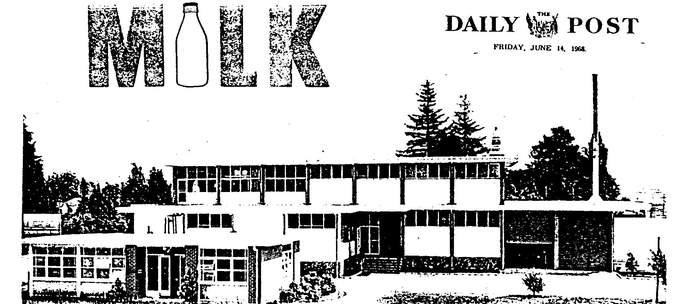 1951, Bob, after his plastering trade, took on permanent work until retirement as foreman at the new Rotorua Milk Treatment Station run jointly by the Rot. Borough Council and the Milk Board. It was in 1968, this became Rot. Milk Treatment Co. Ltd. when the producers of farm milk, under F.S. Hutching as Chairman of Directors, took control.
At Old Taupo Rd. and Sunset Rd. corner.
1923, J.W. Roper opened a factory for butter making — nearby farmers sending in cream. Note: This was year of Rotorua’s 1st. Borough Council with an upturn of new industries. Roper’s Factory closed after a few years due to Ngongotaha’s Dairy Factory improvements.
Mr. Ewert’s Ice-Cream Factory took it over.
1937 Mr. Waters leased it from Mr. Ewert for a Milk Factory to supply pasteurised milk to schools (daily ½ pint per pupil) for Health Dept. which also supplied school apples, because of family poverty in the depression.
1950, Mr. Waters sold — jointly to Rot. Borough Council and the Milk Board. New factory built.
1968, Producers formed Rot. Milk Treatment Comp. Ltd. This closed down about the mid-1980s. This is when foreman Bob Muir retired.
Les O’Connor, King George V Military Hospital and Golf
Les O’Connor, born Rotorua 1919, lived in Fenton St. close to Whaka, 1924-1934 attending Whakarewarewa Sch. He lost his father as a lad. John O’Connor, Les’s father, 1919-1928 when he died, had served in the Red Cross at the King George 5th Military Hospital after W.W.I., with other Rotorua men including Messrs. Curry, Henderson, Keyworth.
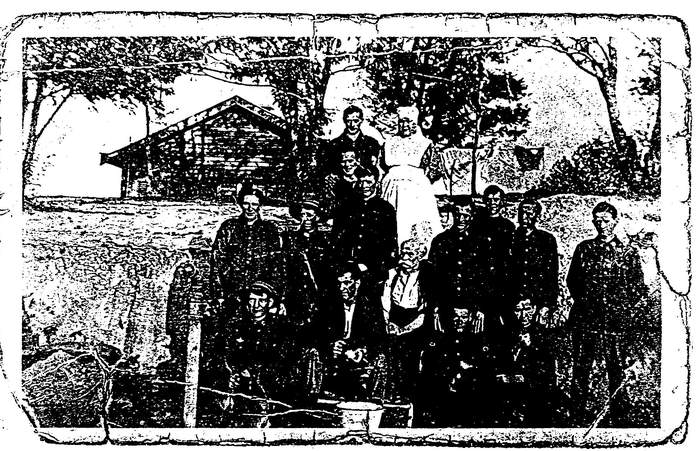 Early 1920s. King George V Military Hospital, Pukeroa Hill Rot., established 1916 for soldiers from the battlefields. Serving in the Red Cross after W.W.I was John O’Connor, 1st. Left Frnt. in photo.
Les O’Connor, in W.W.2 served in the Middle East with N.Z. 5th. reenforcements – 8th. Desert, leaving N.Z. 1941. He was in that first mighty barrage at El Alamein, the battle that proved to be the turning point of allied victory in W.W.2, Oct. 1942. Les was wounded and sent to a Military Hospital with a broken leg, returning N.Z. in 7 mths.
This broken leg fortunately did not deter Les later from his passion — GOLF! From a very young age he had caddied at the Arikikapakapa Course close to his home, as did other young mates of his, all of them later becoming fine golfers. This work proved a boon financially as the Depression was hitting families hard at that time. Caddies could make as much if not more than men on Relief Work which was only for three days per week forming Rotorua’s first aerodrome, Fenton Street. 1934, Les left school to become a full-time caddy until finding work. Caddies of that time remembered now by Les, many still golfing, were — George Harker, Alf Relph, Roy Limozen, Bill McHale, Dudley Smith, Ray Smith, Frank Inskeep, C. Kingsland, Ivan Deadman, Dave Gardner, Brian & Jack Quinlan. In 1980, Les O’Connor records:– Bill and Ted Hill – Club Champions, Ivan Deadman – North Is. Champ. Alf Relph played Freyberg from 1953 to approx. 1975, won N.Z. Vets & had a gross 62 at the age of 67, in 1985, also winning 1985 Sen Champs beating Les O’Connor after 31 holes with 2 over card (V.G. for age 67). In W.W.2, Alf Relph served in R.N.Z.A.F. as a Pathfinder Pilot flying Mosquitos – dropped flares to identify target for following Bombers. After war Alf returned farming back of Tihi Otonga, then Paradise Valley
Les O’Connor’s Farming Career
Les O’Connor made farming a career, both before and after the W.W.2. While at school he knew the two Gunson children whose father farmed the V of land, later to be sub-divided as St. Andrews Estate. When Les left school, he went share-milking for Smallbones opposite this, across Otonga Rd., but first he did scrub cutting on Hardcastle’s run-off land near cnr. of Pukehangi–Clayton Rds. on the town side. He also share-milked after the war for several years for the Lands & Survey Dept. About 1950, through this Dept. considering lands for the Soldiers Rehabilitation Scheme, he procured his own dairy farm. This was at ‘Broadlands’, Earle Vaile’s Estate which the Dept. had doubts about but told Les to give it a go, giving him the best original dairy flats which was heavy clay, not the poor pumice surrounding land. For 27 years he farmed successfully on this land south of Reporoa. 1976, he returned to Rotorua, in Fenton St. opposite St. Chads and near his Golf Course again! He has since moved to cnr. Lytton–Sumner Sts.
 1930s give special country-life recollections of Rotorua to Les. He recalls the drama of ‘Sale Days’ while share-milking for Smallbones. Once horse and rider had rounded up the stock for the sale yards at Ngongotaha and were started along the dirt roads, woe-betide any housewife who had failed to shut the road gate. Sale day was always a Thursday. Many a garden was trampled, crops eaten, children excited or upset by the commotion of drovers shouting, cracking whips, dogs barking, animals calling in a cloud of dust, often hot and distressed leaving a trail of saliver. At other times they moved along quietly at their own pace with steady tread of hooves on soft earth, munching wayside vegetation with the drover calmly alert for break aways.
Tramps moved about the country looking for a job, in exchange for food and a shelter. Some had shacks on a small patch of land perhaps allowed by a farmer, and they did odd jobs round the district. Les remembers the well known, somewhat strange, cantankerous Dan – Tihi St. side of Springfield Rd. Opposite Dan, on the sharp rise amongst the trees overlooking Springfield flats, Andrew had a shack and so that rise along Otonga Rd. became known as Andrews Hill. Les wonders if this had anything to do with naming nearby estate ‘St. Andrews Hill’.
Charles Gee (‘Pop Gee’) and the Rotorua Golf Club
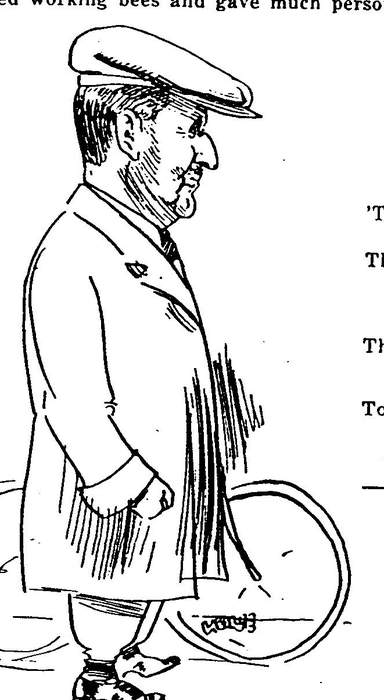
Charles Gee, by 1930s was an old identity of Rotorua living off Devon St. in Kowhai St. where he owned the several sections on the east side. He was an elderly gentleman known as ‘Pop Gee’, usually dressed for his golf in plus-fours, and retired from his Te Ngae farm, Gee Rd. His two sons, Josh and Stewart developed business orchards there till recently.
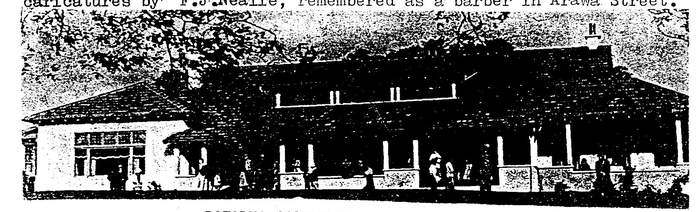 Note: The following is copy from booklet, a print of — ‘Rotorua Post Personalities’, written in 1948 by the ‘Post’ writers, Lawson Smith and Chas. Worthington from Sophia St. area, and the caricatures by F.J. Nealie, remembered as a barber in Arawa Street.
ROTORUA GOLF CLUB
The history of the Rotorua Golf Club since 1911 can be summed up as the history of progress of the Borough. From small beginnings with a membership of 27 and revenue of £74, it has in 1948 a roll of 500 players, and a yearly revenue of £4000. The struggles of early years and assistance given in financial support and material aid forms a valuable commentary on what can be achieved by co-operation in effort. After struggles on uncertain tenure the granting of the Arikikapakapa reserve lease at a peppercorn rental by the Government gave the initial impulse. The late Sir Joseph Ward, after a personal inspection of the site granted a loan of £150; a loan by Sir Ernest Davis of £150; the issue of debentures and bank overdraft guaranteed by members of the club put business on a sound foundation. Since that time the club has advanced in every aspect of golf. Wise management and the utilisation of the greatly increasing green fees in the improvement of the course brought about astonishing results. The first designing of the course was improved by the golf architect, Mr. G. H. Redhead, and to-day the links are second to none in the Dominion.
But before that was done there was a vast amount of work. The area was in scrub-fern and lycopodium. Sour ground was hard to combat and consolidation was costly and difficult. During that period—the lean period—the club received the most generous help not only by residents but visitors, notably by the late Mr. John Bidwell, of the Wairarapa, who yearly organised working bees and gave much personal help.
CHARLES GEE (“Gramp”)
Charles Gee, successful farmer, golfer and former Rotorua Golf Club secretary, goes down to posterity. Diplomatist and organiser, his name is a synonym for efficiency. His genial personality endeared him to thousands of golfers, local and visitors, the world over bear witness to his courtesy and tact, his unfailing helpfulness and imperturbable good humour. “How’s Gramp?” is the first question asked of a golfer of Rotorua in Auckland—a tribute to a Master of Social Arts.
|
THE LONGEST DRIVE ‘Twas a score or so of years ago They come each year, it would appear, |
Figure .: Charles Gee, nicknamed ‘Pop’ or ‘Gramp’ |
|---|