
Bill Neil fought in the Sth. African Boer War round 1900, leaving his Opotiki home to do so. Bill could remember as a child being on a horse when he heard the distant explosions of Mount Tarawera eruption in 1886. From 1907–1924 he was in Rot. Police Force and is remembered for his participation in the capture of ‘Rua’ the ‘Prophet’ whom he wrestled with.
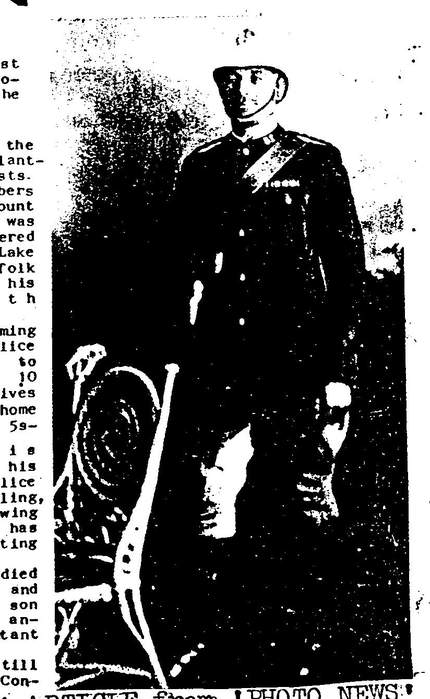
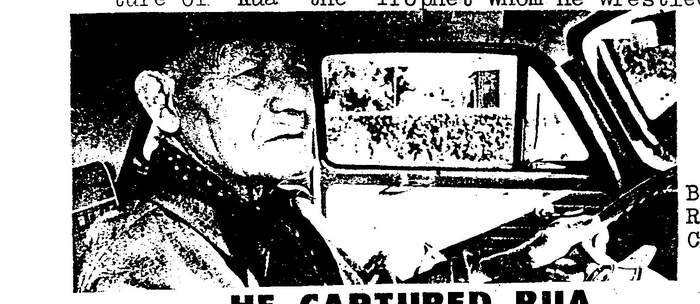
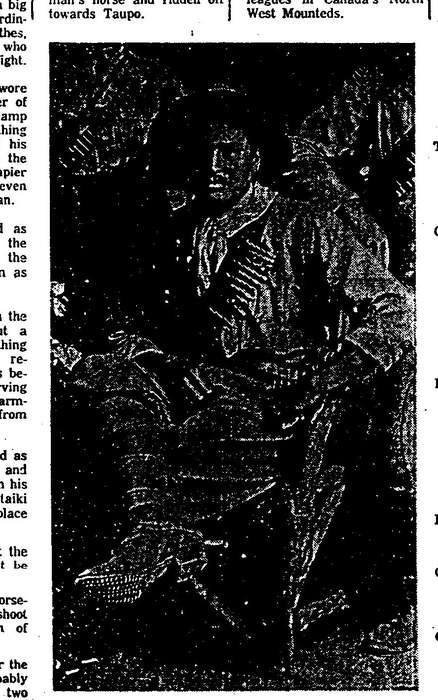
Figure Bill Neil, b. early 1880s. Retired in Rotorua, cnr. Ranolf–Pukuatua Sts.
He Captured Rua
All the townsfolk knew one another and the streets were almost devoid of life… that’s how 67-year-old Bill Neil remembers Rotorua when he was a constable — one of three policemen — in the thermal-land township just after the turn of the century.
Bill has many memories of early Rotorua, and he even remembers the Tarawera eruption. He was about seven years old at the time and living in his home town Opotiki. He recalls it was dark for quite a while, birds were blinded and they flew into trees knocking themselves to the ground, and the fields were covered in volcanic dust.
Bill well remembers the time a large police posse was sent into the Ureweras to capture the famous Maori prophet Rua..
‘I was the only one without a rifle when we marched on Maungapohatu. I went ahead with an axe and cleared a path through the bush. ‘When we reached the stronghold there was a gun battle. Two policemen were shot and two of Rua’s offsiders. ‘I saw Rua and threw away my axe. We fought in a ditch while bullets were flying over us. I had him in a stranglehold when he said “You can kill me now.”‘
Photographs of the march on Maungapohatu lent to ‘Photo News’ by Bill Neil, can be seen on the following two pages. There were some tough characters in Rotorua in the old days, recalls Bill. He remembers arresting many escapers from the prison camps south of the town where the prisoners were planting today’s forests.
He also remembers a ‘gay blade’ Count Montague who was tarred and feathered and thrown into Lake Rotorua by townsfolk irate at his activities with young girls.
Bill went farming after his police work and retired to Auckland for 10 years. He now lives in Rotorua in a home on a 95-year, £8 5s-a-year lease. Among his treasures are his good conduct police medal, and wrestling, rowing and rugby medals. He also has a medal for fighting in the Boer War.
Bill’s wife died three years ago and he has a lawyer son in Auckland and another an accountant in Fiji.
|
Extracts from article by Ross Annabell. This is the second article on Bill Neil, New Zealand mounted police constable who was stationed at Rotorua from 1907 to 1924. It deals with his encounters with Rua Kenana, prophet and former leader of the Tuhoe people of Maungapohatu. CONSTABLE Bill Neil in the uniform of the mounted policeman—helmet, tunic, bandolier, riding breeches and leggings. He executed the most brilliant bit of work of his entire career the day they took away his horse and made him a temporary foot-slogging policeman. It was April 2, 1916, the day of the battle of Maungapohatu, the last fight between Pakeha and Maori. Bill Neil was among the 70 odd policemen ordered to march into the wilds of Maungapohatu and arrest Rua Kenana in his stronghold. Bill got permission to carry an axe instead of a rifle, and went ahead of the small “army” clearing the track from Ruatahuna to Maungapohatu. Bill Neil knew Rua personally. Being of part-Maori descent, he spoke Maori, and understood the Maori outlook. He first met Rua during a police raid on one of the prophet’s sly grog stores long before the fight at Maungapohatu. Rua was at that time in his prime, with a huge following of adherents in the Urewera country, where hundreds of people looked upon him as the successor of Te Kooti, religious leader and rebel. There were some among the Pakehas who viewed with deep concern Rua’s climb to power over his big following of Tuhoe and other tribes, but he held sway unmolested by authority until he began selling liquor to his supporters without a licence.Rua’s grounds for setting up as a supplier were based on his claim that there should be “one law for both people.” The authorities took a somewhat dim view of his arguments. |
|---|
|
Bill Neil of the Mounted Police — the Arrest of Rua Kenana at Maungapohatu, 1916 (Daily Post, 5 September 1962)
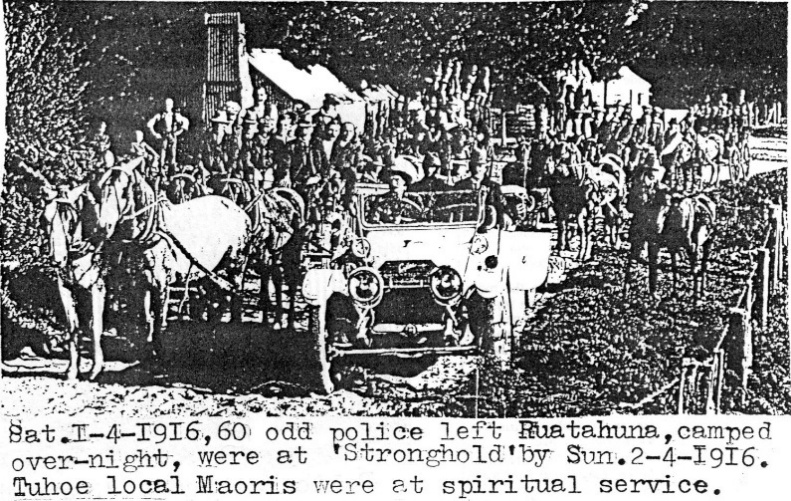
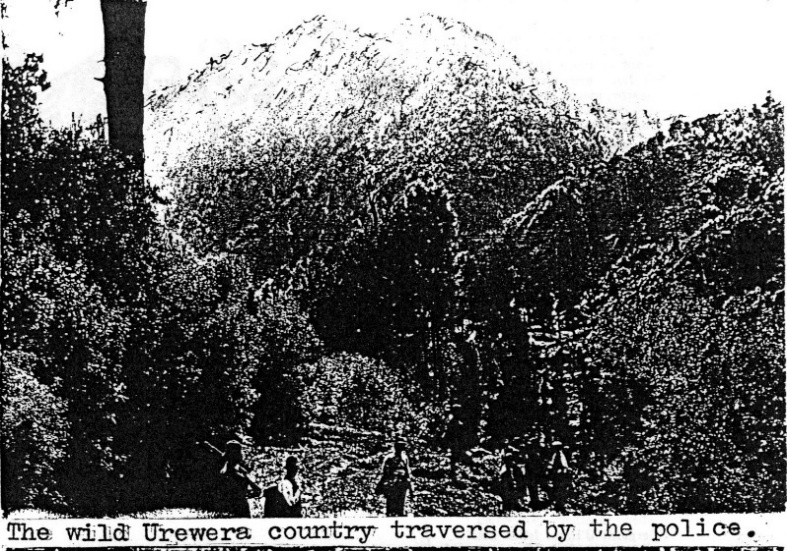
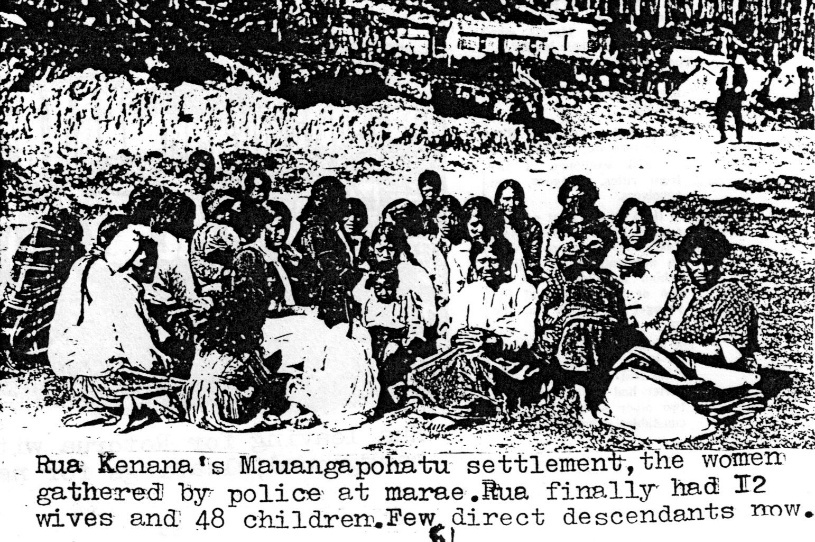
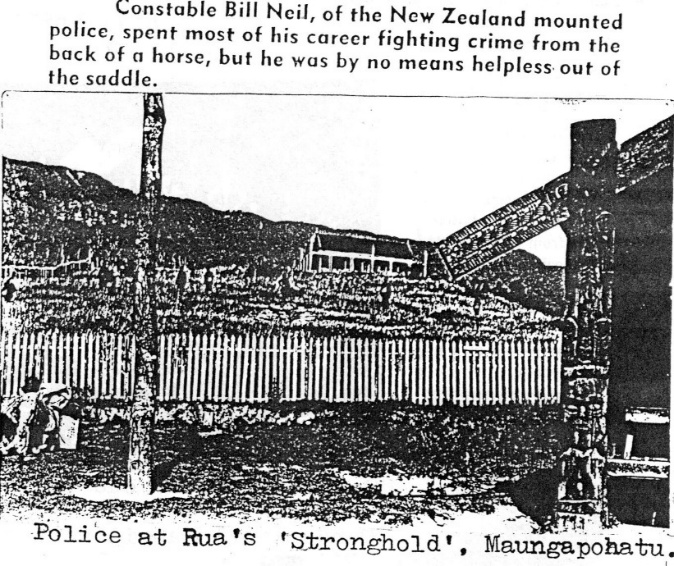
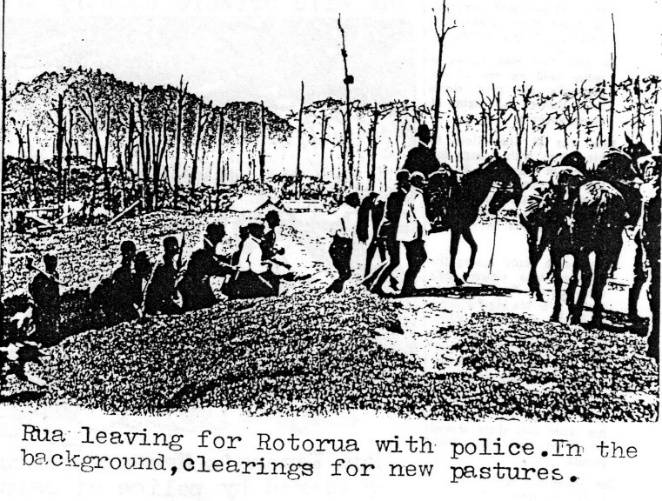
Bill Neil’s photographs — Gordon & Joyce Lloyd’s collection. Top: “Sat. 1-4-1916, 60 odd police left Ruatahuna, camped over-night, were at ‘Stronghold’ by Sun. 2-4-1916. Tuhoe local Maoris were at spiritual service.” Middle: “The wild Urewera country traversed by the police.” Bottom: “Rua Kenana’s Maungapohatu settlement, the women gathered by police at marae. Rua finally had 12 wives and 48 children. Few direct descendants now.” |
|---|
|
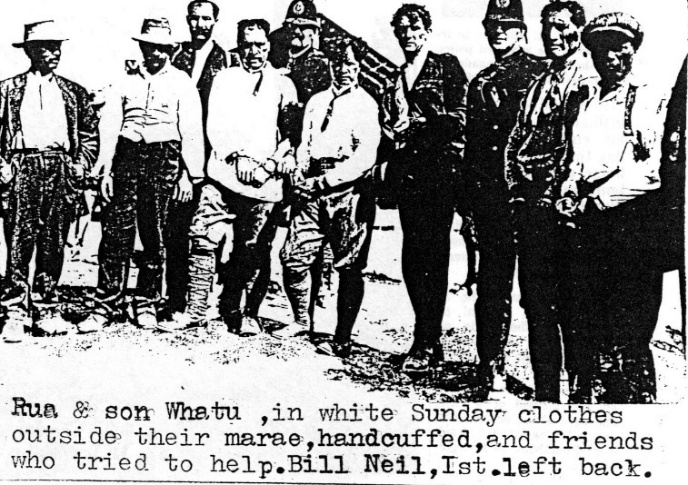
Under the command of Police Commissioner Cullen, two parties of police set out from Gisborne and Rotorua to “invade” Rua’s stronghold. The Gisborne party, and a small advance guard from Ruatahuna arrived at Maungapohatu first, on the morning of April 2, 1916—a Sunday. They found Rua’s followers about to begin divine service. Rua himself met the police, shook hands in friendly fashion, and offered them breakfast. The 60 odd police in the main body left Ruatahuna on Saturday, April 1, camped Saturday night, and reached Maungapohatu about lunchtime on Sunday. Throughout the march Constable Neil kept ahead of the main body, cutting a track with his axe. When the main force reached the pa, they found Rua waiting outside the marae, with one of his sons on each side of him. Rua stood quietly while Sub-Inspector Johnston went forward to arrest him. Bill Neil, who was standing nearby, moved up behind the sub-inspector in case Rua made a break. Sure enough, as the sub-inspector laid his hand on Rua’s shoulder, the prophet lunged and dived over an embankment. The sub-inspector grabbed Rua’s sleeve, but it came away in his hand. Bill Neil dropped his axe and was away like a flash in pursuit. After about a 50 yard dash he dived, landed on Rua’s back, and brought him crashing to earth. There was a short, sharp struggle, which ended with Constable Neil getting the prophet in a stranglehold. . |
Constable Bill Neil, of the New Zealand mounted police, spent most of his career fighting crime from the back of a horse, but he was by no means helpless out of the saddle.
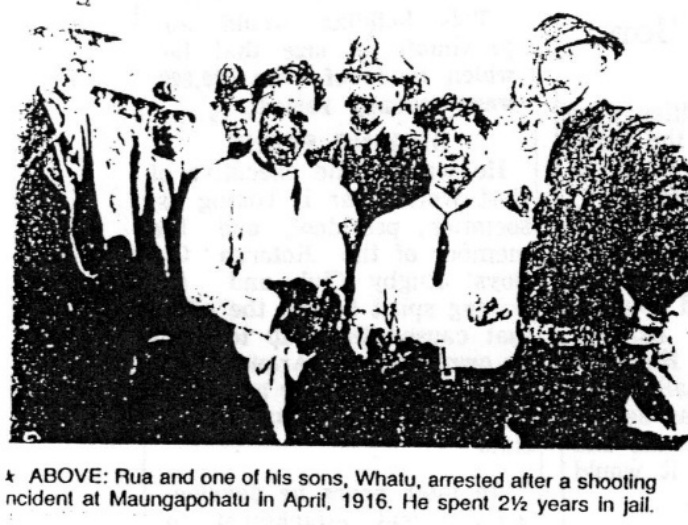
Police at Rua’s ‘Stronghold’, Maungapohatu. Rua & son Whatu, in white Sunday clothes outside their marae, handcuffed, and friends who tried to help. Bill Neil, 1st. left back. Rua leaving for Rotorua with police. In the background, clearings for new pastures. |
|---|
|
While they struggled Rua’s son, Whatu, picked up Bill’s discarded axe, rushed up and raised it over the constable’s head. He was about to bring it down when another policeman, Sergeant O’Hara, felled him with a clenched fist. In a few moments police had handcuffed Rua, Whatu, and several other Maoris who tried to help their leader. The shooting began at the same time as Rua was being frog-marched away in custody. |
Before long police and Rua supporters were engaged in a brisk exchange of fire from rifles, shotguns, and revolvers. The thick of the fight centred around Rua’s younger son, Toko, who blazed away with an automatic shotgun from behind a fence, aided by two or three other of the younger hot-heads in the pa. The shooting lasted about half an hour, ceasing only after Toko and another Rua supporter had been shot dead, two other Maoris and four constables wounded. |
|---|
Armed Publican in Doubt
Daily Post, first article, by Ross Annabell
This is the first of two articles on Bill Neil, New Zealand mounted police constable who was stationed at Rotorua from 1907 to 1924. Perhaps the most dramatic experience of an exciting career was his pursuit of a Waiotapu forestry prison camp escaper during the planting of Kaingaroa Forest . . .
Neil of the Mounted forced to bluff.
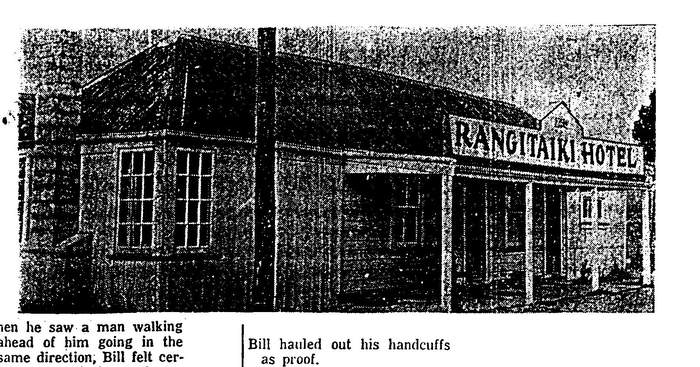
Three men, two of them armed, sat down to lunch one day in 1912 at the historic Rangitaiki Hotel, on the lonely Napier-Taupo Road. Each man eyed the other two in fear and suspicion, each was as tense as a trigger finger.
Mine host, the publican, had a loaded .303 placed handy as he surveyed his guests—two big and strong looking men who had both come from Taupo that morning.
They had walked in to the hotel yard just before lunch, one leading a horse, the other without one.
The man with the horse, a big six foot part-Maori in ordinary workingman’s clothes, looked like a fellow who could use himself in a fight.
The one without a horse wore the uniform of a warder of His Majesty’s prison camp at Waiotapu, but his clothing was travel-stained, and his boots were white with the pumice dust of the Napier coach road. He was even bigger than the horseman.
The publican had waited as the men came along the road together. He had the .303 rifle under his arm as he greeted them.
 As soon as he set eyes on the warder walking without a horse he knew something strange was up. He’d received word a few days before that a prisoner serving a 10-year sentence for armed robbery had escaped from Waiotapu prison.
The prisoner was regarded as potentially dangerous, and the publican had been on his guard ever since. Rangitaiki was a much lonelier place then than it is now.
The publican decided that the man on the horse must be the escaped prisoner.
He decided to watch the horseman like a hawk, and shoot him at the first sign of trouble.
It was an uneasy meal for the publican but it was probably even worse for his two guests.
The big, tough-looking fellow in the travel-stained prison-warder’s uniform was as tense as any of the three.
He was the escaped prisoner. He’d slipped out of camp, burgled the home of a former warder who lived nearby, and stolen the man’s uniform and revolver. Dressed as a warder he’d walked boldly into a roadman’s camp, posed as a warder searching for an escaped prisoner, borrowed the roadman’s horse and ridden off towards Taupo.
He’d slept two nights in freedom, and although still on the run, he had a good chance of getting away. In his pocket was his trump card—the warder’s revolver, fully loaded and cocked.
The third member of the trio, the man the publican contemplated shooting at the first suspicious move, was Rotorua’s Bill Neil, mounted police constable with as formidable a reputation for tracking down and getting his man as any of his colleagues in Canada’s North West Mounted.
For Bill Neil, that Rangitaiki luncheon was one of the least enjoyable of his lifetime.
He was almost certain that the man in the prison warder’s clothes was a prison escaper, but because of the man’s reputation and size he didn’t quite know how to go about tackling him. He didn’t know that the prisoner was armed with a revolver. Constable Neil had no firearm himself.
Bill had been on the trail of the prisoner the moment Rotorua police were notified of the escape. He’d saddled up and hit the road to Waiotapu to look for clues. Finding nothing suspicious around Waiotapu, he rode on down to the Waikato bridge at Mihi, where a roadman told him he’d seen no sign of the prisoner.
The roadman mentioned that he’d lent his horse, a white one, to a warder who’d come by on foot looking for an escaped prisoner.
Constable Neil stayed at the roadman’s hut that night. Before he went to bed he swept the road with a broom at both ends of the bridge. Next morning there was no sign of fresh tracks, but Constable Neil decided to saddle up again and head on towards Taupo.
He soon came on the tracks of a solitary horseman, whom he decided would be the warder on the roadman’s horse. Further on he found signs that a white horse had rolled on the road, riderless and without a saddle.
He began to think a bit more about the roadman’s story of the warder.
Could it be that the warder who’d borrowed the horse was in fact the prisoner in disguise?
Constable Neil headed on towards Taupo. He camped the night there, saw nothing suspicious, and headed on the next day towards Rangitaiki Hotel.
When he saw a man walking ahead of him going in the same direction, Bill felt certain he was closing on the escaper. No man in his right sense in those days would walk the lonely stretch from Taupo to Rangitaiki.
Constable Neil overtook his quarry, and found the man was dressed in warder’s uniform, as he had suspected. He accused the man of being an escaper, but the fellow laughed it off.
“I’m a warder from Waiotapu,” he said. “I’m going up the road to meet some horses.”
Constable Neil decided to bide his time. The “warder” was bigger and stronger than Neil, and he didn’t want any trouble in such a lonely spot as the Rangitaiki road.
He dismounted and walked beside the fellow, leading his horse the rest of the way to Rangitaiki.
When the publican met them in front of the hotel with a .303 under his arm Bill guessed that the news of the prison escape had spread.
He quizzed the publican as to the reason for the .303 and was told: “I was looking for a hare.”
Over lunch Constable Neil became aware that the publican was watching him uneasily. He realised that the publican thought he was the escaper, and that if it came to a showdown the bogus warder was more likely to get the publican’s aid than he was.
The more he sized his man up over lunch, the more positive Bill became that tackling his man alone was going to be a sticky job.
The “warder” didn’t have very much to say. He kept quiet, watching Constable Neil and the publican as he ate.
It was obviously going to be a battle of wits, Constable Neil decided. In an effort to get the publican on his side, he announced for the first time that he was a constable. The publican looked sceptical.
 Bill hauled out his handcuffs as proof.
“Try these on” he said. “See if they fit you.”
The publican showed keen interest in the bracelets. He examined them closely, then put them over his wrists.
Taking them off, he glanced at the “warder.” “I wonder if they fit our friend here?” he said.
Constable Neil could have shouted aloud when the “warder” held out his wrists as meekly as a lamb.
As quick as a flash the cuffs snapped shut, and Bill had his man.
The “warder” admitted his identity, and submitted quietly while Bill searched him—and found the loaded revolver in his pocket.
The publican was still a bit dubious, even then. When Bill asked him to telephone Taupo police the publican did some extra checking.
“I’ve got a Maori bloke here claiming he’s a policeman, and holding a prison warder under arrest,” he told the Taupo policeman. “I’m not too sure which is which.”
He breathed a big sigh of relief when the Taupo policeman assured him that the big part-Maori bloke with a moustache was in fact Mounted Constable Bill Neil.
“By jove, you were lucky,” he told Bill afterwards. “I was dead sure you were the prisoner. I was ready to shoot you at the first move you made.”
Bill waited for Taupo police to come to Rangitaiki and take charge of the prisoner, and then set out on the long ride home to Rotorua, another job well done.
Bill Neil still lives in retirement in Rotorua, a hale and hearty 83—he thinks. He doesn’t know his exact age for certain, but he was old enough to be riding a horse at the time of the Tarawera eruption, back in 1886.
Bill is one of the first policemen of Maori descent to go through the full police training school at Wellington. Born at Maraenui, on the coast near Opotiki, he was educated at Omaio School, and Te Aute College, before he went to the Boer War in 1901 as a scout with the “Silent Sixth,” the 6th New Zealand Mounted Rifles.
He was selected towards the end of the Boer War to represent New Zealand in the Coronation Contingent sent to London.
In 1906 he joined the police, went through a course at Mount Cook training school, Wellington, and was posted to special duties at the Christchurch Exhibition that year.
From 1907 to 1924, when he retired from the force with a long service and good conduct medal to go farming at Maraenui, his birthplace, Bill Neil was stationed in Rotorua as a “mounted.”
 His ability to ride, sometimes fast and hard, but more often slow and far, was to stand him in good stead in the 17 years he helped to combat crime in the big Rotorua Police District, which stretched as far afield as the wild Urewera country, to Taupo and Putaruru, Whakatane and Te Puke.
Bill was probably the first policeman ever to ride through the Urewera country from Rotorua to Wairoa. He went through with a Maori prisoner who alone knew the trail, delivered the prisoner to Wairoa and came back alone.
Rua Kenana and the Maungapohatu Flag
 (Daily Post “Post Flashback”, 1970s, by Chris Birt)
Rua’s lost cause! Memories of a Maori Messiah have been revived by the recent discovery of his “seditious” flag.
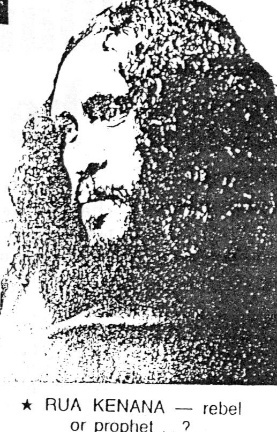
To the Maori tribes of the Urewera country he was the new Messiah, sent to lead them to the Promised Land.
But to the New Zealand Government Rua Kenana was a rebel. He wanted one law for both Maori and European, but he also wanted to rule his own community. His movement had to be crushed.
Using the excuse that he was illegally selling alcohol to his Maori followers, the authorities took action on April 2, 1916, at Maungapohatu in New Zealand’s central North Island region — one of the last areas of wild country opened up to civilisation.
There, in the presence of a large number of local Maori people from the Tuhoe tribe, occurred one of New Zealand’s most dramatic and most highly questionable incidents of that era.
The day began peacefully enough. Rua, the self-proclaimed Maori prophet always striving for peace, had laid on a big feast to welcome the party of 70 armed police coming to arrest him for sly-grogging.
 But during the proceedings a shot rang out. Both sides denied they fired it, but it led to open conflict.
By nightfall the battle of Rua’s “stronghold” was over. The Maori prophet was in handcuffs and under armed guard his eldest son and one of his followers were dead and four policemen lay injured.
Three days later Rua Kenana, together with five of his “disciples”, were taken to Auckland to face trial for numerous crimes against society.
The trial lasted 47 days — a record not broken until 1977. On all but one charge, that of offering moral resistance to the police during an earlier incident, Rua was acquitted.
 For his single crime the man, who years earlier had declared himself the brother of Jesus Christ and son of the famous Maori prophet Te Kooti, was sentenced to one year’s hard labor followed by 18 months’ imprisonment for “reformative purposes”.
Today, memories of that heavy-handed police excursion into the Urewera have again been revived with the news that Rua’s personal flag has been found and will ultimately go back to his homelands.
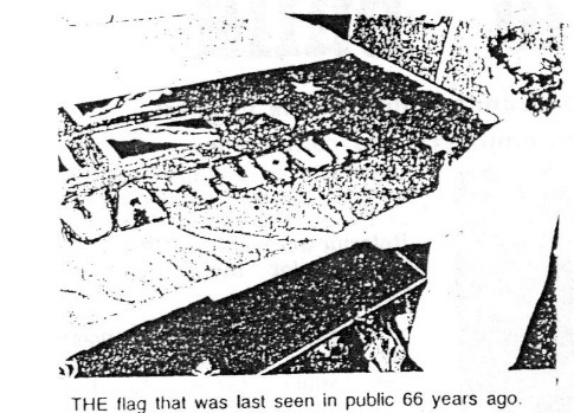
Bearing the name Rua Tupua (Rua — spiritual leader), the “outlaw’s” flag was recently offered for sale from an Auckland man’s private collection.
The sale, made to the Urewera National Park board, comes almost 66 years after the flag was last seen in public, at the time of the prophet’s arrest in April, 1916.
Just where it’s been in the meantime, no one knows. The people of the Tuhoe tribe — who today still occupy land around the Urewera — contend it was stolen by police during their siege of Maungapohatu.
Its last owner, Mr Cecil Winstone of Auckland, says he obtained it from a collector who had bought it from a Maori family in the Urewera about 1960.
Other flags, photographed in those early days at the prophet’s European-style township at Maungapohatu, still exist today. One, bearing the inscription “Kotahi te Ture Mo nga iwi E Rua Maungapohatu” — One law for both peoples Maungapohatu — was confiscated by the police in 1916 as evidence of Rua’s “sedition”.
This flag, described by the New Zealand Herald as late as 1957 as Rua’s “insolent” inscription, is currently held by the Auckland Institute and Museum and is on loan to the Urewera Park Museum. Many contend it is rightly the property of the Tuhoe people and should be returned.
That many saw Rua Kenana as a “man years before his time”, is apparent from the wide range of activities he undertook on behalf of his people. He decreed, for instance, that huge areas of the Urewera were to be surveyed and cleared of bush and that pasture grass was to be planted.
A profitable commercial enterprise involving the growth and sale of cocksfoot grass seed was the result.
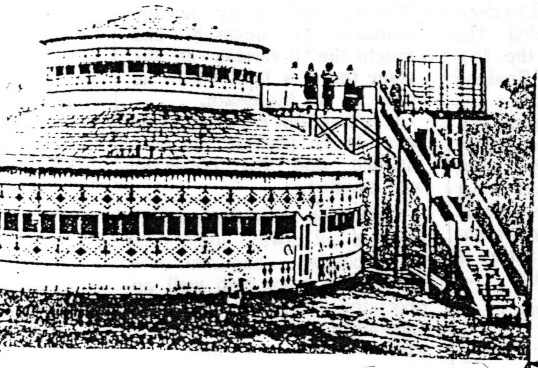
He even built his own parliament and courthouse at Maungapohatu and established his own savings bank, with specially inscribed bankbooks and with interest paid on money invested.
The township was set out in streets, with handbasins outside each small house for washing. Clearly, it was this forethought that made Rua such a threat to European rule in New Zealand’s early days.
Today Rua’s charisma is still obvious in the Urewera. Many of that rugged land’s older residents still remember the 1916 incident and the events that followed it.
They recall the prophet’s return from prison, his efforts in getting Maungapohatu functioning again and his frequent visits to the many small Maori settlements that had sprung up during his confinement.
Certainly he had lost some support while in prison, but it appears Rua’s mana — his standing — among the Tuhoe people remained until his death in 1937.
Few of his direct descendants — he had 12 wives and 48 children — are still alive.
For the Tuhoe tribe, the return of Rua’s flags to the Urewera will serve as a constant reminder of their beloved spiritual leader. For many Europeans the return of the flags will emphasise that injustices are not necessarily a latter-day innovation.
And although Rua Kenana never lived to see it, one law for both peoples did come to New Zealand.