
In this part:
- Glenholme School, Ranolf Street
- Glenholme School in Early Days
- Gordon Thomas McDowell and the McDowell Family
- Adelaide Annie Wedding, née Dodson — A Glenholme School Family
- Depression Years, 1920s–1930s
- Rotorua Is My Home
- The Dodson Family – Addie Wedding's Later Years
Glenholme School, Ranolf Street
Glenholme School, Ranolf Street. Built on Dr. Bertram’s ‘Glenholme’ Property. Opened Sept. 1948.
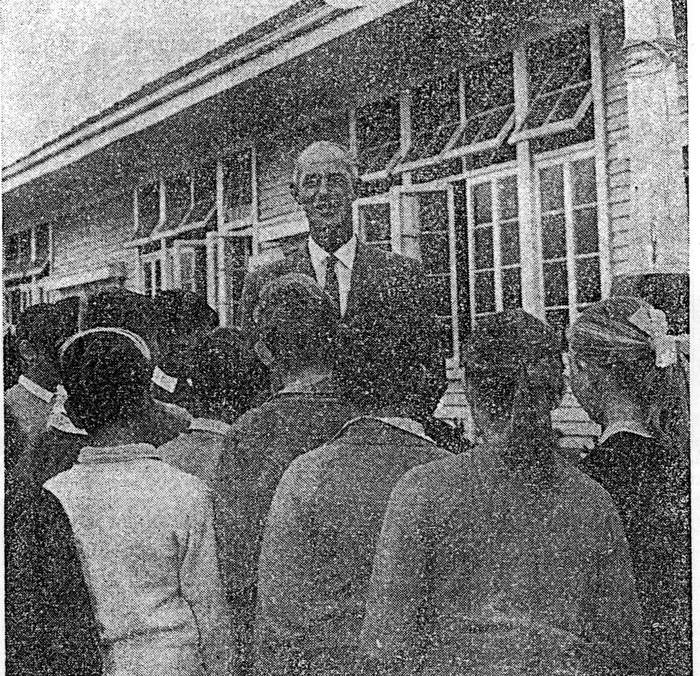
Popular Headmaster… The headmaster of the Glenholme School, Rotorua, Mr A. Bassett, who will retire at the end of the year, finds himself surrounded by schoolchildren. Mr Bassett has been teaching for 40 years and has been headmaster of Glenholme since it opened in 1948. Educated at Auckland Grammar School, Mr Bassett began teaching in 1921 at Auckland’s Westmere School. He taught in many other schools in that area. Mr Bassett says he will be sorry to leave teaching, “but I am looking forward to a good holiday.” Mr Bassett will sail early next year on a 10-month tour overseas.
The following is an article by his daughter Joan – Mrs. Don Civil.
My father Alan Bassett was Headmaster of Karaka School in South Auckland when he successfully applied for the Headmastership of the newly built Glenholme School in Rotorua to open in Sept. 1948. My sister and I were teenagers and as our parents had no accommodation arranged in Rotorua at that time we remained in the area with friends and relations.
There was a big State Housing area in the vicinity of the school but no house provided for the Headmaster nor were there houses to buy or rent. Bill Fortune, a Minister in the National Government and a friend of my father, came to the rescue and was able to put a little pressure in the right places and so a State house at 18 Wallace Cres. was to become our home from the 1st. term in 1949. Meanwhile my mother and father lived in a boarding house in Ranolf Street. When I arrived in Rotorua to join my parents and start my career in the work force, the last person I wanted to have a close relationship with was anyone connected with education. I already had too many teachers in my extended family.
My father decided to invite his family to morning tea at school to meet the staff. Little did I know that I was to meet my future husband, Don Civil. In 1951 we were married and bought a home in High St. with the back boundary on Dr. Bertram’s drive, where we raised our three children, Ian, Gillian and Dianne who all attended Glenholme – or my “Grandfather’s School” as they used to assert. Don and I still live at the same address forty years later, the metal road now sealed, sewerage connected but still no foot path on our side!
Glenholme School in Early Days
Don Civil, opening day assistant teacher, recalls the early years.
During the second term of 1948 while Sole-charge teacher at the Atiamuri School, I was successful in my application for assistant teacher’s position at the new Glenholme School.
Towards the end of the August holidays I visited the area to see what my new work place was like. A large truck pulled up in the grounds loaded with desks. “Where do I put these?” asked the driver. “In here” I said as I led him through the open front door. I helped him with the job and so made my first physical contact with the school which was to be my place of employment during the next seven years.
On the following day during a further reconnoitre, I met a tall gentleman inspecting the school. Mr. Bassett I presumed, – right!
Nessie Board was Infant Mistress. She was a sister of Ray Board who was later a Minister in the Labour Government and later still, Mayor of Rotorua. (Boards owned land in the area on Old Taupo Road opposite Dr. Bertram’s ‘Glenholme’ property.)
The school opened in September 1948 with a roll of approximately 280 pupils. It was the second state primary school in the town with the exception of Whakarewarewa which was then classified as a Maori School with Dave Alexander as headmaster. Down the road was St. Mary’s School with whom we had close liason.
As the population of Rotorua grew rapidly with the expansion of the Waipa Mill and the development of farms on the volcanic plateau that stretched from Rotorua to Taupo, so did Glenholme School increase very rapidly indeed and within a few years was well over 700 pupils. The post-war baby boom contributed much to this also.
State housing construction went apace and it was not long before Totara Street on the southern boundary of the school was filled with homes. The growing roll numbers brought many problems. Teachers were in short supply and space at a premium. At one time even the entrance foyer was used as a classroom. Class sizes were large by any measure, and in one particular year I taught a class of 58 standard 2 children.
Despite these difficulties, Glenholme functioned in a very well disciplined and efficient manner, blessed as it was with a no nonsense headmaster and an enthusiastic Sch. Committee and P.T.A.
Membership of the P.T.A. was two shillings and six pence, and many an enjoyable evening was had playing indoor bowls or flag, and five hundred as a money making exercise.
After a few years we had raised sufficient funds to build school baths. My job was to recruit volunteers for the working bees. Overseer was Percy Allen, later a Minister of Works in the National Party Government. He must have been born for the job because he would be most upset if I did not turn up with sufficient labourers.
Gala days were held annually with folk dancing displays and an array of stalls and of course there was the School Picnic held at Te Ngae near the Whakatane turnoff. It seemed everyone attended and a bus was provided for those who didn’t own a car.
We had a very good school choir which competed in the Rotorua Schools’ Music Competitions with some success as we did not have a Rotorua School’s Music Festival until the 60s.
Those were the days of school uniforms, Boys Grey with maroon strips on the socks and a maroon tie with blue strips. Girls Grey gym with maroon girdle and tie similar to the boys.
Those were also the days of free milk in schools, formal examinations and the ultimate deterrent – a strap in the teacher’s drawer.
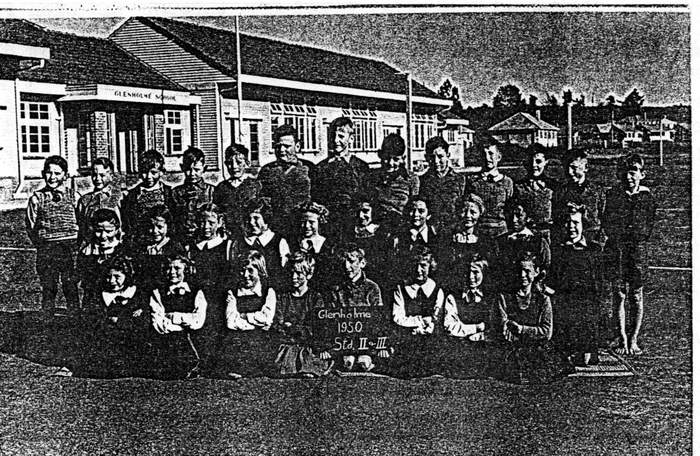
Glenholme School, 1950.
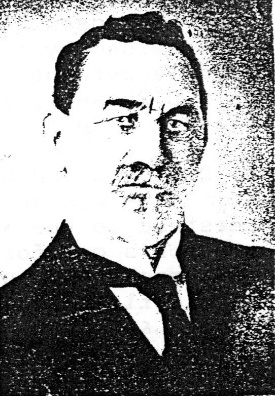 Gordon Thomas McDowell and the McDowell Family
Gordon Thomas McDowell, born 1904 Rotorua, was a solicitor, Rotorua, by 1928. In 1937 he married Kathleen Ruby, daughter of Hamilton solicitor. Their permanent home was 335 Fenton St., two doors up from St. Chads on Devon St. cnr. Gordon was a 3rd. generation Rotorua man. John Mc.Dowell was his father, Thomas his grand-father.
Thomas McDowell, 1851–1928, came to Rotorua 1911 from Christchurch. Their home was near the railway station.
 1918, Thomas was nominated by Rotorua Chamber of Commerce for the new Tauranga Harbour District which took in Rotorua. This was an important development for Rotorua in the years ahead.
Thomas was involved in various business ventures as well as Land Agent.
1923–1928, he served on Rotorua’s first Borough Council.
1927–1928, Mayor, until he died.
John McDowell, 1911, came with parents to Rotorua. He had two salesmen doing his Land Agency business while he concentrated on a Furniture & Factory business on cnr. Fenton & Amohau Sts. (opp. Pak N Sav). This flourished after W.W.2 when new settlements developed for returned soldiers. John had a daughter, a son Gordon whose brother died of polio in 1920s epidemic after 3 yrs. King George V Hospital. John devoted much time to fund-raising for this and the community. 1932, John represented Rotary on the Rotorua Amusement Com., Promoting Tourism in the Depression. New Year Eve’s were a gt. draw.
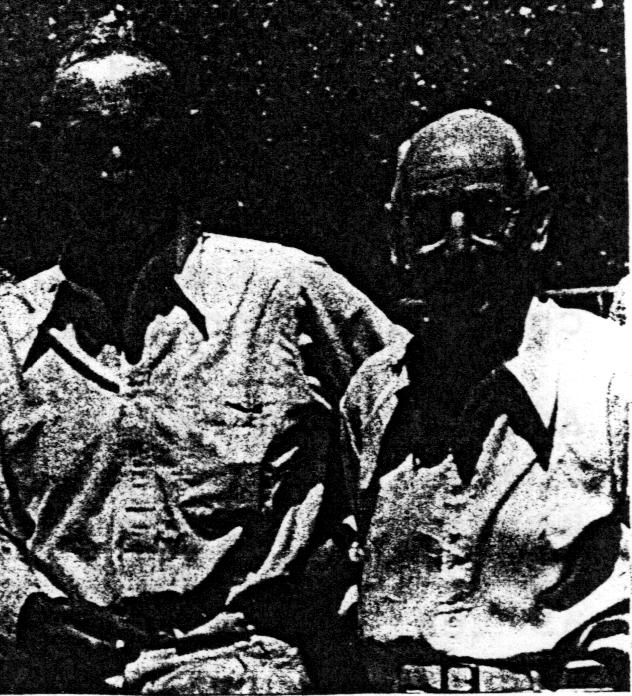
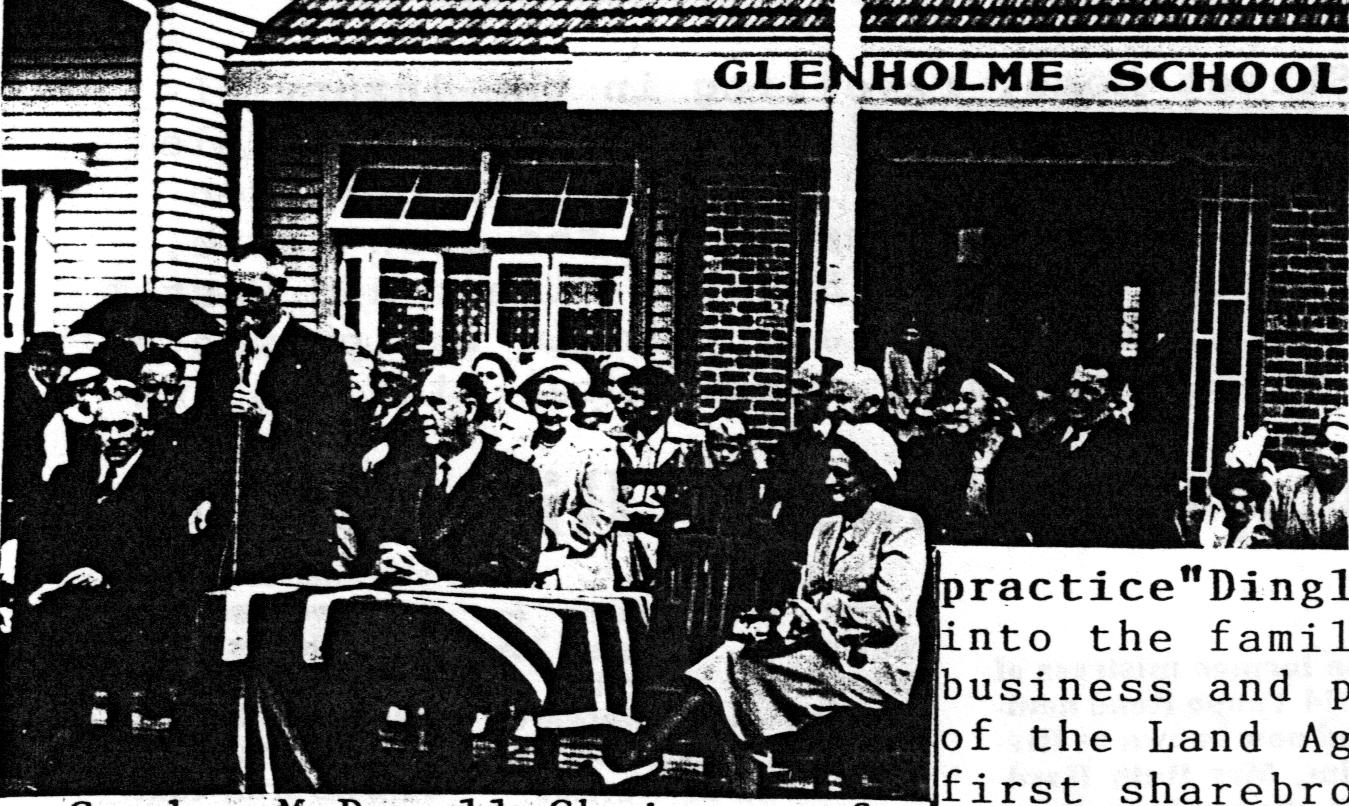 Figure . Gordon McDowell, Chairman of Sch. Committee, and his wife – their son Ian was the 1st. Dux.
John’s son, Gordon McDowell, after W.W.2 gave up his law practice “Dingle and McDowell”. He went into the family Furniture & Factory business and put two salesmen in charge of the Land Agency. Later he started the first sharebroking firm, also a valuation business. When the Kawerau Mills opened he did big business furnishing the workers accommodation quarters.
 Gordon’s wife Kathleen Ruby recalls the three W.W.2 years when she boarded a lady teacher for company while Gordon was in Waiouru camp. The army dug trenches on both sides bordering her property, also her neighbour’s the Blackmores, as they were opposite the Fenton St. Airport – (Blackmore trained the pre-war pilots there). A Japanese invasion from over at the coast was considered a possibility so this threat necessitated the airport being guarded.
Ian McDowell, Gordon’s son, carries on the family business which had its beginnings with his great grandfather Thomas in the early days.
Adelaide Annie Wedding, née Dodson — A Glenholme School Family
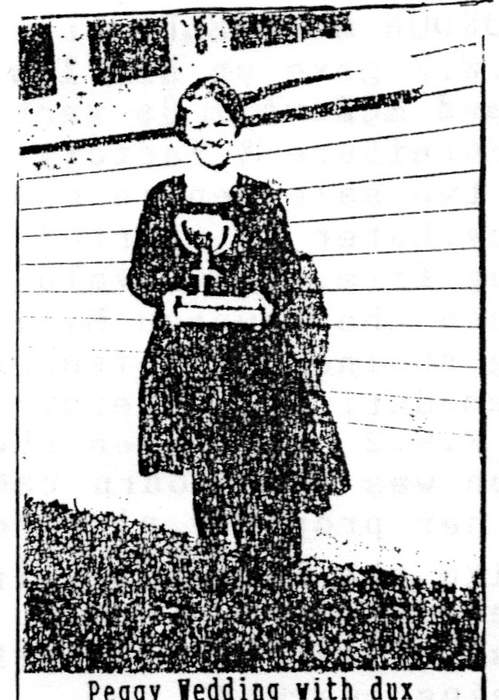
Adelaide Annie Wedding, née Dodson, was living in High Street when Glenholme Primary School opened in 1948. Her children – Don, Joan, Peggy and Ken attended there. Peggy started school the day Glenholme opened. In her final year Peggy became Dux and later returned to teach for a short time.
The High Street home, No. 33, was directly opposite Arthur Street. It was the old homestead house on the Davidsons farm – Davidson Street bears the family name. The block of land bordered by Ashley, Ranolf and Devon Streets was previously owned (according to the Buckthoughts of Springfield) by Mr and Mrs S.L. Russell, who built the Mokoia buildings in Tutanekai Street – 1920s to the 1940s.
Mrs Davidson and her daughter moved into Devon Street when their land was sold to the jeweller Mr Perkins. He rented the homestead to the Wedding family. Mr Reg Wedding milked old Mrs Davidson’s cow for her – the excess provided his family with milk, cream and butter. Reg Wedding had the reputation of being a first class tradesman. He was a joiner for Charlie Beamish & Co. Reg worked voluntarily – with others – on the Malfroy Road Geyser Hall, opposite the Rotorua Intermediate School. Len Holdaway from Arthur Street was the builder.
The Davidson homestead backed onto Dr Bertram’s farm. In the grounds, towered a giant redwood tree which the Wedding children would shoot up when they heard a fire siren. They had the best view in town. Such entertainment was only bettered by the excitement caused by a vagrant geyser which suddenly erupted in the Glenholme school grounds. This blow out, caused consternation until tamed and diverted underground.
Addie loved her High Street home, revelling in the luxury of space. She would often remind her children of the incredible hardships suffered by her own mother. When Addie’s children attained adolescence, she happily returned to the work force, as tea lady for the Forestry Service, Nairn & Fisher and East & Brewster. At her farewell, 25 years later, Addie was presented with a gold watch for dispensing many cups of tea with fun and good humour.
|
Figure 152 Peggy Wedding with dux trophy, 1954. Grand-daughter of Wlm. & Mary Dobson. Glenholme School. |
The former mistress of the Old Taupo Road homestead now known as Riverholm, Mrs Ruth Hardcastle, died in Dunedin on Wednesday. She was aged 87. Mrs Hardcastle and her late husband, Harold, moved into the homestead they had built in 1927 soon after their marriage. An Australian, Mr Hardcastle had made frequent trout fishing trips to Rotorua before buying about 40ha of land around the Utuhina Stream. The dairy farm to which he brought his bride, the daughter of Richard and Margaret Reynolds, Cambridge, was known as Werrina. Extensive vegetable and flower gardens, shrubs and English trees were planted in the homestead grounds and the fruits of the Hardcastle garden were often sent to the Rotorua Hospital. During World War II Mrs Hardcastle frequently entertained invalid soldiers from Rotorua’s Queen Elizabeth Hospital, becoming known for her roast duck in the shooting season. As well as befriending the soldiers, Mrs Hardcastle sent many food parcels to their parents in Britain containing her famous fruit cake. |
|---|
In the early 1950s the Hardcastles moved to a smaller house in Sunset Road and the farm was sub-divided before Mr Hardcastle’s death in 1957. The homestead was sold to the Waikato Hospital Board. Mrs Hardcastle is survived by her only child, Mrs Shirley Childs, Dunedin, and four grandchildren with whom she lived in recent years.
When Mr. Dodson died young, leaving large family, Hardcastles asked (unsuccessfully) to adopt Addie.
Depression Years, 1920s–1930s
Widowed Mrs. Wm. Dobson Struggles to Bring Up a Family of Nine Children. Her 8th. child, Adelaide, now Mrs. Addie Wedding, recalls those days from when they lived in the ‘Stable House’ of the R.M. Coaching Comp. stables on the site of today’s Rotorua Boys High Sch. and where the avenue of great chestnut trees off Pukuatua St. produced great crops.
The following is an excerpt from an article written by Kim Wilson paying tribute to her grandmother, born in Rotorua in 1916.
Rotorua Is My Home
There she bends, tending her garden. Small in stature. Her hair of soft white/grey curls, at times, wound round rollers and encased in hair net. No matter the time of year, if the sun shines, there she will be, tending to her beloved garden. This is how she will be remembered by me, my Kiwi Nana. The year 1991 is the year she achieves the three quarter century milestone in life. This is my toast to Kiwi Nana.
 On the 27th day of June 1916, in the stable house – where the Rotorua Boys High School Gymnasium now stands – Mary Jane Dodson gave birth to a third daughter, her eighth child. The child was named Adelaide Annie Dodson. As the years unfolded she became known as Addie. For the following seven years Addie lived and played on what was known as the stables of the RM Coaching Company. Here Addie’s father, William Job Dodson worked, as caretaker and coachman. He lived with his wife and nine surviving children, (his first child having died some years before in a trolley accident, Queen Street Auckland). Of these years, Addie remembers when she was four years old being given a little cradle, no bigger than a fist, with a tiny baby doll lying inside. She thought it neat. This was the only toy she ever possessed as the family could not afford such luxuries. The children had made their own fun. One remembered game was tying string to two fruit tins to make a telephone line. The old barn was a favourite haunt, where inside, Addie and her brothers and sisters chased rats. They also visited the Utuhina stream where they caught kuras for their mother to cook up for dinner. One day aged four and a half Addie’s foot caught in her father’s motorcycle as she sat behind him. Addie was taken into a house nearby and survived without a broken bone..
Addie loved lying in the paddocks listening to the skylarks, whose song pierced the still air, although they themselves remained unseen. Here she ate little berries that grew like strawberries – only smaller. Every morning and afternoon Addie would walk with her older brother, Tom, to Hardcastle’s cowshed behind the farmhouse – now the Riverholm Alcoholic Assessment Centre on Old Taupo Road. There, they were freely supplied with fresh milk for the entire family. Addie remembers the chestnut trees that flanked the driveway of her home and the kids from Koutu who would come and help themselves to the chestnuts. The house stood in two parts on opposite sides of the drive, the living area on one side, the dining and kitchen area on the other. Addie remembers kicking pumice with hand-me-down shoes as she walked along the road from home to the Rotorua Primary School in Arawa Street – where it still stands today.
William Dodson was admitted to hospital after he took ill at the Lyric Theatre where he took tickets at the door – his night job. Addie’s eldest sister, Edna and her husband-to-be, Bert Gleeson, visited William in hospital the following night. Bert remembers William “sitting up in bed, smoking a cigarette, bright as a peanut. He thought he had a toothache.” The next morning he was dead. William Dodson died at the age of forty-two in 1921, leaving Mary a penniless widow and nine children. Addie was five years old, the youngest child just a babe. As the story goes the Rotorua community rallied round putting on a concert to raise money for this family to survive. The concert was a great success and a considerable amount of money was raised. However, temptation became too much for the Treasurer who absconded with the proceeds.
Edna was already working as a waitress at the Samoa boarding house and the older boys found work to help provide for the family. Their mother took in washing and ironing. An offer was made by ‘Old Man Hardcastle’ to adopt Addie. Mary Jane would not part with any of her children, the offer was declined. One thing always remembered (with admiration) by her family was the bottomless pot of soup or stew that not only provided sustenance for the family but also the workmen nearby.
The younger children would sit on the fence crying as passerbys were sighted, in sympathy they sometimes received coins. Great excitement arose in the event of a fire. After the fire was doused by the local brigade, the Dodson children would scavenge for coins and trinkets amongst the ashes.
The Dodson Family – Addie Wedding’s Later Years
A couple of years after William had died the family moved to Amohau Street, next door to what was the Samoa boarding house – now Harcourts real estate building. From there they moved to a home the Dodson’s could truly call their own. For a very cheap price Mary Jane brought 102 Pukuatua Street from the Whitley’s, who owned a shoe shop in town. The house was surrounded on two sides by a long verandah. This was partitioned off with curtains to enable each child to call a room their own. Years later in the 1980s, Addie was to rush home for her camera to capture the last days of this home being demolished to make room for the flats that occupy the site today.
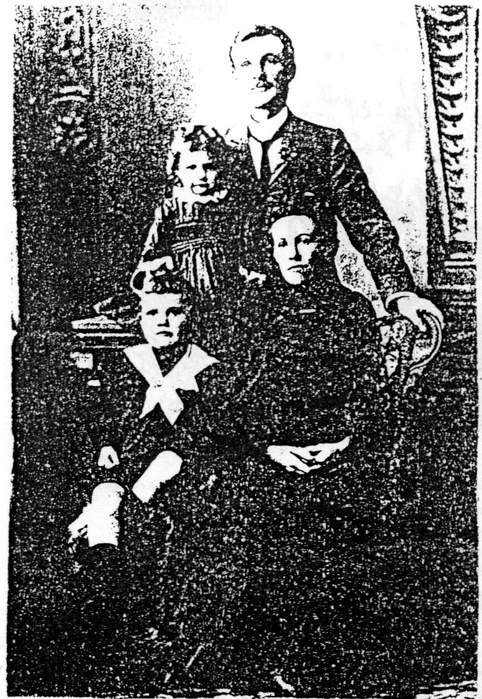 Addie was to return to the place of her birth as a founding pupil of the Rotorua High School, now known as Rotorua Boys High School. She attended the Intermediate Department, leaving school for the workforce at thirteen. Addie always considered herself a loyal pupil. Although she did not excel academically, Addie came into her own on the athletic track – where she proudly held a high jump title for more than twenty years. Athletics was the love of her early years. As a member of Crecy House Addie led the chariot races. Addie was also the only junior in the A grade basketball team. To this day she is proud of her athletic achievements. Addie was very upset years later when she was not, at first, accepted as an ex-pupil or invited to participate in the Rotorua High School reunion as she did not enter the third form.
Addie remembers the day she first saw an aeroplane fly over Rotorua. She was living at the stables then. Her mother, brothers, sisters and Addie herself stood in the paddock with eyes cast skyward. As the aeroplane flew overhead Addie’s mother exclaimed, “The buggers are mad. What ever will they do next. The buggers are mad.” This comment passed the lips of a women unknown to swear under any circumstances! Years later the family were to drive out to a farm past the Whakatane turn-off to witness Kingsford-Smith’s aeroplane land. Soon after, Mary Jane was to buy a Model T Ford from an auction for 16 pound.
The vehicle was towed home, then driven by her sons and later Addie’s husband. The Model T Ford was Mary Jane’s pride and joy. It was crashed at the 7 mile peg at the Te Ngae turn-off by two of her daughters and their friends. Addie remembers “It about broke her (Mary Jane’s) heart”. Addie’s first term of employment was out at the Arikikapakapa Golflinks. She remembers biking out there, doing housework then waiting on all the golfers when they came in for lunch, retiring home by bike – all for ten shillings a week. Of this wage Addie gave her mother seven shillings, leaving the remaining three shillings to provide herself with clothes, the upkeep of her bike and the dance on Saturday night. To this day Addie loves to dance, sing and have a good time. Addie remained in this job until she was fifteen. In between jobs she did housecleaning and “anything for a bob”.
Addie landed her next major job when she was seventeen, washing dishes with her older sister Glady at Sparks’ Tearooms. This was a hard job. Often the two girls would sit, so tired, in the gutter outside and weep, until they could no longer stand this job and both walked out not to return. From there, Glady was hired to manage Sorenson’s Bookshop and Addie worked as her assistant. This bookshop was looked after by the Public Trust as the owner was often admitted to a mental institute. BNZ North, now occupies the site where the bookshop stood originally, in Tutanekai Street. Part of this job was for either sister to open the little shop at the Railway Station when the trains were due to arrive or depart.
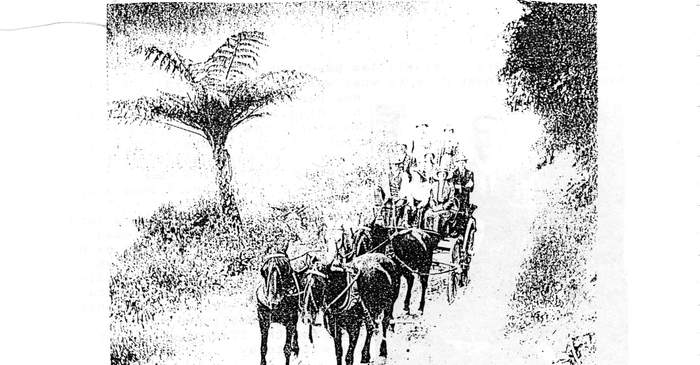
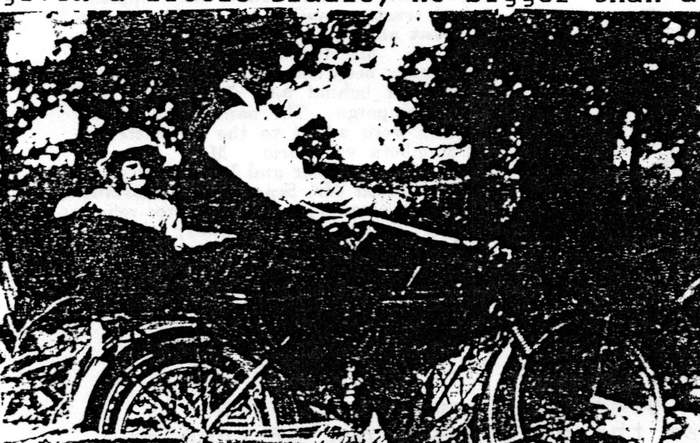
The pace of life was much more sedate than it is today when this photograph of a tourist party was taken beside Blue Lake on March 1, 1915. The Round Trip of those times involved a journey of several days. The picture was supplied by Mr J. W. Dodson, Rotorua, whose father, Mr William Dodson, is the driver. 1915, Mr. William Dobson, Rotorua, driver.
As wild as the Dodson clan appeared as children, strong moral values were instilled. With the approach of adolescence and eagerness to socialise, the younger girls had to be home by ten o’clock, no later. Their mother would send their older brothers out to round them up if the curfew was by-passed. While working in Sorenson’s Bookshop Glady married. Another woman stepped into her position. Around this time, Addie’s grandmother died leaving Addie a legacy – this she used to have her rotting teeth removed and false ones fitted.