
In this part:
- 'Long Newspaper Career'
- The Ewert Family of Rotorua
- Citation for Douglas Ewert's Military Cross
- Don Stafford — Rotorua Historian
‘Long Newspaper Career’
Newspaper cutting, Daily Post, Friday, March 25 1994
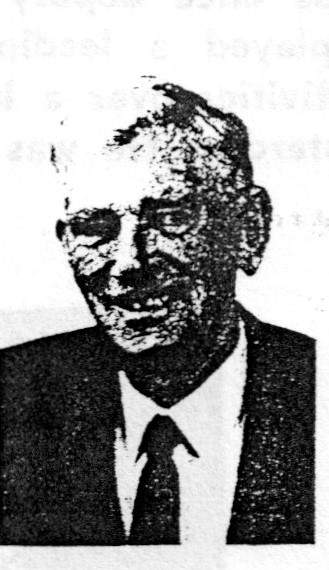
WELLINGTON. – Newspaper publisher Ray Smith says the key to his business success has been to simplify issues – getting to the core of problems and refusing to be side-tracked.
The 73-year-old Rotorua-based publisher is a legendary figure on the New Zealand newspaper scene. His steely-eyed no-nonsense approach has overseen change and forged industry co-operation amid highly competitive opposing companies in a career which spans over 50 years.
Mr Smith stepped down from being president of the Newspaper Publishers’ Association and chairman of the New Zealand Press Association last year, succeeded by Independent Newspapers Ltd managing director, Mr Mike Robson.
Last week at the industry annual conference in Blenheim Mr Smith was made a life member of the NPA.
Yesterday he retired as a director of Wilson and Horton – which stands alongside Independent Newspapers Limited as one of the two major owners of New Zealand newspapers.
As NPA president for 11 years, Mr Smith called on many tactics to achieve continuing co-operation during a long career at the top of an industry in which he out-lived an array of colourful but hard-bitten personalities.
Most of all, his unwavering independent voice – undoubted despite his close links with the Auckland-based Wilson and Horton group – commanded industry unity when warding off threats to newspapers and devising strategies to foster their standing and market share.
In both his newspaper and army careers (he served in the infantry in Italy for much of World War 2 and rose to the rank of lieutenant colonel in the Territorial Army) it was, he says, his like of people that had been his most invaluable asset.
“I like people. I like company. I’ve been fortunate in both my careers that I’ve been very involved with personnel, and I’ve made many friends.”
Technology developments were important to the progress of newspapers throughout the decades when Mr Smith was building his newspaper fortunes. But, he told NZPA, those changes were only the means to the end – “it’s all about people”.
Mr Smith and then Nelson publisher Mr Rex Lucas led a watershed change for New Zealand provincial newspapers when they introduced web-offset printing in 1964, the best part of a decade ahead of other publishers.
Web-offset printing “gave us the facility to use the camera to provide art-work whereas we had been inhibited in our design work because of metal (production). It certainly upgraded us and increased our profitability very quickly.”
Back in those days Ray Smith the advertising salesman would be asked by a shoe company to illustrate a shoe in Rotorua’s Daily Post. But existing technology prevented the paper from properly being able to illustrate a shoe in an advertisement. That changed with web-offset printing. “It revolutionised our selling, doubled our advertising space.”
Newspapers were also plagued in the 1950s and 1960s by a shortage of skilled labour, particularly operators of the now out-dated metal-setting linotype machines. In an era of full employment, the situation required a full-time agent working in Britain recruiting staff.
Again, Mr Smith and Mr Lucas introduced change from overseas, importing simplified type-setting equipment known as ‘justoriters’, the forerunner of photo type-setting.
Much like type-writers, the machines produced “reasonably acceptable” type faces and performed justification – presenting words in an orderly fashion in columns of type.
Most importantly, this enabled the newspapers to start employing local typists to perform bulk setting of type and overcome labour shortages.
As regional newspaper managers confront a new era of threatened circulation and closures of some metropolitan and evening newspapers, Mr Smith urges them to look to their own communities for the future.
|
Panel text: Mr Smith was born at Hamilton in 1921, and came to Rotorua at the age of two. Following his education in Rotorua, he was a cadet with the N.Z. Loan and Mercantile Company till the outbreak of war, when he enlisted in the Hauraki Regiment. He gained a commission in 1942 but relinquished it in 1943 at the age of 21 to serve overseas, sailing with the tenth reinforcements that year, serving with 24 Battalion throughout the Italian campaign. He was recommissioned in 1943, returning to New Zealand at the end of the war with the rank of lieutenant. When the armed forces were reorganised after the war, he joined the reserve, being appointed to the Hauraki Regiment as company commander of the Rotorua Company, and was appointed commanding officer in 1955. Mr Smith was appointed advertising manager of the ‘Post’ in 1946 and manager in 1955. ‘Leading regional newspaper publisher Ray Smith has been made a life member of the Newspaper Publishers’ Association. It was an acknowledgement of a long career which has pioneered change and forged unity in the industry. He discusses some of those changes in an interview with NZPA.’ |
 |
|---|---|
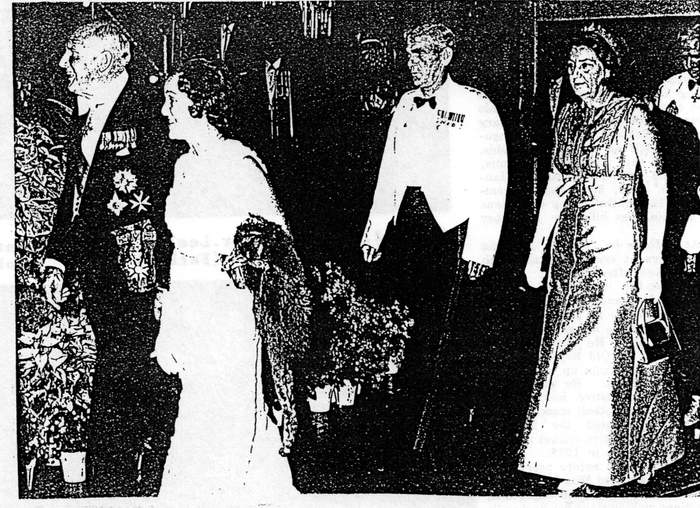 |
Photo montage from the vice-regal ball, early 1970s, showing Sir Dennis & Lady Blundell with Mary & Ray Smith, the commanding officer of the Hauraki Regiment, which followed the afternoon function at Smallbone Park, Rotorua, where the Hauraki Regiment were presented with their new colours. |
:
 The Ewert Family of Rotorua
Newspaper obituary headed ‘Mr L. Ewert played leading part in city’:
A man who was once deputy-Mayor of Rotorua and who played a leading part in many community activities over a long period died in Rotorua yesterday. He was Mr Leslie Ewert, aged 82.
‘Force son Robert, killed in action’
OBITUARY
Pilot-Officer R. L. Ewert:
Official notification has now been received of the death on active service of Pilot-Officer Robert Leslie Ewert, husband of Mrs. L. F. Ewert, of Rotorua, and eldest son of Mr. and Mrs. L. Ewert, Elizabeth Street, Rotorua. Pilot-Officer Ewert was particularly well known throughout the Rotorua and Bay of Plenty district, being an active member of football and cricket clubs. He received his education at the Rotorua Primary and High Schools, where he distinguished himself on the sporting fields. He joined the Air Force in June, 1941, and left New Zealand on January 20, 1942, and after approximately 12 months’ flying operations in Britain, was killed on December 8.
At Rotorua he played for the first eleven at cricket for the High School, and after leaving school, played for the Old Boys’ cricket team. He was, however, more widely known as a football player, and captained the Kahukura Football Club in 1936. He transferred his activities to the Old Boys’ Club and played for that team up to the time of going overseas. He was captain of the representative Rotorua and Bay of Plenty football team in 1937, and also represented the Bay of Plenty representative cricket team at Palmerston North in 1938.
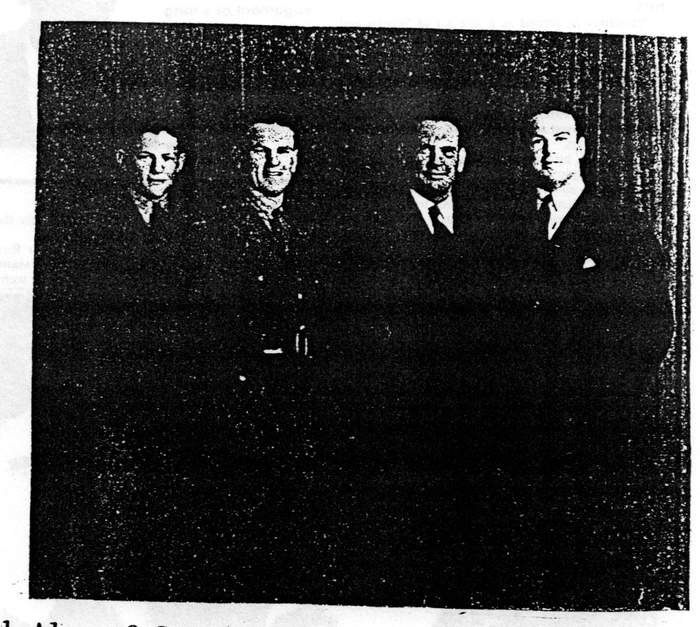
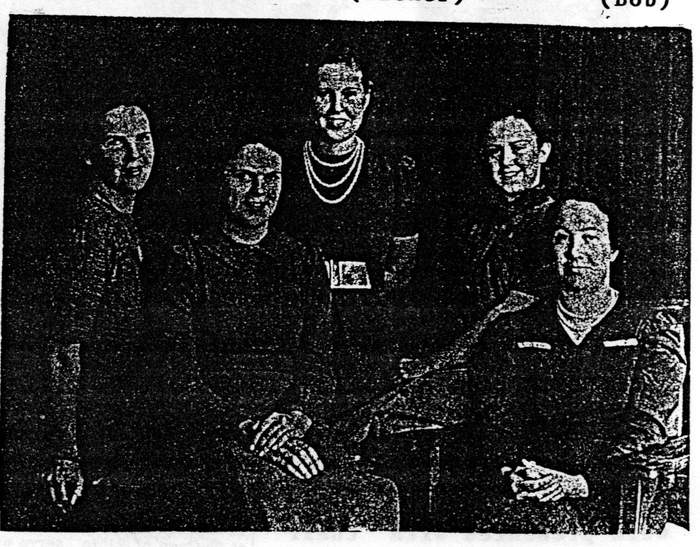
Family group, from left: 1. Alan, 2. Douglas (Bandy), 3. Mr. Leslie Ewert (Father), 4. Robert (Bob). Second group, from left: 1. Jean (Mrs. Ted Quinlan), 2. Betty (Mrs. David Macartney), 3. Doreen (Mrs. Frank Spedding), 4. Mary (Mrs. Ray Smith), 5. Mrs. Ethel Ewert (Mother).
A few months before proceeding overseas he married Miss Lila Bergan of Rotorua, who has been engaged in munitions making since her husband’s departure. Pilot-Officer Ewert’s loss is being keenly felt in Rotorua and district, and the deepest sympathy is extended to his wife, parents, and relatives in their bereavement.
1917, Mr. Leslie Ewert came to Rotorua, settling on cnr. Ann-Eliz. St.. He and his wife brought up 7 chn. who became well known identities:
(Written by Mary Smith nee Ewert)
LESLIE EWERT came to Rotorua in 1917. He was working for the N.Z. Railways in Taihape when he joined the army and was on final leave when the N.Z. Railways recalled him in the emergency of the Influenza epidemic when the loss of manpower became critical. He was sent to Rotorua.
He resigned in 1922 to enter business on his own account, delivering butter and eggs in Rotorua and to the settlers in the newly developing farms of Ngakuru and Reporoa. He also supplied the farmers on the way to Te Puke and Gate Pa, Tauranga, where he would collect the eggs for this district. This entailed very long hours on bad roads, often requiring chains.
Around 1930 he opened a retail grocery shop in Tutanekai Street where part of Deka is now. During this time his wife ETHEL was bringing up seven children but also found the time to melt the honey and pour into the cartons, pack and seal tea and cook all the hams in the copper for the shop. She also sold butter and eggs to the neighbours from the family home on the corner of Elizabeth and Ann Streets.
In 1935 LESLIE became the agent for the N.Z. Co-operative Dairy Board (which he held for 35 years) and so sold his shop and opened up a warehouse for the wholesale distribution of dairy products. This was situated on the corner of Tutanekai and Pukaki Streets, eventually building the block of shops which is where the Outdoor Centre now is.
At this time he also started an icemaking plant in Old Taupo Road supplying all the many Boarding Houses, hotels and shops with crushed ice and salt for their ice cabinets before refrigeration was in vogue. Icecream was only a summer food in those days and he was the agent for McDonalds. He also pioneered the making of Ice Blocks. This building was commandeered during the war by the N.Z. Dairy Board. It eventually became the Milk Treatment Station for Rotorua.
He was elected to the Borough Council in 1935 and served for 12 years, three of which he was Deputy Mayor. He gave more than 40 years of service to the Rotorua community, there being hardly a field of activity in which he was not involved.
LESLIE AND ETHEL EWERT’S seven children were – ROBERT LESLIE m. LILA BERGAN. He was killed in action in 1942. DOUGLAS JOHN m. UNA PICOT. JEAN m. TED QUINLAN. ALAN JORDAN m. BETTY MORRISS. ELIZABETH m. DAVID MACARTNEY. DOREEN m. FRANK SPEDDING and MARY m. RAY SMITH. All the children finally settled in Rotorua.
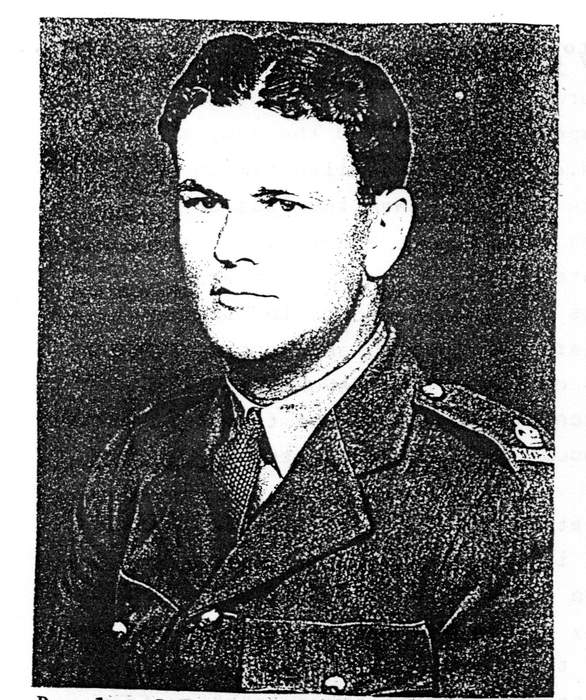
Douglas J. Ewert, B. 1919, D. 1978. In W.W.2, by 22, rank of Major, Burma. 1945, awarded immediate Military Cross. Note: see citation & letter next page.
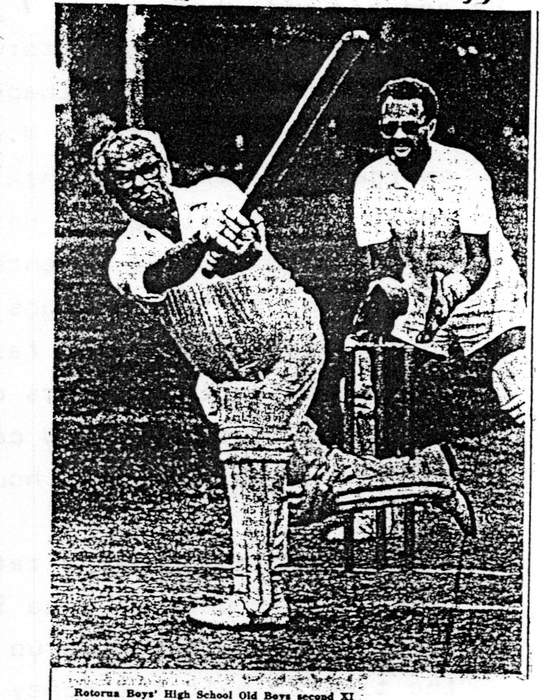
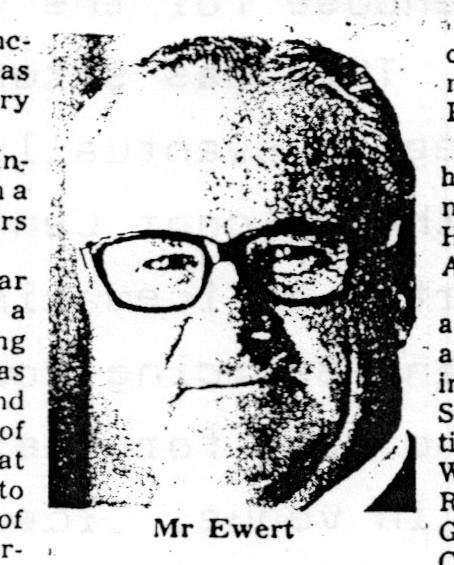
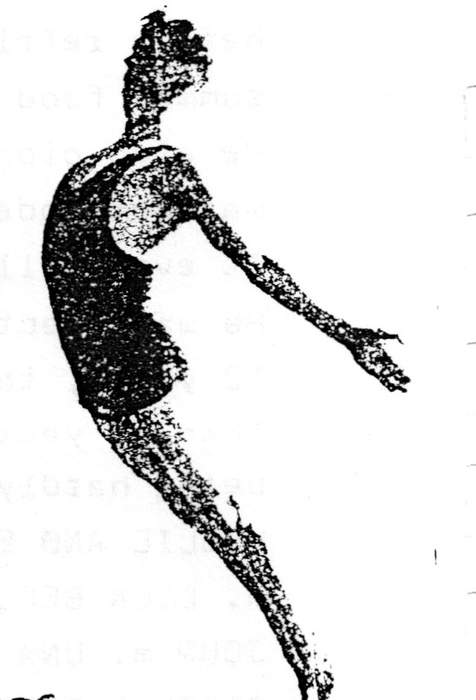
Douglas Ewert (Bandy) batting for Rotorua Boys’ High School Old Boys’ second XI, at the school’s first 50th jubilee celebration day, 1977 – he hit 46 runs before being caught out by Takapuna Grammar Old Boys wicket-keeper D. Speedy. ‘Bandy’ died in 1978. Right Mr Ewert. School mates 1936 watched in awe at Bandy’s Swallow Dives at Blue Baths, from breath-taking heights. He was fearless!
Newspaper obituary: Sportsman, businessman, a tireless worker for the benefit of youth and the community, Mr Douglas John Ewert, Rotorua, died last night. He was 58.
Educated at the Rotorua Primary School and Rotorua High School, Mr Ewert was a prominent sportsman from an early age. While still at school, he played for the Bay against Sir Julian Cahn’s touring side which included Australian test fast bowler J. Lush, and New Zealand test cricketer C. S. Dempster. He was a member of the school 1st XV which he captained for two years. A head prefect at the school, Mr Ewert was also senior swimming champion, taking up diving at the age of 13, winning the national diving title in 1937 and holding it for three years.
On leaving school, he joined the then Rotorua Borough Council as a clerk. With the advent of World War II, Mr Ewert graduated as a Second Lieutenant with the 1st Bn Hauraki Regiment. He moved to the Wellington Officers’ Overseas Training Unit at Trentham and gained a commission in the 2nd N.Z.E.F. In 1941 “Bandy” (as he had been nicknamed at the age of three), volunteered for the Indian Army. He joined the 1st Bn Sikh Light Infantry and saw active service on the north-west frontier of India and Burma with the 17th India Division, rising to the rank of Major at the age of 22.
Serving with distinction, Mr Ewert was awarded the Military Cross and Bar. During his term in India, he played hockey in a team of all India players as an inside right. He finished the war second-in-command of a Sikh battalion, returning to Rotorua in 1946 as assistant town clerk and again representing Bay of Plenty and Rotorua at cricket before moving to Auckland as a director of a large wholesale merchandising firm.
Mr Ewert joined the Grammar Old Boys Rugby Club in Auckland, playing alongside All Blacks F. R. Allen and N. H. Thornton, and winning selection for Auckland in the era of R. W. H. Scott. A mercurial five-eighth, he was on the short-list for the All Blacks tour to South Africa in 1949, but was unavailable because of marriage and business commitments.
Returning to Rotorua in 1954 to establish the firm of Ewert Bros Wholesale Ltd., Mr Ewert was chairman of directors of Direct Transport (Holdings) Ltd and its subsidiary companies covering logging and transport operations, at the time of his death. A director of St Andrews Private Hospital in Rotorua, a director of the Bank of New Zealand, an appointment made in 1969, and the B.N.Z. Savings Bank and a director of Lion Breweries, Mr Ewert was formerly a member of the council of Waikato University, Hamilton, and a member of the council of the Hamilton Teachers College.
An executive member of the Outward Bound Trust of New Zealand from 1962, Mr Ewert served as president of the trust in 1965. A supporter of the New Zealand National Party, he served as president of the Rotorua electorate, and was a member of the Dominion executive, and was national treasurer. A member of the Rotary Club of Rotorua for more than 20 years, president in 1968-1969, and a Justice of the Peace, Mr Ewert played a major role in fund-raising efforts for the provision of the Sports and Conference Centre building, the Girl Guides hall, the Y.W.C.A. hostel in Te Ngae Road, the promotion of the Aquatic Centre in Kuirau Park, and as chairman of the Commonwealth Games Bay of Plenty appeal.
Mr Ewert was this year honoured by the Rotary movement with the Paul Harris International Award. Mr Ewert was associated with numerous clubs and organisations including the Rotorua Returned Servicemen’s Association, the Barbarian and Wasps Rugby clubs, the Rotorua and Springfield Golf Clubs, the Rotorua Competitions Society, the Old Boys Rugby Club, the Northern Districts Cricket Club, the Rotorua Operatic Society, the St John Ambulance Association, the Society for the Intellectually Handicapped, the Red Cross, the Rotorua Citizens Club, the Chamber of Commerce, the Rotorua Swimming Club and the Rotorua Racing Club.
Mr Ewert was an unsuccessful candidate for the mayoralty in 1971. He is survived by his wife Una, two daughters Rebecca and Linda, and one grandson, William.
‘Outstanding contribution’: WELLINGTON. – All National Party members throughout New Zealand will be saddened at the untimely death of the party’s dominion treasurer, Mr Ewert, the party president, Mr G. Chapman said today.
Citation for Douglas Ewert’s Military Cross
Letter from Commanding Officer.
My dear Mr. Ewert
I’m afraid I don’t know what your son Douglas John is called at home, but we call him “Bandy,” in the regiment, so, with your permission, I shall refer to him by that name! I am sure that he will have been very modest about his M.C. and I felt that you and Mrs. Ewert would like to know just what he did. I am therefore sending you a copy of the citation I sent in so that you will know how well he earned his decoration. Bandy is a very fine young officer indeed and one in whom I have complete confidence as well as a great personal affection. He is loved by the men and justly admired by all ranks. He and John Maling, another New Zealander, are my two best officers and I could not wish for two better. John Maling is also in for a decoration.
It is great news that the war in Europe is over and that we can now concentrate everything against these little yellow swine. We have given them a good knock here and I am proud to say that the Sikh Light Infantry have killed over 700 of them and are looking forward to killing lots more. I hope you will excuse a short letter, there is little news one can give. Bandy is perfectly well again and in his usual terrific form. Believe me Sir, you and Mrs. Ewert have every reason to be immensely proud of your very gallant son. I think the day is getting very close now when he can return to New Zealand and achieve his ambition of playing for the All Blacks.
With kind regards to Mrs. Ewert
Yours very sincerely
(sgd) W.H. Barlow Wheeler.
Name: EWERT, Douglas John.
In the Meiktila area on 14 March 45, this officer of Sikh Light Infantry was commanding his coy and attached troops in Box “A”. At 2000 hours a party of 80 Japs approached the Box and commenced to attack. He was wounded in the thigh by a Grenade at 2010 hours. The Japs were reinforced by more Infantry and at least one Tank and attacked five times during the night. He, though wounded, went about his Box in the open under close range fire encouraging his men, directing the defence and directing Mortar fire. His fine spirit of determination and his example of coolness under fire was the keystone of the defence. While limping about in the dark and stumbling from weakness he fell into a thorn bush and many thorns stuck in his arm and his hands causing blood poisoning and rendering both hands and arms useless. Despite this, he himself led offensive patrols out at day break and drove the remaining enemy from the area. He would not report sick until ordered to do so and relieved by me at 1400 hours on the 15th March. By this time he could not use either hand and could barely walk. This young officer’s fine example of dogged determination and outstanding leadership through a long night of pain, under constant fire, was an inspiration to the whole Garrison and in the best traditions of the Army.
Recommended by Lieut-Colonel W.H. Barlow Wheeler, Comdg, 1st Bn. Sikh Light Infantry.
Honour of award: Award of immediate Military Cross.
Above letters from Mary Smith, nee-Ewert.
Don Stafford — Rotorua Historian
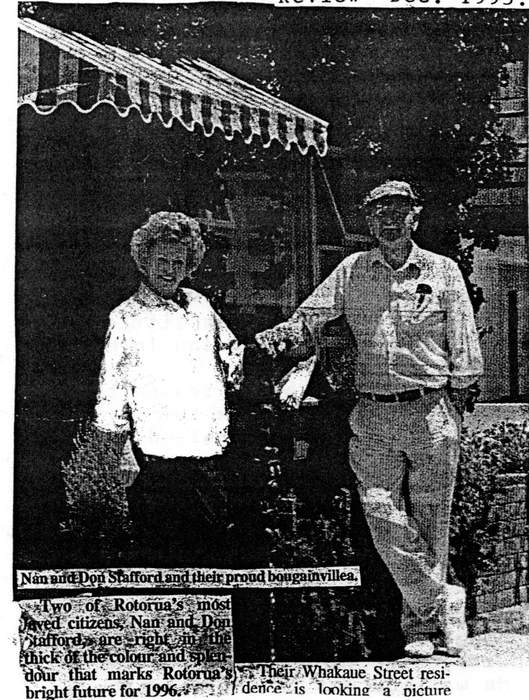
DON STAFFORD, mid-1930s, came to Rotorua with parents & brother Jack. When married to Nan, from Te Puke, their home was next to Glenholme Sch. which their son Max attended before they moved up to Tihiotonga. They have since moved to Whakaue St. over-looking Rot. Lake park area.
Newspaper feature, headed ‘Rotorua historian’, Review – Dec. 1995:
One of the Queen’s highest honours, the Commander of the British Empire, has been bestowed on Rotorua’s leading historian, Mr Don Stafford. It is Mr Stafford’s second royal honour. In 1980 he was created a Member of the British Empire.
The citation for his latest royal recognition acknowledges Mr Stafford as a leading authority on the Maori history of the Rotorua and Bay of Plenty areas.
To Mr Stafford the award is a flattering one. “I am complimented that my fellow citizens should consider it justified,” was his characteristically low-key reaction to yesterday’s announcement. And there was a special tribute from him to Nan, his wife of 47 years. “Without her I could not have done anything.”
Apart from two “lovely years” spent in Texas in the mid 1960s, Rotorua and its environs have always been home to Mr Stafford.
Love nurtured
As a tiny tot he grew up on his family’s Kaharoa farm, then when his school days began his parents became “townies” with his father operating a clothing outfitters in the former Majestic Theatre building. It was there that Mr Stafford’s love of the district and things Maori was nurtured.
“There always seemed to be Maori people in the shop,” he recalled. “As a little boy I spent so many happy hours with them amassing masses of information. They were always so generous with their time and knowledge.”
As he grew older Mr Stafford developed a firm friendship with the then editor of the publishers of A.H. and A.W. Reed, Mr Ray Richards. “It was he who convinced me to put the knowledge I had gleaned into book form.”
The result was Te Arawa: A History of the Arawa People, published in 1967. The year after Te Arawa appeared Mr Stafford established Rotorua’s first museum and art gallery, based in the southern wing of the Bath House.
A Landmark for Rotorua
Newspaper article, by Jill Nicholas, Daily Post, headed ‘A landmark for Rotorua — district historian Don Stafford at the launching last night of his latest work, Landmarks of Te Arawa’:
It was, Rotorua was told, a splendid occasion, and occasions don’t come much more splendid than the launch of the latest work of the district’s resident historian Don Stafford – Landmarks of Te Arawa, Volume One: Rotorua.
Over a thousand entries detail every settlement, locality, battle site, ceremonial event, marae, meeting house and significant tribal experience which has ever occurred on the shores of Lake Rotorua, its contributing rivers and streams.
Backed by 40 full-page detailed maps, a large number of photographs and 100 genealogies, the work is billed as enabling Maori descendants of Te Arawa and its subtribes to identify virtually every aspect of their history and fabled past.
From Ngati Whakaue kaumatua, Mr Pihopi Kingi, came the acknowledgement that the book was sacred to his people and Te Arawa as a whole. But pakeha were assured it is their book, too, despite the fact that apart from the labelling of a few streets there is not a pakeha name in the book.
“Don has done for Rotorua what has been done for no other district in New Zealand,” said the author’s literary agent, Ray Richards. His publisher’s representative, Ian Watt of Reeds, said the man of the moment had done Rotorua and its peoples an enormous service.
 Second Volume of Local History Due
Six years of research and writing culminates for local historian Don Stafford with the official launching next week of his latest book, “The New Century in Rotorua.” The book is the second in a two-volume series published by the Rotorua District Council in association with Ray Richards Publisher.
The first volume, “The Founding Years in Rotorua” – launched in December two years ago – covers local historical events from the 1870s until the turn of the century. It follows on from Don Stafford’s book “Te Arawa” which traces the arrival of the Maori and their settlement in this area. The latest book, “The New Century in Rotorua,” deals with events in the district from 1900 right up until mid 1988.
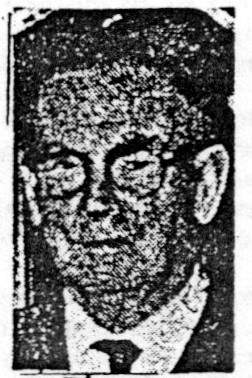
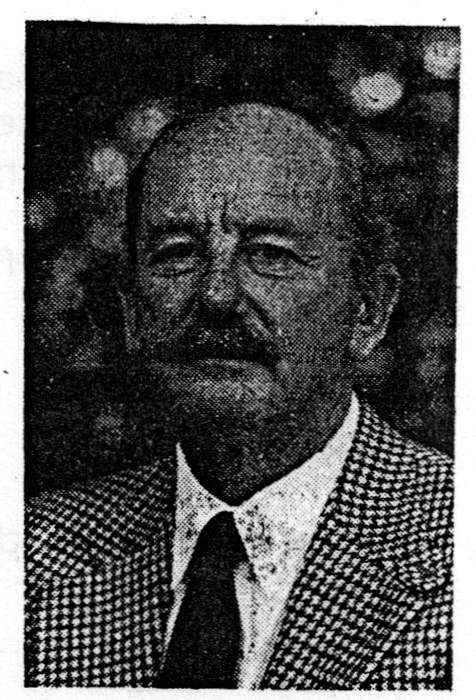
Caption: Mr Don Stafford, MBE 1982, CBE 1993. Photo, Daily Post.