
In this part:
- Arthur Bellingham
- The Smith Family of Gwendoline Street
- The 4 generations of Smiths in Rotorua
- F. Moss Boord's Passenger Launch Enterprises, Pontoon, Sulphur Shipping
- Whaka Native School and the Bus Business
- Ray Smith's Boyhood Home and Adeline Smith
- Colonel R. F. (Ray) Smith, CBE, OBE (Military), ED
Arthur Bellingham
Arthur was born in Te Aroha and was educated in Rotorua. There were family movements between N.Z. and England but on leaving school at the age of 17 Arthur got a job as a clerk at Bedford County Office in England. It was here that he worked until the outbreak of war in 1914.
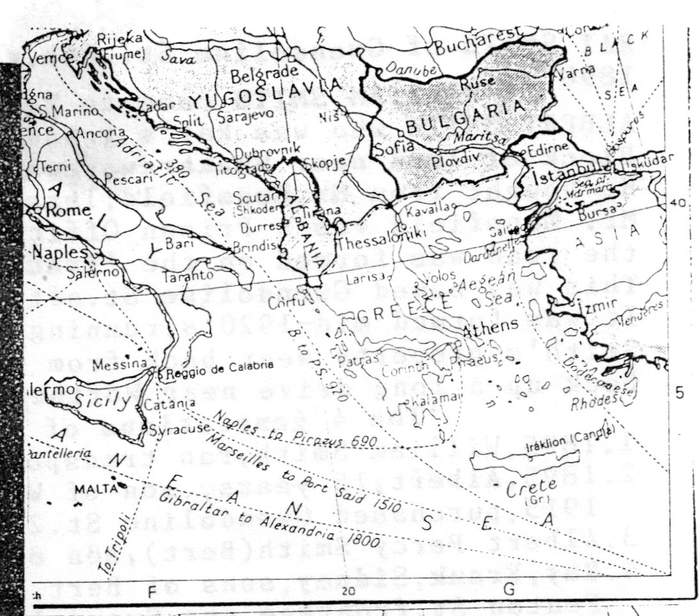
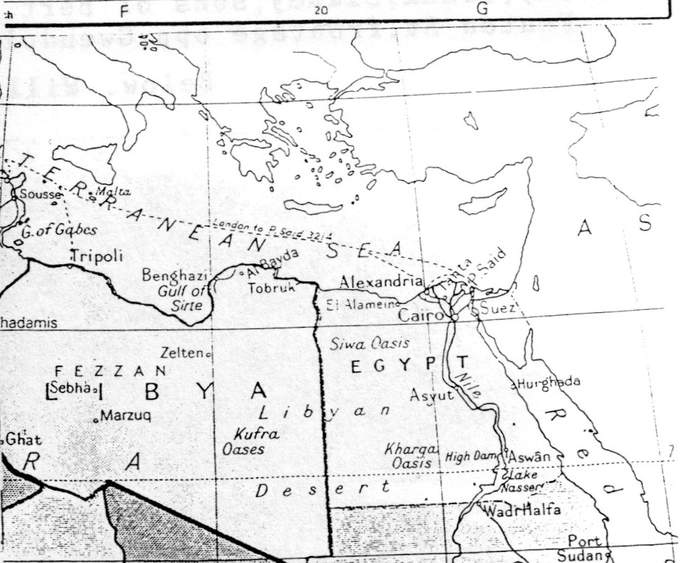
He responded to an advertisement in the London Times for men to enlist in a force which became known as the British Sector. Arthur enlisted on the second day of the war and after training in England began service in Egypt, joining the main body of N.Z. forces which had arrived 2 weeks previously. On arrival in Egypt the unit was disbanded and the men were transferred to other units.
Arthur went to the N.Z. Field Engineers.
In Egypt he met (by accident) his brother Ernest, who had arrived with the main body, and Arthur managed to get him transferred to the Engineers so they were together during the Gallipoli Campaign …. well, at least until Arthur was evacuated to Malta and hospitalised. He was here until December 1915, when he was transferred back to hospital in England. He then served for some time in the Headquarters Pay section before being repatriated home for discharge in N.Z. in October 1917. He was discharged with the rank of Sergeant.
I thought it appropriate to read you a section from Arthur’s diary – lovingly typed out by Ann as a living reminder of his time during the war.
Retiring from the war, Arthur became fully involved in local body work, serving on the County Councils of Pukekohe, Franklin, Tauranga and finally 34 years with the Rotorua Council.
It was 1921 that he married Tris (Beatrice) and had 43 years of marriage before her death in 1964.
Arthur was a keen sportsman ranging from Golf to Bowls and from Trout fishing to a keen eye on the Snooker and Billiard tables. Tennis was another forte. He was an enthusiastic member of the Citizens’ Club and his statement that he was “Going down to collect the mail” left the family in no doubt as to where he was actually heading.
And so you each have your memories of this man –
To Bob, his father was a man of definite opinions, quiet-spoken – a person who enjoyed the company of other men. He had fond memories of biking with Arthur to Tauranga or up Rainbow Mountain.
To Pauline, Arthur had a keen sense of humour – a man who liked others around him.
And to Neil, he was straight and honest – a man who couldn’t be budged on a point of principle.
Arthur’s life was a busy one and he gave himself totally to his work. He liked to keep fit and even when he no longer played golf he still enjoyed a walk down to the golf course. For 20 years it was a common sight to see him walking through town or to Sophia Street.
A very full 98 plus years that ended with a fall out of bed some 3 to 4 weeks ago. The shock of the experience resulted in a deterioration in his health until his death.
I know his family wish me to express their sincerest thanks to the staff at Gardenholm for the wonderful care given to Arthur, and also to Ken Minhinneck – Arthur’s friend – for his care and regular visits to Arthur. His family appreciate all this very much.
So we bring with us the multitude of emotions attached to this death. The obvious sadness of losing a much loved father, grandfather, great grandfather, comrade and friend. But also joy over the times spent with Arthur – the length of his life and the relative good health and mental agility he had until the end. But the joy goes deeper. It is the joy of the Christian hope which we read of today. Death marks not the end of Arthur’s life but rather a change of being. He is a new creation. Life for him has begun anew. The promise – the hope of our faith – is that for those who know Jesus – and know him personally we must – there is a warm welcome. A room is prepared to use Jesus’ image.
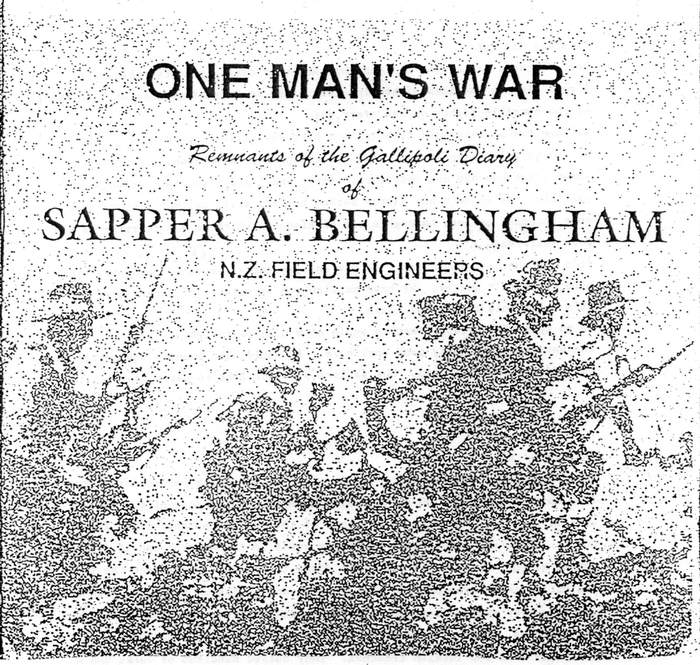
Figure One Man’s War — Remnants of the Gallipoli Diary of Sapper A. Bellingham, N.Z. Field Engineers
One Man’s War — the Gallipoli Diary of Sapper A. Bellingham
April to November 1915. Beginning of Diary destroyed.
Tuesday April 20th.
More land in sight this morning. Destroyer still with us. At 11 o’clock we sighted the island of Lemnos, which is about 40 miles west of the Dardanelles. At 12 o’clock we entered a jolly fine harbour in Lemnos and were surprised to find it full of ships of all kinds. Transports, battleships, cruisers, destroyers, submarines etc. Some English, French, Russian.
Gee! It was a grand sight. I’ll never forget it.
Sunday April 25th.
Left Lemnos this morning at 9 o’clock. Transports had been going out all night.
11 o’clock. We can hear the guns firing quite plain now.
12 o’clock. We are now close to the land. Our big naval guns are firing. Turks are shelling our ships.
2 pm. Shells landing near the ships. We can see our men on the beach under the shelter of the cliffs. There are hills running right down to the shore. It looks like a very difficult position to attack.
5 pm. The first batch of men from our ship was taken ashore by a destroyer. Ernie and I in the first boat. Shrapnel and bullets skipping round us as we got near the shore. We all had to jump into the sea and wade ashore. Some of our chaps got wet through by falling over as we had our rifles and full packs on.
After landing we entrenched ourselves on side of hill. Bullets were whizzing round us.
Saturday May 1st.
Gee! I can’t write down all that has happened during this terrible week. I must give up the idea of keeping this diary as it’s worse than hell to think of the horrible sights we see every day.
We have had a weeks hard fighting and have now gained a good hold of these hills and we’ll keep it too. All the troups here have done splendidly and shown great courage and endeavour. Ernie and I stick together as much as possible. We’ve both had narrow shaves but are still smiling. Ernie took some shrapnel bullets through a tin of biscuits which he was carrying on his back yesterday.
It’s now nearly 5 weeks since we saw any pay but as we can’t spend anything here it doesn’t matter. We have no blankets or waterproof sheets here yet so it’s a bit cold and wet at times.
We go up to the firing trenches again at 9 o’clock tonight.
The navy has done jolly good work here. It would have been an impossible task to land without their aid. Our sailors are just fine to watch, so cool too.
Monday May 24th.
Today has been a very exciting one for us. An armistice was declared from 7.30 this morning to 4.30 pm this afternoon for the purpose of burying the dead. Gee! it was very necessary too as some of the bodies had been lying for a month. There was practically no firing early in the morning and at 7.30 it ceased altogether. It was a strange sight to see our fellows and the Turks hop out of their trenches and walk towards one another. Ernie and I went up but they soon sent us back as only the burial parties were allowed between the trenches, which at this place (Pope’s Hill) are only from 10 yards to 100 yards from the Turkish trenches. They buried hundreds of Turks and a good number of our men. The Turks and our men were talking together (a few of them could speak English) and exchanged cigarettes.
It does seem to me to be a peculiar world in which we live when we cannot think of any other way of settling disputes, without murdering one another.
It was fine to be able to walk about all day without continually ducking your head to dodge shrapnel, ‘Jack Johnsons’ and bullets. At 4 o’clock the men on both sides got back into their trenches and in a very few minutes were hammering away again just as if nothing had happened.
Every day we get one or two Turkish deserters coming into our lines and they all say that they don’t want to fight us.
Ernie and I went up as soon as the armistice was over and worked until dark.
Tuesday May 25th.
Ernie and I worked from 4 o’clock this morning to 12 midday.
Just as we came down at 12 o’clock we saw a damn Turkish or German submarine sink our Battleship the ‘Triumph’. She is a 2nd class ship but had been doing good work here. Gee! it was rotten to see her sink. Ernie and I saw the whole thing from beginning to end as we were on our way down the hill. A big cloud of smoke suddenly rose up from the middle of her and we all shouted “the Triumph is hit”. The whole thing seemed to be over in a minute but it was really 15 minutes. Several Destroyers and Trawlers rushed up to her and saved as many men as they could. The cursed Turks were putting shrapnel on the rescue boats all the time and we could see it bursting over them. As soon as she was hit she began to settle down in the water and keel over and in five minutes she was gone.
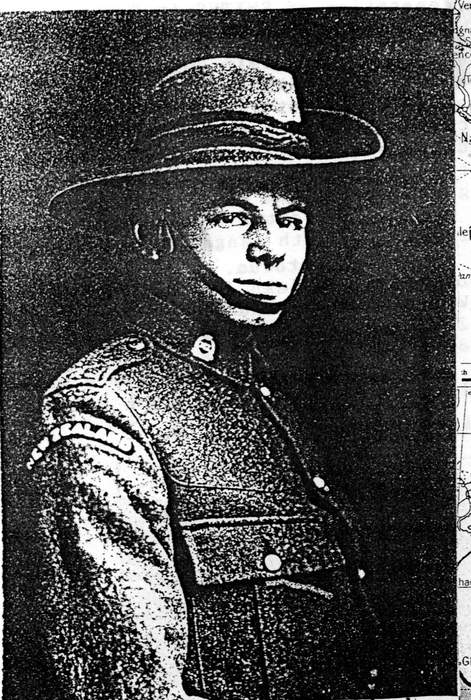
Sapper A. Bellingham, N.Z. Field Engineers.
Thursday May 20th.
Ernie and I were on together at 8 o’clock this morning. We carried up some heavy timber for head cover. I think I must have strained myself in doing so, anyway I knocked off about 10 o’clock as my back ached.
There was great excitement this evening when the firing suddenly ceased at 7 o’clock. Orders came right along the whole line to cease fire and in a few minutes not a shell could be heard except the big naval guns away over in the narrows.
Our men hopped up out of their trenches to have a look at the Turks who were doing the same. The interpreters with white flags were having a conflab between the trenches. Two Australians brought down a Turkish Officer blindfolded. He had given himself up.
Gee! it was a wonderful change. The quiet after a month of hard fighting. I believe there was more excitement during that lull than when the firing was on. The truce lasted until nearly dark when suddenly the firing broke out louder than I’ve ever heard it before. The noise was terrific – it sounded as though the world was coming to an end. Most of us think that it was a cunning dodge on the part of the Turks to get a good view of our positions and also to give them time to bring their guns up from behind. The noise was so great that for a while we had to shout to one another to make ourselves heard.
Gee Whittaker! I’ll never forget that night as long as I live.
The enemy just poured shrapnel over us.
By this time it had got dark, but the flash of our guns and the bursting of shells lit up the whole sky. It was great to see the ships putting in their big shells. We could see the flashes from the sea. The enemy must have lost large numbers of men. From the trenches we can see hundreds of dead and some only a few yards from us too. The battle was still going strong at 11 pm but I don’t know quite when it died down as I fell off to sleep then.
The Smith Family of Gwendoline Street
RAY SMITH of Gwendoline St., 4th. generation of SMITHS in Rotorua.
1890s, WILLIAM SMITH came to Rotorua as well as his 15 yr. old son ALBERT SMITH who was Ray’s grandfather, who in 1915 bought Albert Block of land near Whakarewarewa, bordering Arikikapapa Golf Course. He bought from Mr. Mansfield, leasehold at first, later as freehold. Mr. Mansfield was a Prison Officer. Later, when the family subdivided, the road was formed on the ‘Track’ from Fenton St. across Golf Course. This was named Gwendoline St. after the death of a close friend’s child. It was formed mid-1920s, running through Albert’s two acre Block, Smith’s property went back from the cnr. of Fenton St. & Sophia St. back up a long drive near Worthington’s & Kath Langguth – 52 Sophia St..
The 4 generations of Smiths in Rotorua
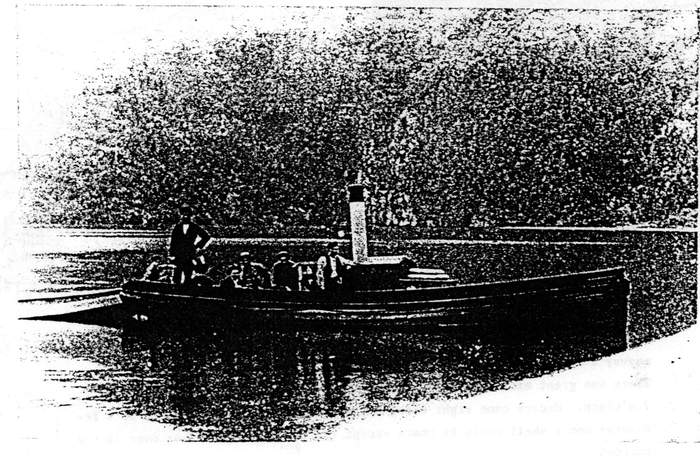 1. 1895, William Smith, ran transport boats on lake for Moss Boord.
2. 1895, Albert, 15 years, son of William, married Adeline Green 1899. 1915, purchased Gwendoline St. 2 acres for home & transport work.
3. Albert Percy Smith (Bert), son of Albert, had 1st. bus Whaka-to-town.
4. Ray, Frank, Sidney, sons of Bert. Land subdivided so that Ray’s was Fenton St. frontage opp. Gwendoline Court Motel, then Frank’s & Sid’s.
Note: information from Don Stafford’s ‘Founding Years in Rotorua.‘
F. Moss Boord’s Passenger Launch Enterprises, Pontoon, Sulphur Shipping
1891, Moss Boord bought the steam launch, ‘Alice’ from J.M. Logan, thus his association with Rotorua began, lasting till his death in 1955. He went into partnership with Herbert MacDonald for lake excursions. 1892, the ‘Alice’ was overhauled for a new enterprise – towing a newly built pontoon loaded with sulphur mined by the Maoris at Tikitere & Taheke, taken by dray to Mourea or by the Whakatane turnoff for shipping across Lake Rotorua. (Previously, J.H. Taylor mined sulphur – 1889, using bullock waggons to reach railhead at Tirau, then railed to Auckland, but his sulphur was in Rotorua at back of Race Course – ‘Sodom & Gomorrah’.) ‘Alice’ also pontooned firewood from Waerenga Maoris. (2nd. boat ‘Mokoia’.)
Whaka Native School and the Bus Business
Whaka Native School was blessed for many years by having the renowned Mr. Banks as Headmaster who ran an outstanding school for both Maori & European pupils.
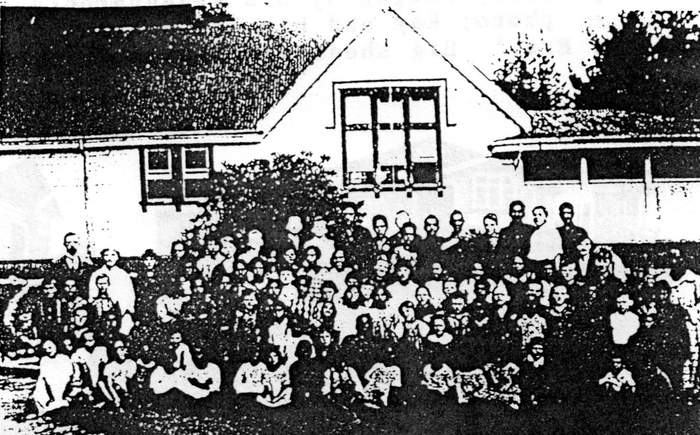
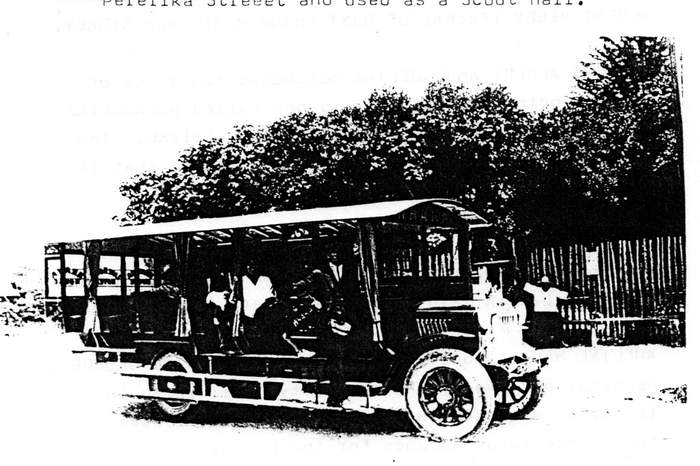
Whaka Native School, 1926. RAY and brother SIDNEY in photo. The school situated on present second green at Arikikapakapa Golf Course. School building removed in 1942 and is now situated by Rotorua Boys’ High School, Pererika Street, and used as a Scout Hall. (Caption by Betty Smith.) Below: A. Smith & Sons bus.
1921. Albert Smith (Snr.) had the 1st. bus run from Whaka to Rotorua township. This became ‘A. Smith & Sons’. (Bert & Sidney)
Mid 1920s, Albert Smith worked towards co-ordinating the operating services for sight-seeing as competition was becoming unpleasant. By 1929 the ‘Rotorua Bus Company’ was formed with the main operators, Jimmy Diver, Mau & Son, Albert Oakes, Arthur Robinson, A. Smith & Sons.
Note: Don Stafford’s ‘New Century in Rotorua’ quotes: ‘All you had to do was arrive with a motor car and you could start a service if you thought you could get the passengers … a train came at night, and of course, there’d be eight and ten carriages. Everyone was down there, all the bus drivers and these blokes were fighting each other … there was hell to pay … all trying to get passengers to hotels & boarding.’
Ray Smith’s Boyhood Home and Adeline Smith
Ray Smith’s (born 1921) boyhood home near Whaka, with his parents, on the property bought by his grandparents in 1915 – Albert and Adeline. Inset photo: Ray and his brother parading signs of ‘Rotorua’s 1920 Motor Era.’ Big sheds were built on the property to house buses.
(Article written by Mary Smith.)
ALBERT SMITH, grandfather of the writer RAY SMITH, came to Rotorua in 1895, aged 15 years.
Married ADELINE GREEN in 1899. They had three sons – ALBERT PERCY (father of RAY), FRANK BASIL and SIDNEY.
In 1915 ALBERT and ADELINE purchased two acres of land on both sides of what is now called GWENDOLINE Street, named after the daughter of a friend. The street was formed in around 1924; prior to that it was a private drive.
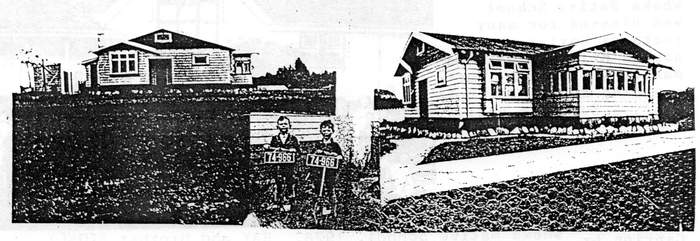
Ray Smith’s boyhood home near Whaka. Inset: Ray and his brother beside signboards from ‘Rotorua’s 1920 Motor Era’. Below: the laundry building on the Gwendoline Street property.
In 1921 A. SMITH and SON formed a bus company, running between Rotorua and Whaka. This was eventually merged in 1929 to form the ROTORUA BUS COMPANY.
ADELINE had a laundry contract with the KING GEORGE V Hospital and employed over twenty Maori women in laundries situated in Gwendoline Street. Also, there were large garages for the buses.
ADELINE was one of the first ladies in Rotorua to own a motorcar. Also, there is a Rotorua Golf Club Cup named after her.
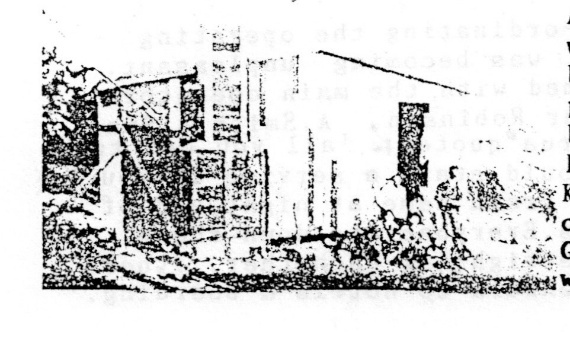 Adeline Smith had the laundry contract with King George V Hospital, which was built for returned soldiers of W.W.1, employing Maori women. The laundries were built on the property along Gwendoline Road, which was formed in 1924. Kath Langguth remembers puzzling over the strange odours and steam from these as she passed. Gwendoline St. is now delightfully modern, with lovely homes, some belonging to Smiths.
Note: pages 144, 145 and 146 have no corresponding scans in the source folder and are omitted here.
Colonel R. F. (Ray) Smith, CBE, OBE (Military), ED
RAYMOND FRANCIS SMITH was born in 1921. Educated at the Whaka Native School and the Rotorua High School, now Rotorua Boys High, gaining his University Entrance. He left to join the N.Z. Loan and Mercantile Coy. During this time he and his brother contracted to deliver the Rotorua Morning Post, as the present Daily Post was then known, to Te Puke. Many years later at a function to commemorate the Rotorua Post’s 25th Anniversary in 1956, the Managing Director Mr. Ted Guy recalled the following story:
“In response to representations from residents of the district, the ‘Post’ then a morning paper decided to make a delivery in Te Puke. Tenders were called for the conveyance of the papers and the successful tender was submitted by two brothers then aged 15½ and 17. They acquired a Model A Ford car and took it in turn to pick up their copies of the ‘Post’ every morning at 4 o’clock, take them to Te Puke and return in time for work. The war put an end to this when both boys joined the army. “Can you wait half an hour?” the editor asked the young newspaper delivery contractor. “We’re waiting for the ultimatum on Poland”. The place was the office of the Rotorua Morning Post, the date September 3rd. 1939, the event the declaration of war and the people Mr. Ted Webber, editor and Ray Smith, 18. By 4.30 a.m. that day Ray had loaded the newspapers into his car and drove off to Te Puke. “I’ll never forget all the cockies waiting at the roadside at Paengaroa Flats for the paper”. Most who complained about the state of the highway today (1956) would scarcely appreciate what hazards were involved in driving every morning to Te Puke and back “come hell and high water”. Sometimes it was high water, many times it was hell, said Mr. Guy”.
In 1940 RAY enlisted in the Hauraki Regiment. He gained a commission in 1942 but relinquished it in 1943 at the age of 21 to serve overseas. He sailed with the tenth reinforcements in that year, serving with 24 Battalion throughout the Italian campaign. He was recommissioned in 1943, returning to New Zealand at the end of the war with the rank of Lieutenant. When the armed forces were reorganised after the war, he joined the reserve, being appointed to the Hauraki Regiment as company commander of the Rotorua Company with the rank of Major. He was appointed commanding officer of the 6th Hauraki Battalion from 1955-60 and Hon Colonel
1962-74. In 1957 he was awarded the Efficiency Decoration. This award is for Territorial Officers only, who have served for 15 consecutive years. In 1958 he was awarded an OBE in the Military Division of the Queen’s Birthday Honours.
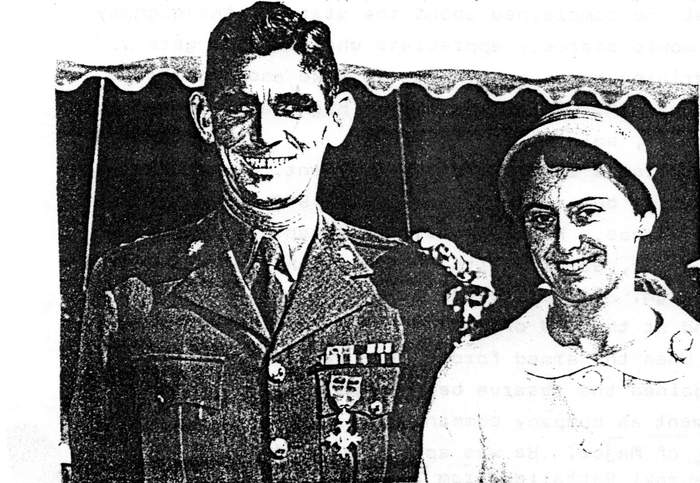
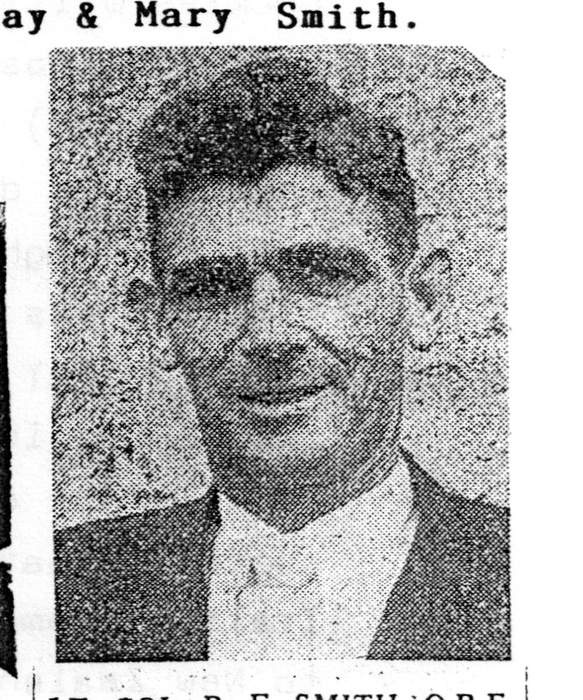
Below: Ray & Mary Smith. Ray Smith, 1958 OBE, 1992 CBE. Right: newspaper clipping, ‘Haurakis Colonel wins O.B.E.’ – Lt. Col. R. F. Smith, O.B.E.
On returning from the war he started work at the Rotorua Post as Advertising Manager and when this paper merged with other provincial papers to become the United Printing and Publishing Coy. he became General Manager, Managing Director then Chairman. In recent years United Publishing has become the provincial arm of Wilson and Horton Ltd. of which RAY is a director.
In 1982 he was elected the first non-metropolitan president of the Newspaper Publishers Association, for the previous 10 years he had led the Association’s provincial newspaper section. He is also the New Zealand Trustee on the London based board of Reuters and apart from his NPA role, chairs the New Zealand Press Association and Newspaper Advertising Bureau. RAY is recognised as an authority on communications developments in newspaper fields and helped introduce the Web Offset printing system in 1963.
In 1992 he was awarded a CBE in the Queen’s New Years Honours for personal commitment and achievement over a career stretching back some 50 years in the newspaper industry.
RAY married MARY EWERT, daughter of another well known Rotorua family in 1949 and they have two sons, Keith and Robert, who were educated at the Rotorua Boys High School and are now accountants in Auckland.