
Extracts from Daily Post Feature, 1991
In 1989 Roger was offered an amount of money far exceeding anything he’d ever dreamed of for his old home on the corner of Fenton and Marguerita Streets. Roger is showing visitors around his spacious new home with all the enthusiasm of any new home owner. He traipsed happily around Rotorua for weeks before deciding on this one, just up the road from his old place. It’s hard to believe he’s in his ninth decade. In the house, shared with his cousin Dick Dansey, aged 70, he opens the doors of fridge and freezer, lifts the lid of the new washing machine, switches on the chandeliers, discusses the pros and cons of a waste disposal unit. He’s plainly delighted with all his new acquisitions.
Painful
‘My knees were very painful with arthritis,’ Roger says. ‘I found a new doctor and he put me on a special diet and told me to get a bit of exercise. “I can’t run 10 yards!” I told him. “Run 9 then”, he said.’ ‘So I started off like that and went a bit further each day until I was going around and around the race course. I used to put 10 little stones in my pocket and every time I went round I’d throw one out so I knew how many laps I was doing.’
 The television crew found not only a man in his late 70s who was running 10 miles every day, but also one who’d recently launched his own successful business, making wooden clackers (the kind you cheer on your team with at football matches), and pop-guns out of off-cuts from the Waipa sawmill. As well as giving his sales a tremendous boost, the aftermath of the programme saw Roger receiving stacks of mail from people all over New Zealand, inquiring about his toys and his cured arthritis, or just congratulating him for his zest and enthusiasm.
Writing
‘I had women writing, asking me to go and stay with them. I could have got married half a dozen times!’ he laughs. Roger no longer runs 10 miles each day, but he still enjoys making his toys, although in much smaller numbers than he used to when he was a lad of 80. The older of two boys, Roger was born in 1899 in the old Kusabs homestead ‘Moerangi Villa’ which used to stand on the corner of Rangiuru and Pukaki Streets. (A translation of Moerangi is Heavenly Sleeping Place). He believes himself to be the oldest man still alive in Rotorua, who was born in the city.
Surrounds
‘We had six fireplaces in our house. I remember my mother used to go up to Pukeroa Hill, where the hospital is now, to get pure white clay from the banks along Rangiuru Street. When she got home she’d mix it with water and paint it on the fire surrounds to keep them clean.’
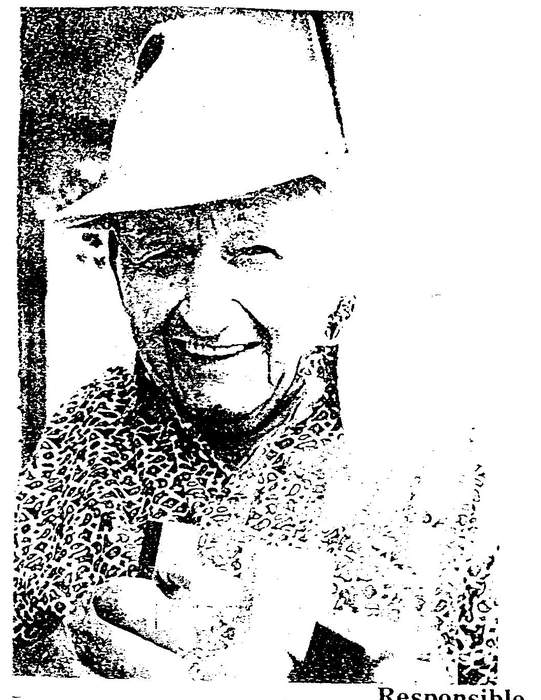
 Running a hand over some ancient scars on his bald pate, he laughingly recalls the time he tried to intercept a cat fight.
His father had three launches for taking tourists around the lake. ‘You’d go across the lake and transfer into a rowing boat at Hamurana. You’d be poled up to the springs and with all the native bush overhanging the water it was like going up into the jungle. It was a real adventure. There were many more hot pools around the lake in those days, some of them quite tiny — about six inches in diameter. We used to catch koura and pop them into one of these little pools and eat them straightaway.
When Roger was a boy, Christmases were spent at the Dansey farm at Tarukenga near Mamaku. It was a long haul by buggy from Rotorua, with frequent stops for the horses to drink. ‘There was a trough where the Lake Hotel is now; at Fairy Springs you’d swing the horses off the road into the stream; and near Ngongotaha there was a stream running right across the road.’
‘The whole family gathered for Christmas. Even though he was married to a Maori woman and spoke fluent Maori himself, my grandfather never really became a colonial,’ Roger reflects. ‘His dress was immaculate, he always carried a cane, and he liked to keep to the old traditions. We had traditional English Christmases with plum pudding and all the trimmings. ‘At New Year people would come from all over the North Island to see the parade. They’d knock up a wooden stage for the day in the town square — where the Civic Theatre is now — and there would be concerts and singing. The floats were always beautifully decorated and there would be lights in the macrocarpa trees that surrounded the square.’
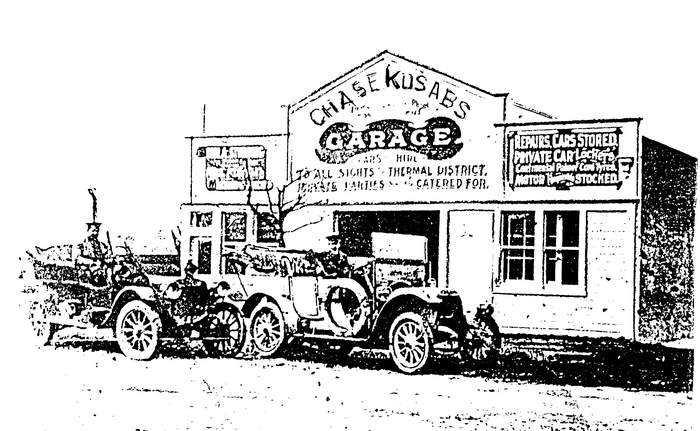
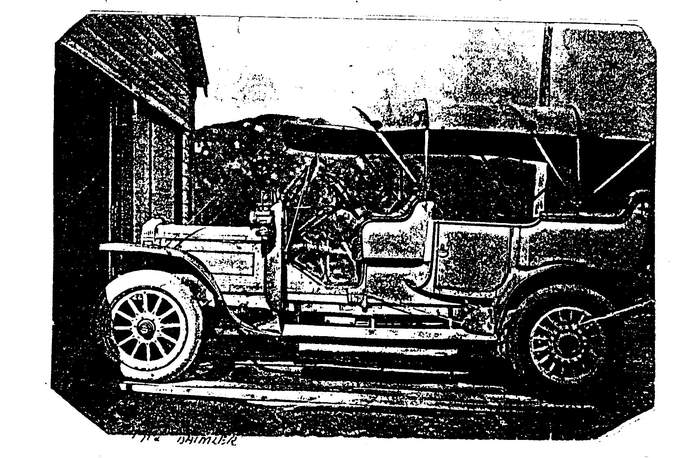
Roger’s education began in Rotorua, but after his mother died when he was about eight, he was sent to King’s College in Auckland, returning to Rotorua when his father remarried a couple of years later. He then attended Rotorua Primary School.Later, he remembers, his father bought ‘the flashest car in Rotorua.’ A shiny black Humber. He took Lord Kitchener out to see the sights in it. As a young man Roger worked in sawmills around the North Island as well as stints at flax cutting, possum trapping and surveying.
Cookhouse
‘The toilet was only about 20 yards away from the cookhouse and was just an open drain with a log over it that you sat on. ‘I got about 2 pounds 10s a week there. When the armistice was declared after World War One, they let the whistle blow all day.’Later I worked at a sawmill near Atiamuri where a murder was committed. A duck-shooter shot his hunting mate — both barrels in the back of the neck. He pinched his money and pushed him into the river. Police suspected foul play because the murderer began spending money about the place. They had divers going into the river and policemen all the way from Auckland. A murder was a rare thing then. ‘It left a dreadful dark feeling over the place and I was glad to leave.’
It’s hard to believe that possums were once a protected species in New Zealand. The trapping season was limited and restricted to certain parts of the country. Roger and a couple of mates decided to try their hands at trapping when they heard that skins were fetching 13 shillings each. They outfitted themselves with traps and supplies and headed for Waikaremoana. ‘The first job I had was at a sawmill down in the King Country. It was in a gulley where the sun never seemed to shine and it was always dreadfully cold. The first thing a new man had to do was to go down to the stables and get sacks to make himself a mattress and blankets.’
Horseback
The road only went as far as Te Whaiti, so from there they went on horseback through the bush, guided by Maori from Ruatahuna. When they arrived at the government designated area it was to find dozens of other men with the same idea, all guarding their territories jealously and a trapping spot hard to come by.
Roger can’t remember how many skins they took, but he recalls that they decided to take them down to the skin sales in Wellington. Three-quarters of the way down the island the price had dropped to five shillings, out of which the government took two shillings.
Flax Cutting
Roger decided to look for work and got a job cutting flax just outside of Shannon. He never heard from his friends again and was never recompensed for the money he’d put into the venture.
A later foray into possum trapping near Paekakariki proved more successful, and in Wellington he was able to buy a Ford car for £40. ‘There were three pedals, one for forwards, one for reverse, and one for the brake. There was no such thing as drivers’ licences or warrants of fitness in those days.’
It took three or four bone shattering, dusty days over roads riven with pot-holes to get back to Rotorua via Napier. The car was left with a mechanic after skidding on a pumice-strewn road and crashing into a bank just south of Taupo.
During the depression years Roger became a fisherman. He opened his own shop in Tutanekai Street, just around the corner from Arawa Street, and put someone in to look after it while he went fishing off the coast from Maketu. ‘I had one of the greatest experiences of my life then. One night I put down my crayfish basket on the western side of Motiti Island, with a kahawai hung by the tail in it for bait. After a couple of minutes I pulled it up and there were about a dozen crayfish in it. All night I put it down and pulled it up and it was full of crayfish every time. By morning there were so many of them crawling and wriggling all over the place they almost sunk the boat! I set off for Maketu but I was too early for the tide so I fished for hapuka. ‘I caught plenty of them too, and had to tow them all behind me because the boat was too full of crayfish. Even after giving dozens away at Maketu I still had plenty to take back to the shop. In the end if someone came in and bought a snapper, I’d give them a crayfish for nothing. It was the biggest fluke under the sun!’
Security
Roger decided to plan for his future security when he turned 30. He leased two sections on the corner of Marguerita and Fenton Streets for 10 pounds each and later bought the freehold for £240. He built two houses there, to ensure that he would always have both a family home and a source of income.
He resumed his work as a sawmiller in the Rotorua district, eventually becoming manager of the sawmill in Clayton Road. ‘But my life began all over again after I retired when I was 70,’ he says.
In his seventh decade he served as an outspoken and active member of the then Rotorua Borough Council. He worked voluntarily as a woodwork tutor for the Intellectually Handicapped Society and as a field officer for rehabilitating prisoners.
Then came his new career as a toymaker which saw him once again travelling all over New Zealand.
‘I could get $2000 worth of pop-guns in the station-wagon. It was like a holiday. I’d just load up the car and set off. I had no trouble selling them to toy shops, even service stations. When I got tired I’d book into a motel for the night, and when I’d sold the last pop-gun, I knew I’d made $2000. I had to get the dry cleaners to extend the pockets of my trousers so I could fit all the money in,’ he jokes.
When he was 85 he sold pop-guns and clackers all the way down to Ashburton, a town he’d last visited 75 years before.
 Roger still enjoys driving. ‘If I happen to want to go to Hamilton or Auckland I chuck 100 or so pop-guns in the car and sell them to a shop in Hamilton. That pays for my fare.’
Responsible
He is responsible for all the grocery shopping, attends church every Sunday and enjoys a game of indoor bowls on Wednesdays. A keen footballer in his youth, he will stay up all night to watch a game on television. ‘When I was young the football field used to be on Pukeroa Hill. There was a big stink when they wanted to build a hospital there because everyone loved their football. We used to get changed behind the trees and our jerseys were flour sacks with holes cut in for our heads and arms. They were good because they were so tight that no-one could grab hold of you by them.’ He is enormously proud of his five children, his grandchildren and great-grandchildren whose professions include accounting, teaching, and science. On July 22 this year he will be 92, although he doesn’t think he will have as big a party as when friends and family gathered at Apumoana Marae to celebrate his 90th birthday 18 months ago. ‘When my son said they were going to organise a party for me I thought he was mad. “Who’d come?” I said.’
About 250 did.
In this part:
- War Heroes Commemorated by Street Names — Tilsley, Sumner and Wylie Streets
- Wylie Street.
- Mr A. L. White, Bath House Physiotherapist
- Mrs Annie White
War Heroes Commemorated by Street Names — Tilsley, Sumner and Wylie Streets
War heroes commemorated by street names, Wylie, Sumner and Tilsley St.
D. Tilsley, was a W.W.1 Rotorua hero. He is thought to have worked with the Native Land Court. He is remembered for gold prospecting — 1900, in Ngongotaha area at Kaharoa to as far as Katikati, unsuccessfully.
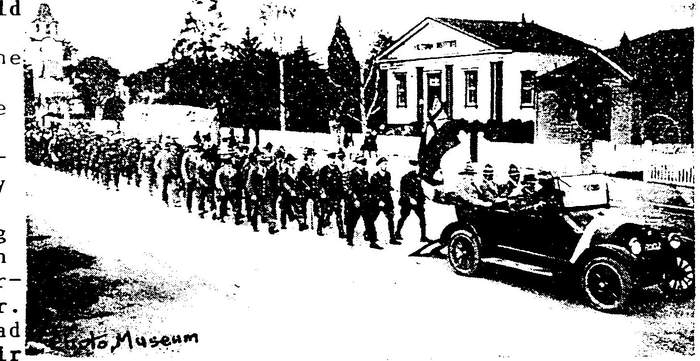 Major Sumner, first World War, had a fine war record. In civilian life he worked in the Native Land Court. Note: quote from Don Stafford. ‘In 1924 a service at Ohinemutu at which six very special flags were delivered for safekeeping in St. Faith’s Church. On the marae were territorials under Major Sumner. Six old veterans who had fought with Captain Mair almost 60 years before, appeared, each bearing a standard. H. Tai Mitchell received the flags and handed them to the clergy. This was in accordance with the wishes of the late Captain Mair. These six flags were borne by the friendly Maoris in the wars of 1865 to 1872.’
Major Sumner lived in Ranolf St., near Victoria St. Elderly Mrs. King remembers him in his latter days having a sleeping tent on his lawn, reason unknown, but a strong possibility could be results of W.W.1 experiences when the Germans used ‘Mustard Gas’, affecting soldiers’ lungs, so fresh air was important. Also, T.B. was prevalent then.
Wylie Street.
Named after prominent Wylie family, from Fenton St. through Ranolf St. Joseph Wylie, 1886, owned new Rotorua’s first store, N.E. cnr. of Arawa–Fenton Sts., known as the ‘Pioneer Store’. Soon sold to T. Corbett, ’89. Joseph and Ellen’s two sons, James and Frederick Wylie rose to fame.
James Wylie, born Rotorua, became in 1913, our first All Black, touring British Columbia and California — loose forward, N.Z. winning all games.
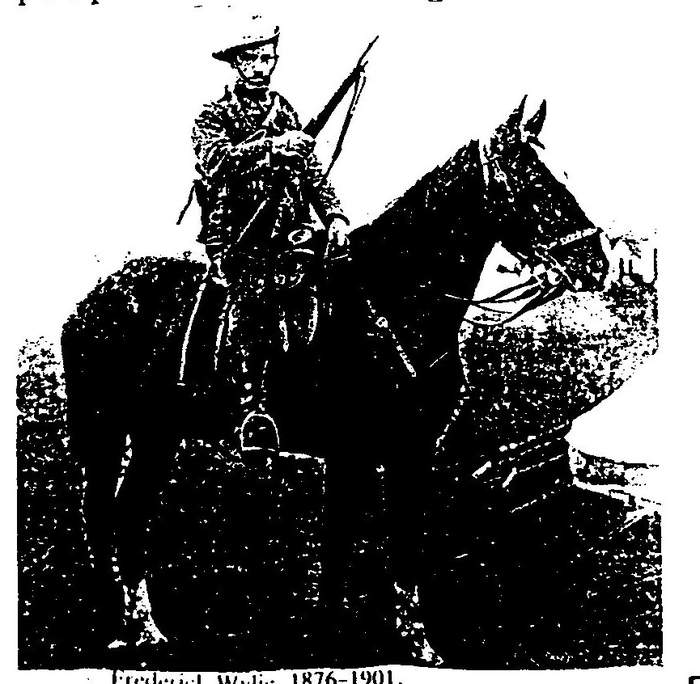
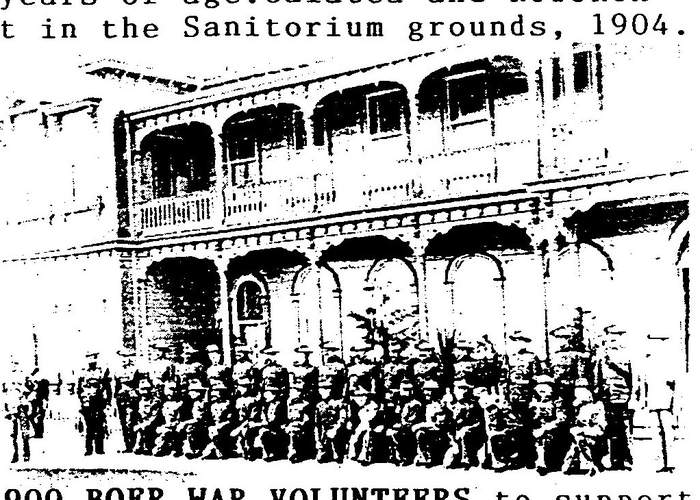
Frederick Wylie, 1876–1901, when teaching with his wife, Galatea, in 1900, left with N.Z.’s fourth contingent for South Africa to support Britain against the Dutch in the Boer War (1889–1902). Within a year he was promoted to King’s Sergeant after he recaptured, unaided, a 15 pounder gun and taking two prisoners. He then joined the 7th. contingent, known as the ‘Rough Riders’ and was killed leading an attack at Klipfontein, 26 May 1901, at 25 years of age. Galatea and Rotorua people erected a granite monument in the Sanitorium grounds, 1904.
|
Frederick Wylie, 1876–1901 (Stafford Coll./W. Springrice). |
1900, Boer War Volunteers, to support British against the Dutch in South Africa, taken in front of 1st. Grand Hotel, N.W. cnr. Fenton–Hinemoa Sts. |
|---|
A Mr. Wylie, very early 1900s, (related to Galatea Fred Wylie) had farm property between Whaka Rd. and Ranolf St., according to a Mr. Keith Richards who came to Rotorua as a young lad with parents in 1914. His father established their carrying business between Arawa and Haupapa St. where R.S.A. is, leasing the stables from Sam Hale who went into the Ford Motors. 1910–1920 saw the last of horse-drawn coaches.
Keith remembers also, after time of Wylie’s farm, the R.M. Coaching Co. paddocks, for their horses, from Ruihi St. up to McLean St. by Devon St. Note: McLean St., originally planned from Ruihi St. but not developed, as now extending from Sumner St. through Wylie St. to almost Sophia St.
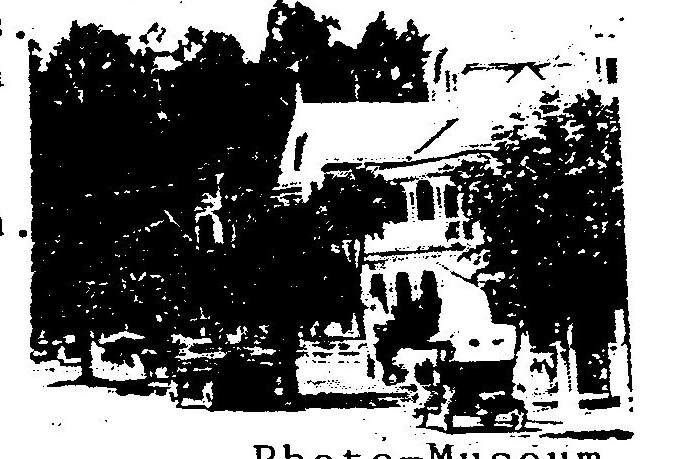 Mr. J.N. McLean, was prominent in the business affairs of Rotorua from about 1910 onwards. He was involved in tourist accommodation. By 1907 McLean’s ‘Australia Inn’ was being advertised. This was at the corner of Tutanekai St. and Amohia St., across from the Railway Station. Next, he built the ‘Empire Hotel’ in almost the same position, this being very popular and convenient for travellers.
1920, J. McLean was the President of the Rotorua Chamber of Commerce when the Prince of Wales visited here. For one year, he was also elected 1929, as Mayor, between Mr. McDowell and T. Jackson. Like many hotel owners, it was necessary for them to own a produce farm. McLean’s farm was enclosed by the Utahina River, Malfroy Rd. even before there was a bridge there, and the drive to it was off Whitworth Rd. They had dairy produce, poultry, and particularly fine rows of raspberries as well as fruit trees.
Grey Street. In 1849, Governor Grey first visited Rotorua, Ohinemutu, travelling with his party from Auckland by ship to Thames, then overland, walking such poor tracks that they became lost several times before reaching Lake Rotorua. They went by canoe to TeNgae to visit Rev. Thomas Chapman who had settled permanently in Rotorua in 1835, in 1840, first occupied the TeNgae Mission House.
1866, Sir George Grey, while on tour of N.Z., visited Rotorua in those troubled times of warfare, meeting Arawa Chiefs and 2 from Taupo. By 1865, the Arawa people had committed themselves to fighting against the religious Hauhau movement originating in Taranaki under prophet Te Ua. Grey came by boat from Auckland to Tauranga, overland to Lake Rotoiti, then by war canoe to Ohinemutu. After several days he went to Te Wairoa to visit Rev. S.M. Spencer at his Mission Station and also to see the famous Pink and White Terraces.
1879 the Maori Great Committee sought audience with Sir George Grey, resulting in all private agents for surveying and leasing Maori lands should be removed, then arrangements left in the hands of the Government so that lands auctioned had proceeds benefitting Maoris. 1884, the Governor General presented the carved wooden bust of Queen Victoria which stands on the marae at Ohinemutu, to Ngati Whakaue people, at the unveiling ceremony. He arrived from Tauranga the day before, his coach being met at the Utahina Bridge by the residents, where the horses were taken out and the natives and Europeans pulled the coach up to Lake House. Over 300 people witnessed his arrival.
1892, Sir George Grey visited the district, staying at Lake House, where the Rotorua Brass Band paid its respects to this veteran statesman with a two hour evening performance of splendid music.
After a week, he returned by coach to Oxford, and train to Auckland. 1894, he made a final visit to Rotorua before his departure back to England, where he remained till his death in 1898.
Note — above information from Don Stafford’s book, ‘Founding Years Rot.’
Mr A. L. White, Bath House Physiotherapist
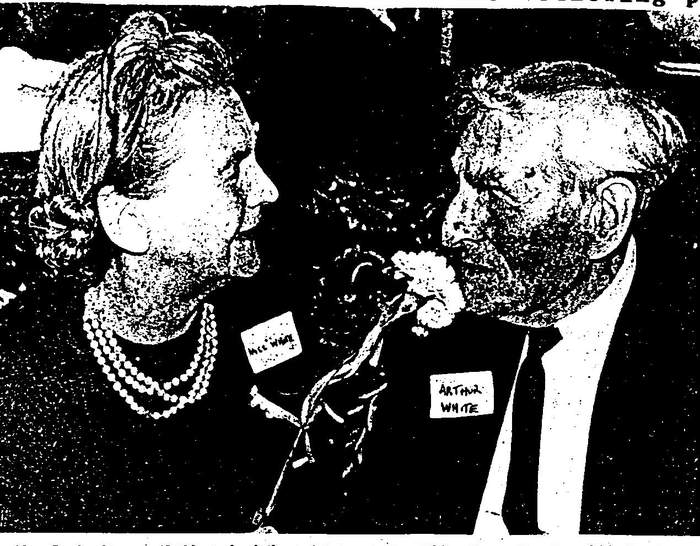 Mr. A.L. White, 1915, came to Rotorua as Bath House Physiotherapist. He settled in Peace St. where his daughter Verna is still living. Verna White has written the following pages on old identities and streets.
‘My father came to Rotorua in 1915 where he was engaged as a physiotherapist for the Tourist and Health Dept., and worked at the Govt. main Bath Buildings Health Spa. Mr. Arthur White was born in Kent, England, in 1890 and died 14/3/1981, 30 days short of 91. He was a N.Z. Registered Physiotherapist for 66 years. He gave 42 yrs. before retiring. One year we decided to count how many treatments he had given in that year and it numbered between 3,000–4,000. During that time, he had treated many influential people from all over the world.’
Photo — 1980, Daily Post.
|
General information from V.M. White. During my school years, we had the milkman call and ladle out the milk into our billies. The grocer used to call for his order and deliver it later, and the fruiter called weekly. We had to depend on steam coal and carbonettes for the coal range. I can remember the beautiful graceful kerosene lamp we had before the days of electricity. There were three very old houses on No. 3 Peace St. and Mr. Dick de Vantier bought the section, cleared and built a lovely modern home and home unit. Mr. Olaf John de Vantier established the ‘de Vantier Transportable Homes’ and also the cartage removal buildings. |
So they decided to buy No. 4 Peace Street, Rotorua, 71 years ago. It was part of the Fleurisham Estate. A wealthy Jew had bought 20 acres in this area. It meant a lot of pioneer work to get it into shape. He died 8.8.1990. His son John took over the business but has since sold his interests. The year 1980 was a year of significant events for Mr. A.L. White. 1. The Rotorua Centennial Celebrations Old Identities Luncheon at which my father and I spoke. 2. The same year Mr. White was interviewed for ‘Spectrum’ Radio Series. 3. Later in the year the Duke and Duchess of Kent arrived in Rotorua, and Mr. White had the pleasure of talking to Her Royal Highness — the Duchess of Kent. |
|---|
Verna White’s remarkable memory recalls details for the following — History of Rotorua.
Information from V.M. White, 4B Peace Street, Rotorua. South of the railway plantation to Whakarewarewa. I have been at 4 Peace Street, Rotorua over 70 years. I was born and bred in Rotorua.
As a small child I went to the Whaka Mission House Sunday School in Sala Street, across arid land between there and Maida Vale Streets, with a stream running through the midst of it which originally passed through the property at the corner of Sophia Street and Fenton Street.
The name Whaka Road was later changed to Fenton Street which runs from ‘Memorial Drive’ lakefront to the ’round-about’ at the end opposite the golf course. This particular property had a wishing well on the corner of the section. Later the vacant area was converted into an aerodrome, and the stream was diverted around the boundary of the area. In the early days there were a number of large families with small children in the Peace Street area, and the Anglicans at St. Luke’s canvassed around the various families to ask their support to send their children to the proposed Devon Street Church (Anglican) Sunday School.
The building is now known as St. Chad’s and used for the disabled and their various activities. The church was built in 1923. Naturally, I became an Anglican. We used to have regular dance evenings — called ‘Devon Street Pops’ and we paid either 1/- or 1/6d per night. The mission at Whaka was run by two Miss Bulstrodes and Miss Shoad. There was always great excitement in the air when an aeroplane arrived at the aerodrome. ‘Scotty Fraser’ and ‘Mad Mac’ — MacGregor were among the early pilots. The time came when the R.D.C. decided to move the aerodrome out to the present airport, and naturally has enlarged the area and buildings to accommodate the larger inter-island planes and to foster the tourist industry.
Later the council sold the old aerodrome sections for hotels, motels and residential housing.Mr A. White, Physiotherapist, Govt. Bath House (continued)
The massage rooms were fitted with the latest installations of electrical equipment — Bristowe tables, diathermy, high frequency, Bergonie chair, X ray, Schnee baths, Greville hot air, ionization, ferradic, and other apparatus for carrying out the most up-to-date methods of electrical therapeutic treatments.
There were other types of treatment given downstairs by bath attendants.
There was a sanatorium in the Govt. Gardens with seventy beds, where patients whose finances were restricted could receive treatment at an exceedingly moderate cost. The sanatorium consisted of cubicles and open wards. Thermal baths and massage rooms in the building provided for the more helpless type of invalid.
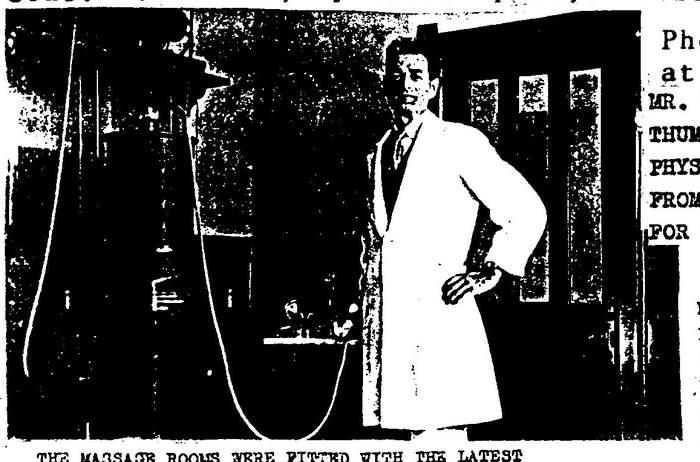 The following are just a few of the well known identities Mr. White had as patients: — Governor General of New Zealand — Lord Bernard Freyberg. Sir Archibald Edmonston who owned a castle in Scotland. Lord McGowan of England. Sir Frank Gavin Duffy — Chief Justice of the High Court of Australia, and his son Justice Gavin Duffy of Australia. Sir Robert Stout — Chief Justice of New Zealand. Sir Michael Meyers — Chief Justice of New Zealand followed Sir Robert Stout. Sir Andrew Russell — General in the first World War, and Lord Freyberg — General in the Second World War. Both these generals came for treatment on the same day, and neither knew that the other was having treatment from Mr. White until he told them. Justice Nigel Wilson — Judge in New Zealand.
Mr. White had three medical doctors for treatment in one day — on Friday 25th Nov. 1938.
Mr. White worked under Dr. Wohlman until he retired in the early part of the first World War. He was replaced by Dr. Bertram’s relative — Major General Dr. Evans, then Dr. Duncan with relieving doctors Townsend, and Dr. W.S. Wallis, then Dr. Blair.
Mr. White treated a lot of doctors at different times.
He gave 42 years of wonderful service for the benefit of humanity, as a dedicated physiotherapist, and retired April 1957.
Mr. White was born with a double flange in his thumb — in other words he was ‘born to be a physiotherapist.’ He got marvellous results from his treatments. He had a heart of compassion for those who were sick and suffering. He was there 42 years. During that time he had given treatments to many influential people from all over the world. One such patient was the former Governor General of New Zealand, and as he entered the treatment room, he would hold up his thumb to Mr. White and say ‘I want some more of your double thumb.’
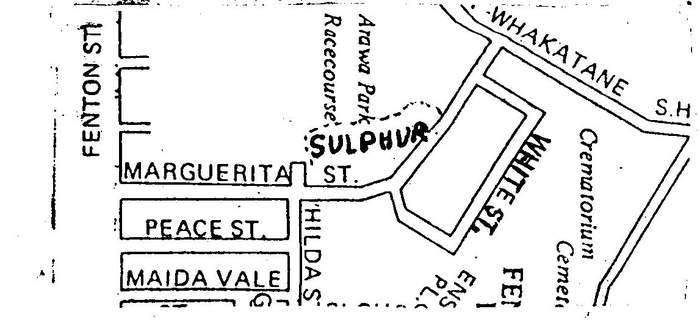 At the end of Mgt. St. is Sodom and Gomorrah and Leisure World have taken over the area for amusements etc and fenced off the dangerous pools. In the early years the parents and their young families used to go down to this area and let the children throw stones into the so-called bottomless boiling mud pool. Once there was a dreadful tragedy when a boy fell into the pool and my father was there to help to bring him out. Mr. White was a very fit and active man right up to the last moment of time. While he was walking across the lounge floor to sit in his favourite swivel chair, he had two sharp stabs near his heart region, and he was in eternity just like that, but he was prepared to meet the Lord.
My brother Cecil and I started our schooling at the original Whaka School which was then surrounded on three sides by the Arikikapakapa Golf Links. When I was in Standard 2, our parents transferred us to the Rotorua Primary School, then finished off at the Rotorua High School. Fenton Street was bituminised between Holland St. and Tilsley Street, and it was lined with poplar trees on one side of the street, and now only six trees remain near the Kingdom Hall run by the Jehovah Witnesses. I was very keen on ballroom dancing in those days and I would follow the circuit. They were clean, healthy dances, no smoking, no alcohol, and good exercise and good company. Sometimes it was necessary for me to stay with friends in town overnight who owned private hotels as my parents were concerned about my safety.
It was in the latter part of 1956 when my mother was in Auckland on holiday that she took suddenly very ill. I think she must have had a premonition that her illness would be terminal, and just prior to her departure from our friend’s home in Mt. Albert, I knelt beside her chair, she prayed and also asked me to look after Dad — she was in hospital for five weeks. So, I looked after my father for the next 24 years.
Having lost my mother who was like a sister to me, made me seek an alternative way of treating ailments, so I became interested in joining Dr. Bernard Jensen’s Health Club in Auckland which had a membership of nearly 1,000 people. We learnt a lot from Dr. Jensen’s health talks and from various local practitioners. Later, an ‘off-shoot’ from the original Health Club resulted in the formation of ‘The Healthy Life Society’ of which I was a committee member. During my working years I held many responsible positions in Rotorua, Hamilton and Auckland. While I was a sales representative for tourist publicity in Auckland, it afforded me a lot of freedom to travel between Auckland and Rotorua, and quite often Dad was able to accompany me on my trips. Finally, I decided to give up office work etc and stay full time in Rotorua.
Mrs Annie White
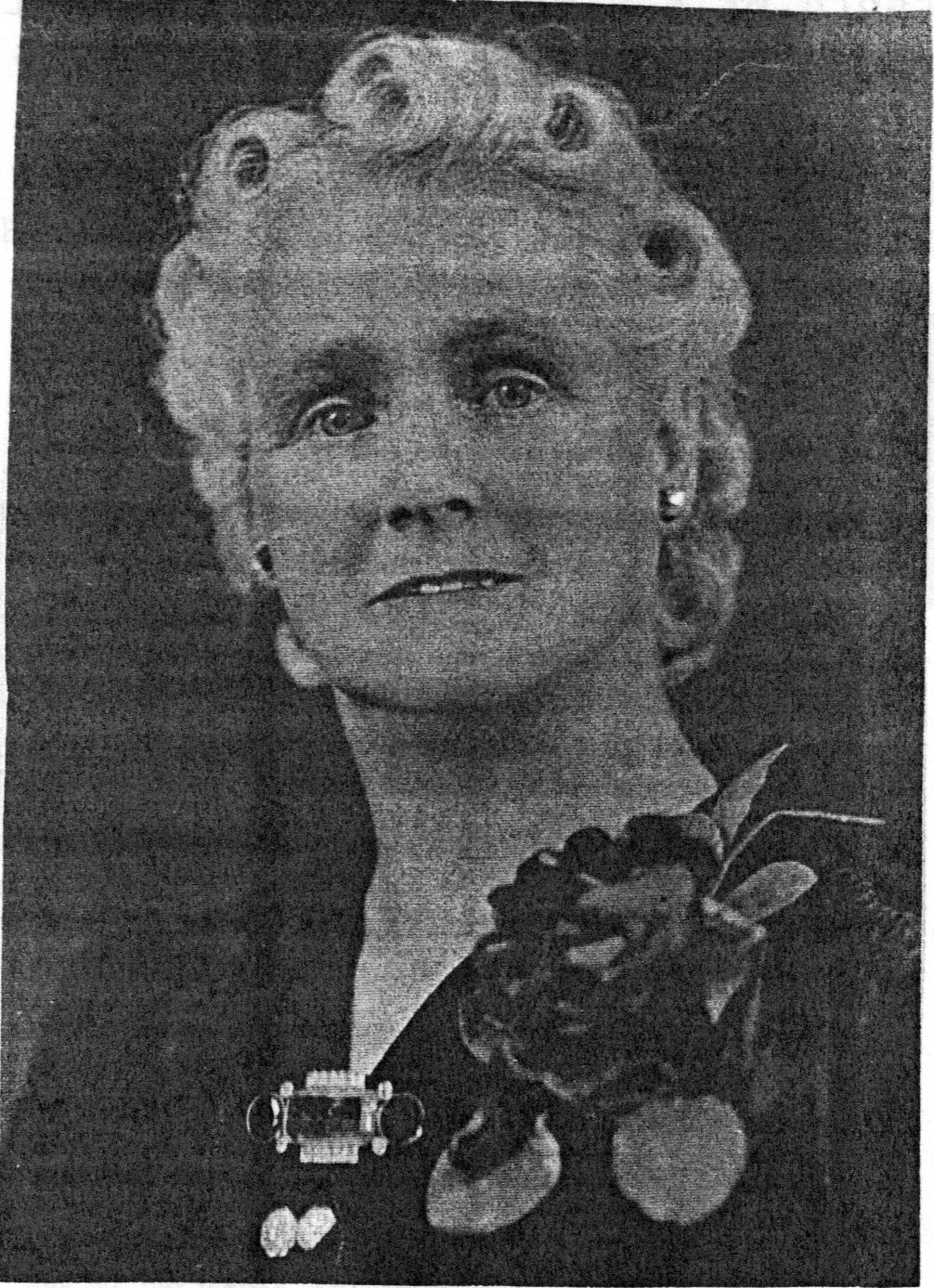 My mother came from a pioneer family who settled in Dunedin and Christchurch, N.Z. She was the youngest daughter in a family of eleven. She was the only member of the family who ever drove a car. She bought a ‘Morris 8’ in 1939 and drove for 17 years.
Mrs. Annie White was a keen entrant in the annual A. & P. Shows (Agricultural & Pastoral Shows) held in the Ritz Hall (where Pak-‘n’-Save is now). The last year when she entered competition she won 21 prizes out of 22 entries and most were ‘firsts’ in those days we had to depend on a wood/coal range which also provided the hot water service. We had a small ‘Shacklock’ range with no such thing as a thermostat on the oven door, and she would have to judge the heat by her hand. Pioneering days were not easy and no car.
The night before ‘show day’ she would be up most of the night baking, and then first thing in the morning would have to take her entries in an oblong shaped ‘dress-basket’ and catch the bus at the bottom of the street. In those days we had a direct bus service from Whaka to town. It was necessary to make several trips. Most inconvenient without a car. Some of the prizes were really good. Once she won half a tonne of coal. We went through the depression years and it was not easy. It meant making ‘do’ with what we had. My mother used to do all my sewing, even turning of my school gym to make it last longer, and also made my overcoats and latterly my evening frocks. I was very fortunate to have loving, caring and capable parents.
Mrs. A. White was also interested in the formation of the Rotorua Caledonian Society and was on their committee. She made a big fruit cake and got Johnstone’s Bakery to ice it, and it was raffled by way of a lucky number, to raise funds for the purchase of kilts for the Rotorua Caledonian Pipe Band. We also had a Queen Carnival. Our regular Scottish dances were held in the ‘Ritz’.
Mrs. A.L. White. General information from V.M. White.
Snippets: in the early days public receptions to certain ‘V.I.P.’s’ such as Sir Kingsford Smith the aviator were held upstairs from the balcony of the Govt. Main Bath Buildings.
In the very early days when ‘Pohutu’ geyser played a flag would be hoisted at the Grand Hotel and later at the Tourist Office, to let people know.
Dusty pumice roads created a nuisance.