
Article written by Lucilla (Lu) Quin, 1992.
In 1912 this area was held under one title. In 1992, eighty years later, it is again one title. In the interim many, many families have had their homes there. Between 1950 and 1960, when it was used as a Nursery School for three and four year olds, over two hundred children played there. A number of children, too, enjoyed their first music lessons there. However, that is all another story. This article is simply to try to cover the first twenty years — from 1912 to 1932.
This area has always been a happy place. I hope that whatever use it is put to in the future it will always be a place where many people can find peace and happiness.
How does a town take shape? The following notes may help you to understand how development is started. In 1912 my parents were married. Dad had already been practising Law in Rotorua for four years and had bought a little, old farm cottage in the country with three and a half acres (or more than 1.4 hectare). This area was surrounded by open farm lands with no neighbours in sight, no shops, of course, or amenities of any kind. Like other people in the same situation they had to be self-supporting. Apart from the butcher calling twice a week, with meat and ice, all provisions had to be bought in bulk. Why ice? We had no frig. until 1952 but we had an icechest and some meat safes. (The latter hung from the trees.) There were large bins to hold a bag of sugar and a bag of flour. There was a house cow, chickens, an old horse — then a vegetable garden and an orchard were developed.
Of course there was no public transport. Dad used to walk to the office each day, and he had a bike if time was short. He told us how sometimes he would take Mother to the pictures — on the bar of his bike. (Silent pictures, of course, and black and white.) A car soon became a necessity as the family grew. By 1922 there were five children — by 1932 there were eight of us. The train was the normal means of distance travel. When travelling by car it was necessary to have chains, and, if wet, a potato. (No windscreen wipers.)
For the first ten years, and covering the period of the First World War, people were needed to cope with all this development. It was work for quite a number of people, many of whom were brought in from England and Ireland. Accommodation had to be supplied for them, so more jobs were made for builders, etc. Sections were opened up nearby as these people, in turn, needed accommodation. The necessary amenities followed to cater for all — this, again, creating more jobs. A bakery opened in Seddon Street, a milkman started in Pretoria Street, small shops opened up and dairy food was available from a house in Malfroy Road. This road, by the way, was known simply as the stock route or stock road. It was not sealed for a long time and in summer the dust was terrific. To try to combat this, Dad planted a thick hedge right round the corner of the property. As these amenities developed, and with the call up of many young men, the number of people needed to run our place was reduced. This, then, meant some of the property could be sold for housing.
Health in this area. One of the resident doctors of Rotorua moved from town to live in the area, and in 1922 Sister Mitchell took over the running of the King Street Hospital, where she was always on hand for sickness and accident. Maternity care was in the hands of Nurse Cassel, who used to visit in people’s homes, and Nurse Naumann, who had a nursing home in Ranolf Street, just to the south of our property. (We used to gather acorns and take her bags of them to feed her pigs.)
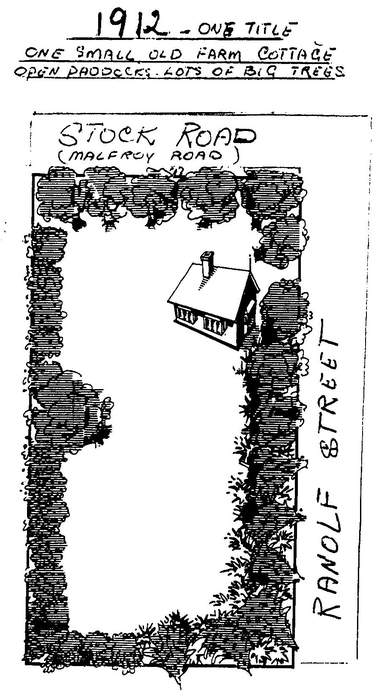
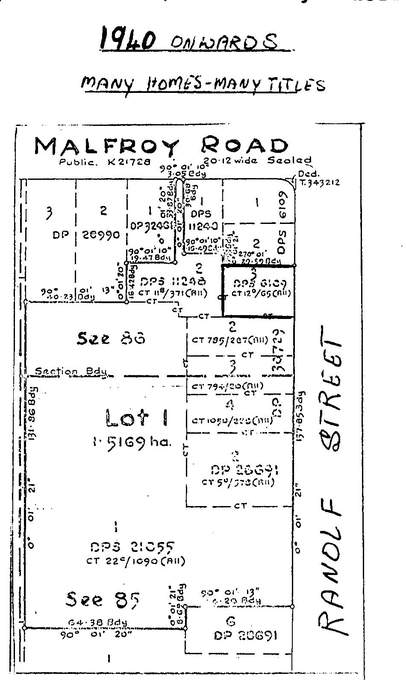
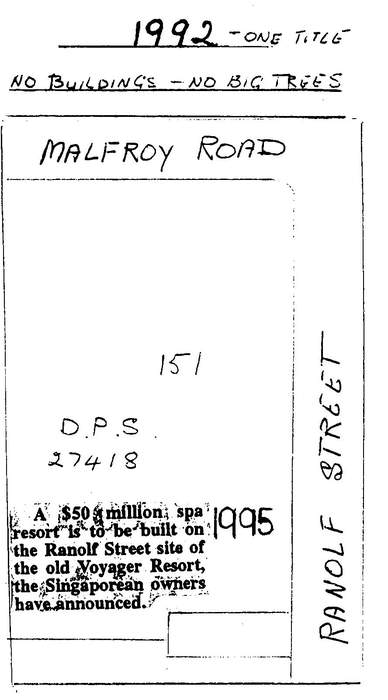
Three survey diagrams of the Hampson’s Corner property at Malfroy and Ranolf Streets: 1912 — one title, one small old farm cottage, open paddocks with lots of big trees, on ‘Stock Road’ (Malfroy Road); 1940 onwards — many homes, many titles, the block subdivided into numbered lots (DP survey plans shown); and 1992 — one title again, no buildings, no big trees (Lot 151, D.P.S. 27418).A note added to the 1992 diagram of the property reports: a $50 million spa resort is to be built on the Ranolf Street site of the old Voyager Resort, the Singaporean owners have announced, 1995.
1908, Martin H. Hampson, Rotorua lawyer, bought 3 acres of land with an old cottage on it, at the Stock Road Corner, later referred to as Hampson’s Corner, now the Malfroy-Ranolf St. corner.
Education was a different story eighty years ago. The school starting age was seven years by which time our education was well on its way, thanks to home environment and older brothers and sisters. Most children left school after passing the Proficiency examination which was held at the end of standard six. A point of interest: as recently as the nineteen forties it was against the law to TEACH any child under the age of five, though it was, of course, surprising just how much they could — and did — LEARN.
Prior to 1920 the only schools in the Rotorua district were the Rotorua Primary School, in Arawa Street; the Convent School in Lake Road, Ohinemutu; the Whakarewarewa School, in Whaka Road, (Fenton Street) towards the southern end. To cater for the growing population in this area the Convent School was opened in Ranolf Street, in 1924. A few years later when the roll at the Whakarewarewa School became too big they used the Devon St. Hall (now St. Chad’s) as an extra classroom.
In 1927 a major step was taken. To cater for the further education of the girls and boys at all these schools the first Rotorua High School was opened. It was built where the Rotorua Boy’s High School stands today. For many years the Convent School in Ranolf Street continued to give secondary education for those who so wished. They specialised in commercial classes, but some people today will remember getting their Matriculation from that school.
In 1924 the only music teacher I know of lived with her mother and taught from a lovely old home in Ranolf Street where the Thermal Gardens Motel now stands. Later she built a studio on the property. A few years later Sister Cecelia taught from the Convent where the Nuns lived. The old building is still standing.
The mention of music brings to mind the most heavenly sounds I have ever experienced. Every New Year, on the stroke of midnight, we would wake to the harmonious strains of magic music, unaccompanied, and resembling a glorious pipe organ. Bleary-eyed, we would all gather on the side verandah to be serenaded by members of Dad’s Maori Choir. This ritual was followed by a meal of ham sandwiches and Christmas cake. Years later — in 1929 — he arranged for the Columbia company to come from Australia and record this choir. Some of these records are still in existence.
The trees on this block must have been planted before the turn of the century. There were large oaks, gums, pines, turpentine pines, wattles, a laurel, macrocarpas, large flax bushes are a few I remember. Gradually they had to be cut down to make way for buildings but not before they had supplied fuel for heating and cooking for many years. One tree that has survived was our annual Christmas tree. From about 1950 it was brought in each year — potted, decorated, then replanted again for the next year.
Although the large oaks are no more they live on in many parts of Rotorua and further afield. From 1950 till 1960 every year on Arbour Day each Kindy child would go home proudly carrying a tiny oak, complete with roots, acorn and leaves. There was a mixed response from the parents — as you can imagine — but many of those trees have survived to this day.
I hope these few notes will help you to better understand the history of this lovely area you live in.
Lucilla (Lu) Quin — ‘Women to remember’
The Daily Post, Saturday, August 14, 1993 — by Enid Brinkler.
Born to the sounds of bells pealing, and dancing in the streets of Rotorua amid celebrations following the declaration of the end of World War I in 1918, Lucilla (Lu) is a long-time resident.
Her father, Martin Heywood Hampson, a practising lawyer in Rotorua in 1908, purchased an old farm cottage and some 3 acres of land in what was then the country, the corner of Stock Road (now called Malfroy Road) and Ranolf Street. In 1912 he married Katherine Hand Rogan, descendant of John Rogan — an early surveyor and later first judge of the Maori Land Court. Eventually parents of eight children, Martin and Katherine had a full but happy home.
Martin Hampson was choirmaster of the Rotorua Maori Choir, involved in the recording of an album by the Columbia Record Company in 1929. Lu enjoyed a family New Year ritual which saw her woken on the stroke of midnight to the sounds of the singing of Maori Choir members, followed by cake all round. She grew up surrounded with music Educated at St Michael’s Convent, Ranolf Street, Lu also went to boarding school in Auckland for 3 years when she was 11 and suffered acute homesickness. A shy child afflicted with a stutter and a weight problem, at 16 Lu begged her parents to allow her to leave school. Reluctantly, she was given the task of housekeeper in the family home, paid a wage of 30 shillings a week.
With her sister Madeleine, she founded one of the first private pre-schools in Rotorua in 1950, based in the family home. This continued until 1960. In 1965 she married Oswald Joseph Quin, a widower from Hawera with three adult children. After his retirement, until his death in 1983, Ossie assisted Lu energetically in her involvement with the local IHC Society; she had been a voluntary helper since 1968. Active in the development of mathematics, she pioneered a music teaching method based on letters instead of musical notes. Trainees had to know their alphabet first but they could then read simple melodies from prepared sheets. The process is explained further in ‘Matching Music: The Quin Way.’
In 1974, sponsored by the IHC Society, Lu attended a music therapy course at Auckland University by overseas experts Dr Paul Dordoff and Mr Clive Robbins. Coming to Rotorua, they offered encouragement and advice after assessing her methods. At this time the Lu Quin system was being introduced to geriatric and long-stay wards at the Rotorua Hospital.
In 1975, she opened the local branch of the N.Z. Society for Music Therapy. As an extension to the work with the IHC trainees, St Chad’s resource centre was established with a grant from the Ministry of Recreation and Sport in 1978. Opened as an Anglican Church in 1925, the complex was on the corner of Fenton and Devon Streets. The dilapidated buildings were transformed into a family-home type rehabilitation centre, run for the handicapped by the handicapped. It was there for anyone in need, en route to Whakarewarewa, tourists would drop in for a cuppa.
Lu Quin became a co-ordinator and member of the St Chad’s Communication Trust formed in 1982, while donations and Telethon grant money upgraded the centre. Three years on, Lu felt the time was right for a change and resigned, but continued voluntary work in hospitals and her home. In 1988 she helped set up the Continuing Care Trust and the Whare Aroha Hospital, where the library is named in her honour. In 1990, in co-operation with Jill Norris and others, the formation of the Rotorua Music-communication Team fulfilled Lu’s hopes for the continued future of music therapy in rest-homes for the elderly and infirm.
Lu Quim was awarded a QSM in 1982 for deep commitment to the less fortunate members of her community.