
Guide Rangi
Rangitiaria was born at Ngapuna, “a tapu child” of Tuhipo Tene, daughter of a great Arawa carver, and Te Mango Ratema. Thus she described herself in her 1968 autobiography Guide Rangi of Rotorua, one of the many achievements of this remarkable woman.
Having attended Whakarewarewa Primary School earlier, Rangi completed her education at Hukarere School in Napier. In 1914 she became a teacher at Torere and then later at Ruatoki. A career change to nursing at Napier Hospital ended with ill health and she returned to Whakarewarewa where she began 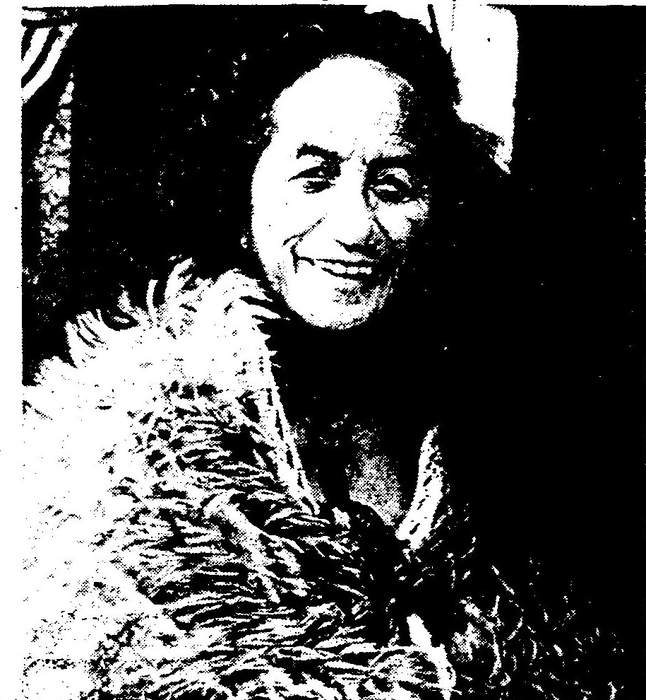 her unique contribution to tourism in the early 1920s. Rangi became famous as guide to many international figures, royalty included. A photograph of her traditional greeting to Eleanor Roosevelt, wife of the then President of the United States, made world headlines.
In 1957 she received an MBE, accepting the honour from Governor-General Sir Willoughby Norrie in Maori dress. Rangi later commented that she may have been the first woman to attend a Government House investiture in bare feet.
A founding member of the Women’s Health League, Rangi was also the first Maori to be made a Serving Sister of the Order of St John in recognition of her work during the war years in Rotorua.
 Her marriage in 1938 to Te Aonui Dennan ended with his death in 1948. Guide Rangi travelled widely in New Zealand and overseas. A respected and popular figure, she believed strongly in the promotion and preservation of her culture. — Daily Post, Jan. 1993.
1874, James Morrison bought Thom. Bennett’s 1873 Rotorua Hotel at Ohinemutu, adding a store, later run by Mrs. Morrison. J. Morrison was Rotorua’s member on Tauranga County. He supported the 1878 scheme to connect by road, Rotorua to Waikato. 1888, railways secured the freight trade via Waikato by dray from Rotorua to Tirau, then by rail to Auckland. This was quicker than by ship from Tauranga port, a major gain for Rotorua. — Daily Post, May, 1995, on Mrs. Kahu Morrison.
Tributes Pour In — the Death of Mrs Kahu Morrison
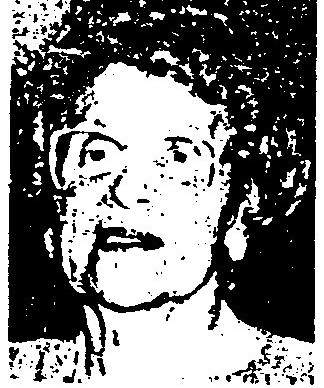 She was gracious, dignified, charming and the matriarch of Rotorua’s first family of entertainment — the Morrisons. She was Mrs Kahu Morrison, who died last night aged 84. Today the tributes flowed for the woman who was of mixed Maori and European parentage, but who was the cornerstone of Maori culture and entertainment both nationally and internationally.
Mother of six (one son, Laurie, died a number of years ago), she continued to sing with her other son, Sir Howard Morrison, and four daughters until around 15 months ago. Her haunting delivery captivated the country. In 1987 she was honoured by Royalty with the Queen’s Service Medal. She was also the holder of a Rotorua Community Service Award.
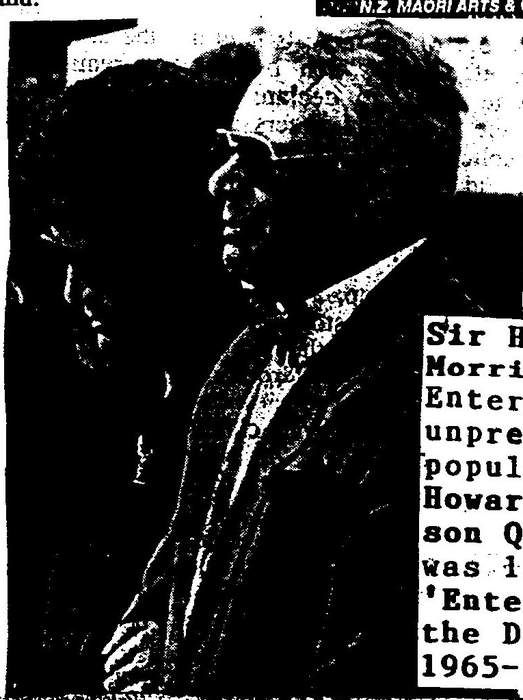 Born in Rotorua Gertrude Hareta Davidson, she was better known by her grandmother’s name, Kahu. Although an only child, she died leaving a string of descendants. Apart from her own children she had 20 grandchildren and 40 great grandchildren. As a small child she lived in Te Teko and Kawerau, but when her mother died when Kahu was 11 she returned to Ohinemutu to live with her grandparents. Her father had earlier died of typhoid. Married at 20 to Temuera Morrison (the acclaimed actor of the same name is her grandson), Kahu spent the first years of her married life with her Maori Affairs Department field officer husband.
Her grandmother was a hard taskmaster in some ways. “My brother was brilliant but I wasn’t very good at school. I only went to play. But one day I got chosen for the basketball reps and I was so excited. I raced home and told my grandmother.” “I suppose you think you’re wonderful,” she said. “Well, as long as you think some of the good is coming to the people over there’ (Whakarewarewa) ‘but don’t do it just for yourself.'” “She was always like that. She taught us our principles. Young people need them pointed out sometimes.” Her grandmother spoke little English and Bubbles grew up speaking Maori in the home. She contrasts that with the way young people learn to speak the language today.
Autiti Wikiriwhi — a Whakarewarewa Elder Remembers
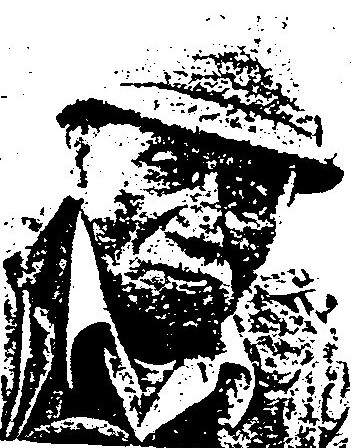 Daily Post, 1-8-1992. Autiti Whikiriwhi found dead. A Whakarewarewa elder whose grandmother claimed to have seen the phantom canoe on Lake Tarawera before the mountain erupted in 1886 has died at the village. The body of 85-year-old Autiti Wikiriwhi was found in a thermal hot bath at 5am today. He died of natural causes. Mr Wikiriwhi for many years played a watchdog role over the Whakarewarewa thermal area, believing strongly that drawoff from bores near the area was depleting the thermal field.
Autiti Wikiriwhi was born at Whaka in 1907. He had five sisters and four brothers. His grandfather on his mother’s side was a half brother to Hongi Hika. His mother was Guide Miriam, daughter of Guide Sophia, who claimed to have seen the phantom canoe on Lake Tarawera before the eruption. Mother and daughter sheltered about 50 people in their whare after the mountain erupted. Guide Miriam was aged 14 at the time. The family went to Whaka to live following the eruption. Mr Wikiriwhi went to Whaka Primary School. He won a scholarship to Te Aute College and went there for four years.
He returned to Rotorua and worked in the bush for 25 years, planted trees in the Tokoroa area and worked on a Lands and Survey sheep and cattle station. Mr Wikiriwhi had 16 children. He is survived by 12, his wife Kahukura and many mokopuna.
|
The prominent Maori elder Autiti Wikiriwhi died recently. For some time he had been in failing health and died at Whakarewarewa where he had spent much of his life. Ever a helpful source of information for historians and students, Mr Wikiriwhi — “Beaker” to his friends — was willing to share his knowledge of Maori lore and tribal matters. In 1986 Alison Masters interviewed him at Whaka. Daily Post, 15-8-1995. |
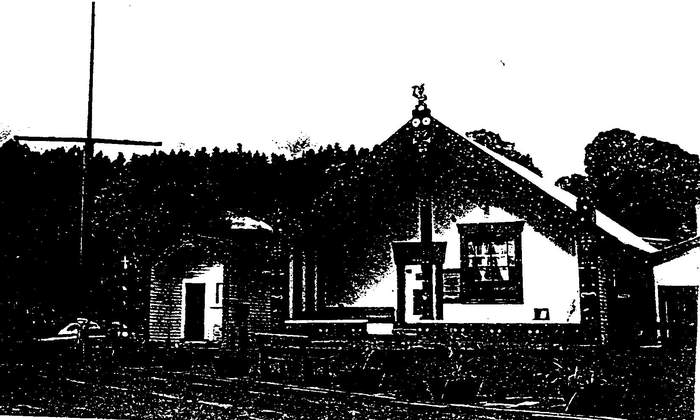
Wahiao Meeting House, Whakaarewara |
|---|
|
Autiti Wikiriwhi, born in 1907, was a grandson of Guide Sophia. His mother, Miriam, was also a Whaka tourist guide. He could remember back to 1912 when he was five. He estimated that in those days about 300 people lived at Whaka. At the time of the interview numbers had dwindled considerably, with possibly only 60 or so folk remaining. Families lived happily, if humbly, at Whaka then, he told me. By today’s notions homes would have been considered sub-standard, with no electricity, sparse furniture or furnishings, and people sleeping on the floor on Maori mats. But as a community they lived with access to Maori custom — as a people, worked as a people, children were raised in the concept of Maori law, and families held fast to tradition. Now and then the old man would pause, gathering thoughts. Tourists ambled by, languid in the heat, and he raised his hat to them. He spoke carefully, slowly, allowing time for me to take notes. |
Most of the men at Whaka — and many women — were employed by the Forest Service. Workers rose early, between 5 and 6am, dressed by candlelight and went down to the hot pools carrying kettles and pots to fill. After breakfast they would gallop off to work on horseback. From his mat, the waking child Autiti could hear hoofbeats fading in the distance. Later the children would take their dip, sing action songs, play hand games and then scamper home for breakfast. In 1912 Autiti started school. Mr Burgoyne was headmaster at Whaka school. A capable, hardworking disciplinarian, his special interest was music, laying foundation for future talented singing groups and concerts. Mr Banks followed Burgoyne as headmaster — another disciplinarian, from Lancashire. During his tenure Whaka school boasted the highest Proficiency. |
|---|
| Examination passes of all native schools in New Zealand. He also founded a scout troop, a band, and, believing stoutly in King and Empire, conducted a morning “Salute the Flag” ritual. | When the First World War broke out there was 100 per cent enlistment from the Whaka men. Mr Banks and the publican of the Geyserland Hotel raised funds for the war effort by holding concerts, entertainments, copper trails. |
|---|
900 A.D. Kupe, the great navigator, discovered Aotearoa, now N.Z.
1100 A.D. From Hawaiki, a small migration came and settled here.
1350 A.D. The Great Migration, Arawa canoe landing near Maketu.
Te Arawa sub-tribes gradually moved inland, settling in the Rotorua district, two prominent villages being Ohinemutu and Whakarewarewa.
Guide Bubbles Mihinui — Reflections on Maori-Pakeha Relations
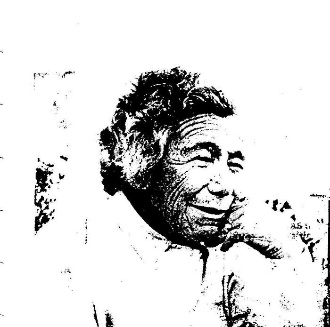 Daily Post, 9-5-1992. Article by Catherine Watson
At 72 years, Bubbles Mihinui reminisces about her lifetime involvement with Whakarewarewa and guide work. Her life spans the time from old Maori customs to modern life, entitling her to make comments of wisdom, often nostalgic. Being half Maori and half European, without bias, allows her to express a sound point of view. Rapid changes in life-style make her ponder about challenges ahead. — Dorothy Hahuna Mihinui, b.1920, became a popular Whaka guide.
 Her outspokenness on the subject of race relations often brings a shocked reaction — especially from Pakeha. But Dorothy Hahuna Mihinui (better known simply as Guide Bubbles) is unrepentant. At 72 she feels she has earned the right to speak her mind.
The emerging divisions between Maori and Pakeha sadden her. “A divided people is never a good thing. Our strength in the past has been our concern for each other. But values are changing and not everyone is prepared to be as tolerant as in the past.” “But I can’t understand this recent antipathy. I’m not saying I like every Pakeha I meet, and I don’t have to. But I’ve never had these hang-ups with Pakeha some of them have.”
Unusual
Her experience of Maori-Pakeha relationships is an unusual one which enables her to live in both worlds with no sense of dislocation. She is the daughter of an Australian father and a Maori mother, but was brought up by a Maori grandmother who spoke virtually no English.
She spent much of her childhood and almost all her adult life living in Whakarewarewa, the Maori village, but mixed with people from all over the world. In later life she represented Rotorua and New Zealand overseas on several occasions.
All this from a girl who left school at the age of 12 at the height of the Depression. But in that era every Whakarewarewa household had a guide in the family, some of them two or three. That’s where Bubbles headed eventually, to continue a Tuhourangi tradition which had begun the century before in the villages of Tarawera and the Pink and White Terraces and continues to this day in Whakarewarewa.
Tradition
It is a tradition that has included some famous names: Guide Sophia, Guide Maggie Papakura, Guide Rangi… and Guide Bubbles. Over the years, as she became a senior guide, she escorted hundreds of famous and influential people around Whakarewarewa.
“You people don’t know what unemployment is,” she told them. “We’ve had it in Rotorua for years. No-one even noticed till the rest of the country went through it. Before that we were like a voice in the wilderness when we tried to say what was happening to our people.”
These days she works one day a week at the Social Welfare Department, liaising between the clients and the staff. “I thought I was down to earth but when I first went in there I couldn’t believe my eyes or ears about what those people are going through!”
Of course this is not her first experience of hard times hitting the country. At the time of the Depression, she was living in Auckland with her grandparents. “When we went to school my grandmother would go out fishing. She would fillet them, salt them, dry them, pack them in kerosene tins and send them down here. She was always producing. My grandfather grew flowers and she grew food.” “Sometimes I’d say to her, ‘I’m sure this is grass we’re eating.’ ‘I’m not dead yet. You eat it,’ she’d say.”
That was an indication of how differently people handled poverty then. What she also recalls from the great Depression is the lack of crime or violence. “In those days the unemployed had to work three days a week for the relief. And that meant nobody was idle all the time like they are today, and you didn’t get these problems.”
Planting
She recalls the relief workers planting the Kaingaroa Forest in the 1930s. “Some of them were from families in Auckland, good middle class families, but they were not averse to going where the work was. When Kaingaroa Forest started it was Maori and Pakeha and they shared a billy of tea.” “But oh, it was cold then! There weren’t even the trees, just the pumice plains and the wind used to sweep across them. They lived in tents out in the cold, and only came in once a fortnight.”
Bubbles and her younger brother were brought up by their grandmother. Their mother died when they were very young and their father, an Australian, returned from the First World War suffering shell shock. It affected the hearing, the balance, the nerves and the mind. “Most of the time he didn’t know who he was or where he was going. Sometimes he would disappear and I wouldn’t know if he was coming back or not. Eventually he went back to Australia. We wrote for a while then the letters just stopped.”
But she says she and her brother never went through the upheaval that children go through now when families break up. “It was a typical Maori family, a family nest. My grandfather would have been affronted if anyone had said ‘What’s going to happen to the children?’ Of course we had a home with them’.”
Her grandmother was a hard taskmaster in some ways. “My brother was brilliant but I wasn’t very good at school. I only went to play. But one day I got chosen for the basketball reps and I was so excited. I raced home and told my grandmother.” “I suppose you think you’re wonderful,” she said. “Well, as long as you think some of the good is coming to the people over there’ (Whakarewarewa) ‘but don’t do it just for yourself.'” “She was always like that. She taught us our principles. Young people need them pointed out sometimes.” Her grandmother spoke little English and Bubbles grew up speaking Maori in the home. She contrasts that with the way young people learn to speak the language today.
Fluency
“When I hear them say, ‘I’ve got my certificate…’ I cringe. A lot of young ones go to a special school but when they come out their Maori hasn’t got the flow and fluency. They’re being taught in English first and they don’t even have the command of English grammar.”
She does not consider herself an orator, but says some of the best speakers she has heard have been women. It is a misconception that the women of Te Arawa cannot speak on the marae, she says. “There are certain times when she must not speak. But if it is a meeting where policy is being discussed then everyone can speak, from the youngest up.”
Oratory is full of metaphysics and rhetoric and consequently as untranslatable as poetry, she says. It is also an area in which Maori generally leave Pakeha far behind, lost in their prosaicness.