
1340–1350 A.D. The “Te Arawa” canoe landed at Maketu, after sailing in the “Great Fleet”, approximately 1340, from Hawaiki, about 3000 km. The canoe had a deck in the forward part above the two lashed together hulls of about 40 m. in length, capable of carrying 200 people. Tama-te-Kapua was the navigator and instigator of this voyage, who followed directions for this “Great Migration” to Aotearoa as set many long years previously by that great Polynesian sailor, Kupe.
Ihenga, who landed at Maketu with his grand-father, Tama-te-Kapua, by 1350, had become pathfinder to Lake Rotoiti (small lake), Ohau Channel, Lake Rotorua (second lake). He settled on the shore of Lake Rotorua in the thermal area which was called Ohinemutu when his wife died.
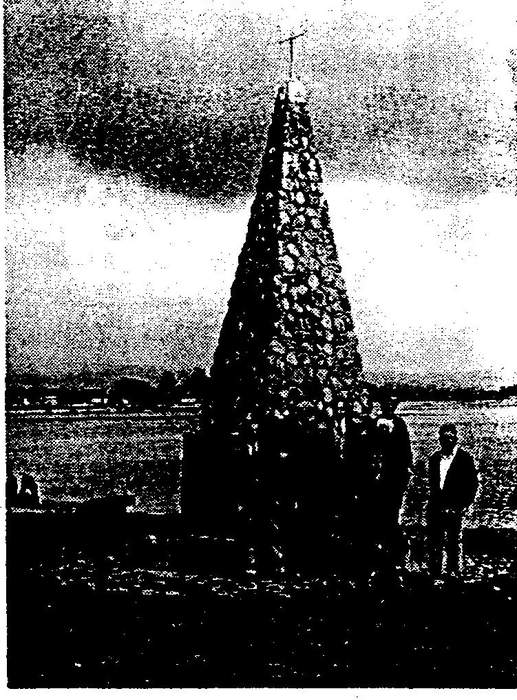 1450s, Rangitihi, great-great-great grandson (5 generations) of Tama-te-Kapua, started the first major territorial expansion from Maketu, his family occupying the pa at Mourea near the Ohau Channel. Revered by Te Arawa for his prodigious strength, he also brought them prosperity and peace. In adulthood, this family of 8 children became influential in controlling the Rotorua area and beyond, except for Mokoia Is. until Rangitihi’s grandson Rangiteaorere, 1500, captured this from the descendants of Ika from original Te Arawa crew, now strangers from long separation.
Eight Main Sub-Tribes of Te Arawa
Descendants of Rangitihi’s eight children. Ngati Pikiao, mostly round shores Lake Rotoiti and Lake Rotoehu. Ngati Whakaue, occupying land around the lake shores and city of Rotorua, Mokoia Is. 1650, when settled N.W. at Kawaha Point, they attacked Ohinemutu, ousting Tuhourangi. Tuhourangi lost also Okawa Bay at Mourea but still controlled their lands at Lake Tarawera, Lake Rotomahana, Okareka district with L. Rotokakahi (Green), L. Tikitapu (Blue).
Ngati Whakaue’s territory extended north to Mamaku, Horo Horo in the south taking in Tihiotonga, and east as far as Owhata. Their Kawaha Point land extended to Weriweri at Waitehi by Ngongotaha. 1886, after Tarawera Eruption they gave Whakarewarewa to Tohourangi relatives whose villages at Te Wairoa and the lakes were devastated. Subtribes in due course, spread out further, having fortified pas.
Ngati Rangiwewehi, people of Awahou, north of Rotorua remained there. 1870, discussion for direct Tauranga–Rotorua road to pass through their lands south of the Mangorewa Gorge took place as the wars with Te Kooti were now over as far as Rotorua was concerned.
Ngati Wahiao tribe of Tohourangi people which occupied one of the hilltop pas or fortress was called after Ngati Wahiao, an ancestor; this famous settlement is now known as Wakarewarewa after his pa. Wahiao conquered and settled the land round the Blue & Green Lakes, living out in that area prior to the Tarawera eruption.
Enid Tapsell, in her book “Rotorua”, quotes Cowan’s origin of name “Whakarewarewa” as being in commemoration of Chief Wahiao, who, before setting out on the warpath against another tribe, paraded his men at the foot of the hill to do the customary war dance. “It must have been an impressive scene, as rank after rank leaped up from a kneeling position, and the ground trembled with the thunderous stamping of the war chant.” Hence the name of the hilltop pa:– Te Whakarewarewa-tanga-o-te-ope-o-Wahiao. The Leaping-up, the War Dance of the Army of Wahiao.
Development of Whakarewarewa Settlement and Tourism
1849, Sir George Grey first visited this thermal wonderland, then in 1858, due to his persuasion, an overseas scientific expedition came to examine the volcanic areas, thus making the first written account of Whakarewarewa, describing it as the greatest springs area in district. 1872, Anthony Trollope described it as being deserted & uninhabited. 1870s, in earlier years, little interest was shown in tourism.
Maori Settlers
1870s, Mohi Atarea, in the earlier years, was the only occupant living at Whakarewarewa, as well as his family. He was Ngati Whakaue tribe.
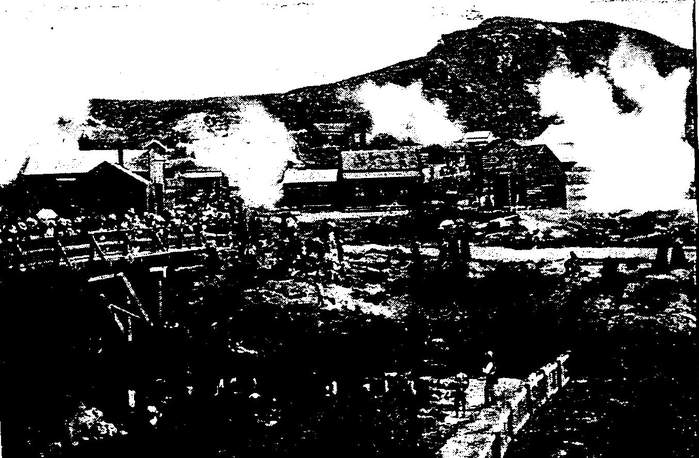 1870s, in the latter years, there was increased interest from tourists resulting from Ohinemutu Hotel’s first commercial advertising. Visiting geyser-land at Whakarewarewa was an added attraction. 1870s, Ngati Wahiao, nearer the 1880s, began occupying by force this Whaka. settlement which belonged to Ohinemutu Ngati Whakaue Arawas. Ngati Wahiao was a Tuhourangi of Te Arawa. He remained at Whaka. despite Mohi Atarea’s complaints to his own Ngati Whakaue tribe. Presumably this intrusion was motivated by the income from tourists. Ngati Wahiao still owned his territory at the Blue & Green Lakes.
1882, Whakarewarewa was part of Rotorua’s normal tourist round. Visitors were delighted with the Maori village midst boiling water, steam, geysers, bubbling mud pools, sulphur volcanoes, strange hissings and gurglings. They arrived by horse and buggy, then carried across Puarenga Stream.
1884, local Maori Committee posted notices of regulation for payment for such things as baths, lodging at cottages now provided, photographers. This was by order of William Paul, Chairman of the Com. and all Ngati Wahiao tribe.
1897, this new Whakarewarewa bridge replaced the original 1885 bridge, a foot-bridge then known as the ‘Wahiao Bridge.’ Children dived for pennies thrown in, holding all in mouths.
1886, after the Tarawera Eruption
At Te Wairoa, the Tuhourangi Maoris who survived this horrific disaster, found their way out of the ‘Buried Village’, heading for Rotorua. At the Green & Blue Lakes, the land was uninhabitable. Tuhourangis of the Ngati Wahiao tribe also left the villages for Whakarewarewa. Te Arawa cousins of the Tuhourangi, the Ohinemutu Ngati Whakaue now offered Whakarewarewa to the homeless.
1889, Maori Land Court recognised the ‘undisturbed occupation’ of the Ngati Wahiao in the central village area of Whakarewarewa, No. 2. 1890, three blocks, Nos. 1, 2, 3, were amalgamated into one title by the Court, setting out the list of new owners, 474. Ngati Whakaue Nos. 1 & 3.
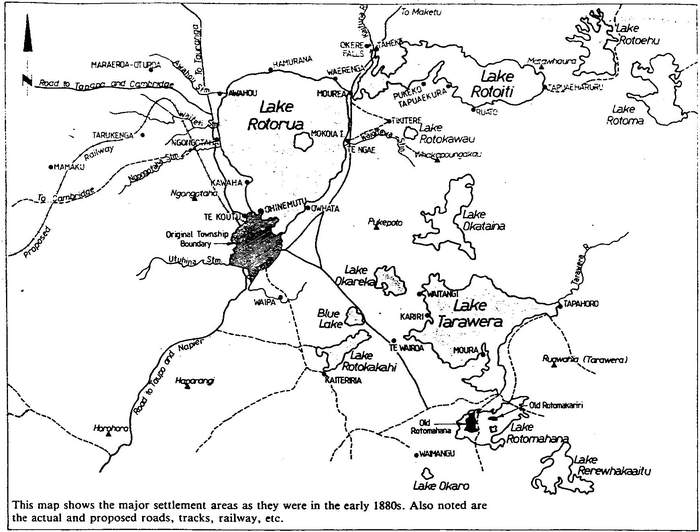
Figure This map shows the major settlement areas as they were in the early 1880s. Also noted are the actual and proposed roads, tracks, railway, etc
Ngati Wahiao, son of Chief Tuhourangi of Owhata, was Hinemoa’s brother. It was from Hinemoa Point, in the famous love story of Hinemoa and Tutanekai, that she secretly swam across to Mokoia Is. to Tutanekai who guided her by playing his flute. He also was of high rank, being youngest son Ngati Whakaue at Ohinemutu. This was finally accepted by both tribes and from this union sprang the very powerful hapu of the Ngati Whakaue. Hinemoa is buried on small Motutawa Is. in Green Lake, this lake strictly tapu to Europeans for desecrating graves in the sacred burial place of the hapu.
Whakarewarewa Becomes Rotorua’s Main Tourist Attraction
1884 onwards, Whakarewarewa became Rotorua’s main tourist attraction. Regulations for fees had been set by the local Maori Committee, improvements in facilities for tourists like an entrance bridge, bath sheds, safer tracks through thermal areas and more accommodation.
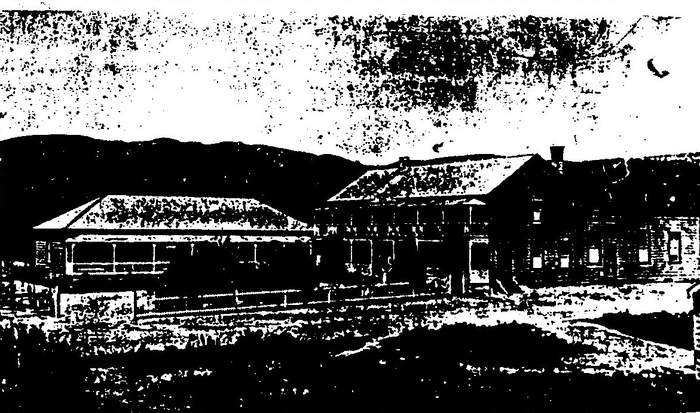 Mid 1880s Geyser Hotel was established by Wlm. Rogers, a well known early businessman and licenced interpretor. There were 40 bedrooms and a popular and convenient bar, opening onto the pathway by the roadside. Coach drivers waited here for return trips. Rotorua’s tourism thrived! Hundreds came from Auckland by train, then whisked off to Whaka by a fleet of coaches. “Coachies” were well known characters like Te Puke Chas. Willmott, Charlie Andrews and son, Vessey Stewart, Tom Aikinson, Chris Jespersen. Then in 1906, Rotorua Motor Coaching Co. formed.
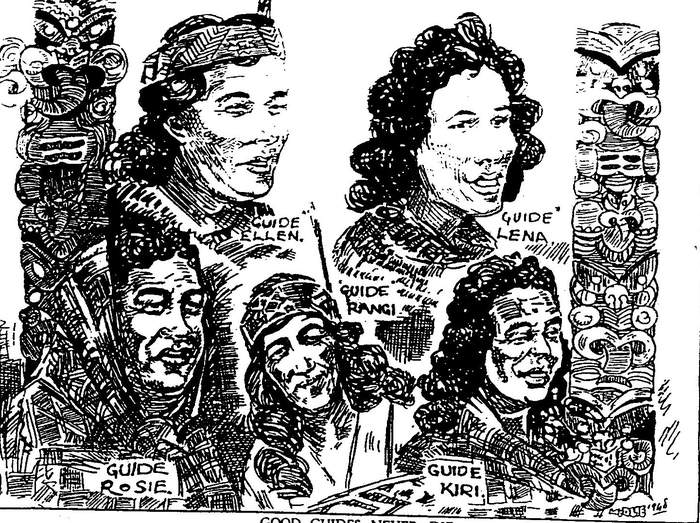
Guide Sophia & Maggie (Makareti) Papakura, earliest famous guides at Whakarewarewa. (Two streets off Fenton St. named Sophia & Marguerita.) Sophia’s fame began at Te Wairoa, showing tourists the Pink & White Terraces by crossing Lake Tarawera, then inland to L. Rotomahana. 1886, during the eruption of Tarawera Mt. she saved lives of overwhelmed people by getting them to her whare, only half covered in hot mud.
Maggie Papakura, in early 1890s, was guiding with Sophia at Whaka. Both had European fathers and were given very good educations. Their fine qualities, talents and charm won the hearts of all. A statue of Maggie and her son Te Aonui Dennan stands at right of entrance gate. During W.W.1 Maggie was in England, Oxford, with her husband. She helped invalided N.Z. soldiers, some Maori, helping form concert party. This was forerunner to many Maori concert parties in later years.
Guide Maggie Papakura lived, 1872–1930.
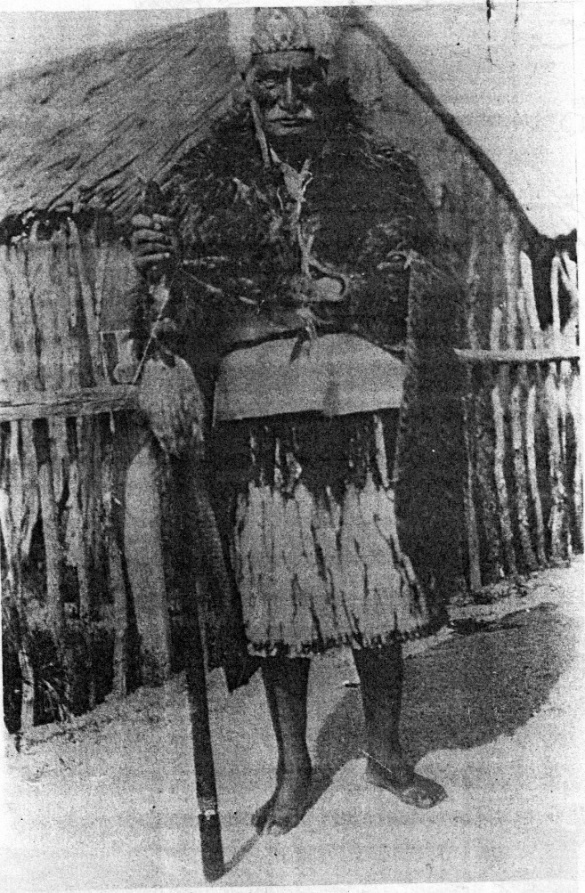
1846–1935, Mita Taupopoki, was a prominent chief of Ngati Wahiao at Whakarewarewa in the early 1900s. He displayed outstanding personality and command at ceremonies, especially at each royal visit since 1870, having a brilliant gift, oratory. He was painted by Goldie.
Mita earned a decoration and pension in the Maori Wars when Te Arawas, as from 1864, supported the Govt. against ‘Kingite Movement’ at Tauranga & Maketu, also, 1868–70 when Te Kooti sought revenge for this loyalty.
 1880s Depression, unemployment had many families desperately hungry especially Europeans as they had no land except for a few like Te Ngae Mission Station supplying produce to town. Govt. gave relief work, forming this end of the railway lines to connect Rotorua & Auckland. Rotorua needed advertising so two writers were invited.
1885, G.A. Sala, visiting writer to N.Z. was invited to open the “Blue Baths” in Govt. Gardens. Sala St. is off upper Fenton St..
1885, J.A. Froude, novelist, on his visit, stayed at Lake House in Ohinemutu. As Brit. historian his comments on Rotorua are published in “Oceana” 1885. (Froude St. by Sala St. borders Whaka Resr.) Meade St. also next to Whaka is named after Lt. Herbert Mead, traveller who wrote in 1870 about Rotorua.
|
J.A. Froude’s account of Rotorua, 1885, from Don Stafford’s “Founding Years Rotorua” is about the Owhatiura area, east. ‘The soil was almost black, so rich it was. A few acres of it were cultivated, much like an English allotment garden, and were covered with patches of potatoes, maize, and tobacco. The cabins are of the purely primitive type — four mud walls, two gables, a roof of poles leaning against each other at a high angle and filled in with reed and turf. Essentially they are exactly the same as the mud cabins in Ireland, but they are cleaner, neater, and better kept. Round each is a stout fence of Ti-tree, through which the pigs, at any rate, are not allowed free entrance. As in Ireland, however, it was the wrong sex that was doing the hardest work. The men lay about on the ground, or looking on, while the women were digging. We saw more than one young mother, with a child slung in a pouched shawl at her back, hoeing maize and turning up potatoes, while her husband sat smoking his pipe as composedly as if he had been bred in Connemara.’ A little further out, the people near Owhata were producing crops of oats for William Kelly. To the northwest of Rotorua land was also taken up during the 1880s, in the Maraeroa-Oturoa Block, near Ngongotaha. |
|---|
Whakarewarewa’s Carved Meeting Houses and Guides
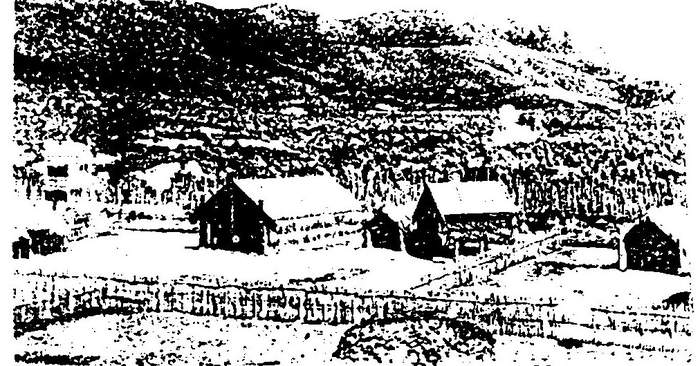 Meeting Houses with carvings. Early 1900s was an important time for construction of Te Arawa carved houses. At Ohinemutu, their old “Tama-Te-Kapua” of 1870s, in 1904 was rebuilt into a magnificently carved meeting house.
 Whakarewarewa, about same time, constructed two houses also. Te Waru begun his house on the roadway leading into village, and opposite Geyser Hotel site. One day he transgressed ‘tapu’ by entering, smoking, while it was under construction and ignored the tohunga’s advice. He lost all his family, discontinued, storing the carvings away. 1897, C.E. Nelson, manager Geyser Hotel, acquired these carvings, employed carvers Tene Waitere with 2 others to complete it in 1900, then 1904, he sold for German who took carvings for museum.
1906, Nelson had rebuilt this ‘Rauru’ carved house, using carvings called the ‘Hemana Te Pokiha’ from Matata. Chiefs at Whakarewarewa had found the burden of building too great, stored them, but made them tapu. Nelson, on acquiring these, had Tene Waitere & Neke Kapua do some extra carvings.
1908, new ‘Wahiao’ house opened on the Pakira marae, this one having carvings. The first woman across threshold was Mere Kanea, daughter of Mita Taupopoki.
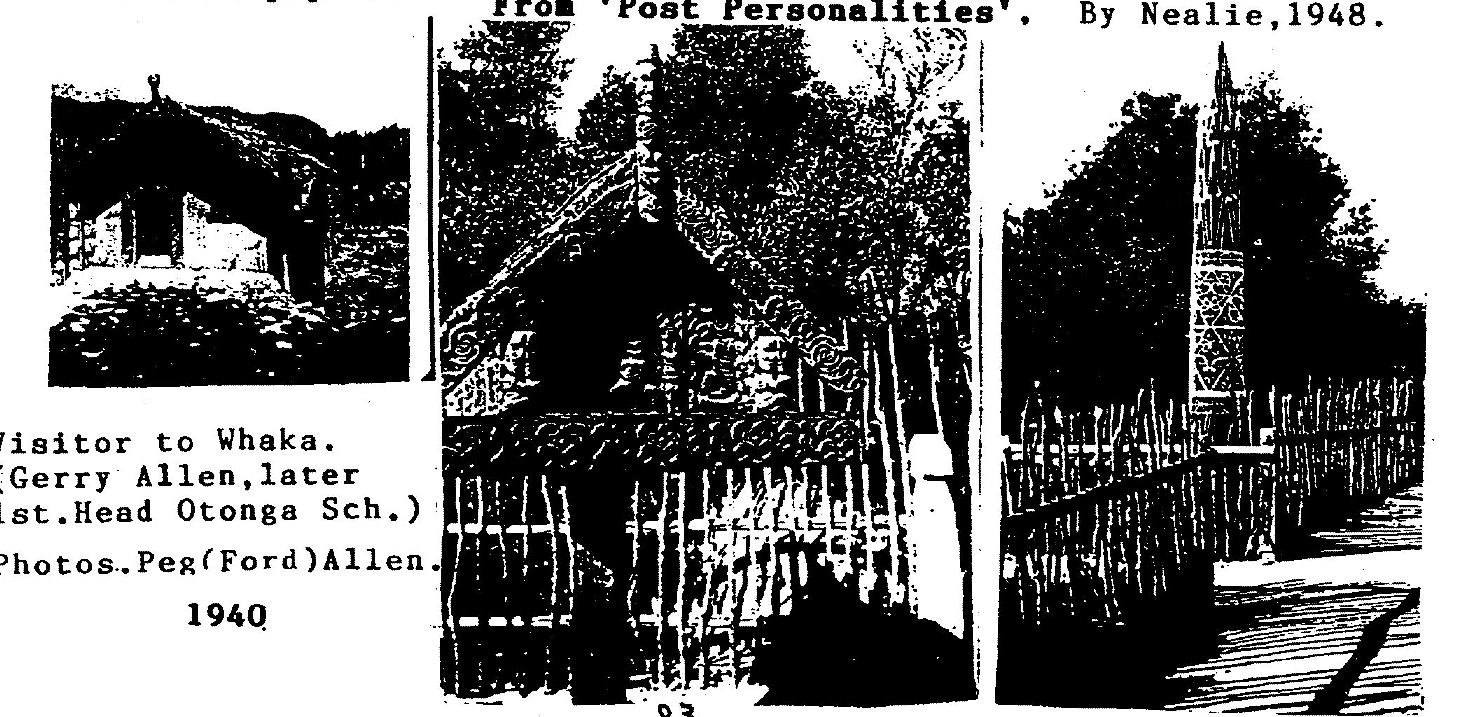
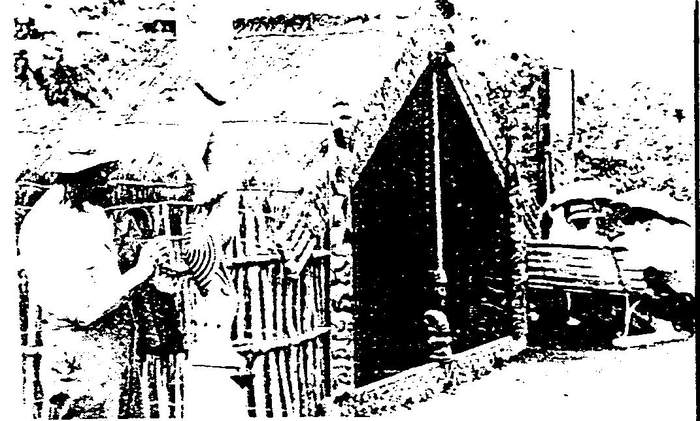
Left : visitor to Whaka (Gerry Allen, later 1st. Head, Otonga School); photos, Peg (Ford) Allen, 1940.
Tribes of both Whakarewarewa and Ohinemutu, as Te Arawas, have had close association in Rotorua’s important functions and ceremonies. The long established Ohinemutu settlement has been a focal point during Rotorua’s development. Whakarewarewa has been a major attraction with V.I.P’s visits. Both have fine carvings on meeting houses.
|
Figure Tene Waitere, renowned carver (Photo, Museum). Here Tene Waitere is completing his work, the ‘Te Whare-a Maui’, for a manager of the Tourist Dept. In 1906 it was exhibited at the Christchurch International Exhibition. It now rests in Frankfort museum, Germany. |
Highly skilled carvers, greatly respected within their tribe, became legend. Tene Waitere, a great Ngati Te Rawhai, acquired fame in this Rotorua area. At Ohinemutu in early 1900s he had a room where he instructed. Later in 1920s, this arts and crafts centre became established nearby at Whittaker Rd. This also became over-crowded. Negotiations resulted in the Whakarewarewa fine centre, at the Hemo Rd. end, being formed. This was a year after 1931 when Tene Waitere died. This centre has become world famous. |
|---|
Starting Ohinemutu’s carving school was encouraged by Sir Apirana Ngata so as to preserve the art of carving, probably not realising the future benefits to employment and tourism. Little money was available. The Govt. realised Whakarewarewa and Ohinemutu were special areas. 1907–1922, these villages were controlled by the Rotorua Town Council, which was under the management of the Govt. Dept. of Health and Tourism. This Dept. was given the power of assisting villages, financing necessities for health requirements. Govt. revenue was insufficient so, in 1923, the 1st. Rotorua Borough Council met, after residents requested local control by charging themselves rates for amenities and improvements.
1940 Rotorua Centennial Celebrations caused an upsurge in carving. Ohinemutu’s meeting house, Tama-Te-Kapua, was rebuilt for the 3rd. time. Awahou (Ngongotaha-Mamaku) was modelled on the Tunohopu house at Ohinemutu. Bay of Plenty’s other Arawa sub-tribes also wanted more carvings. A new Wahiao house was built at Whakarewarewa — 50 years earlier Mita Taupopoki had built the old one. He died in 1935 and this new one was a memorial. It was opened in 1940, Centennial Year, with a grand official celebration.
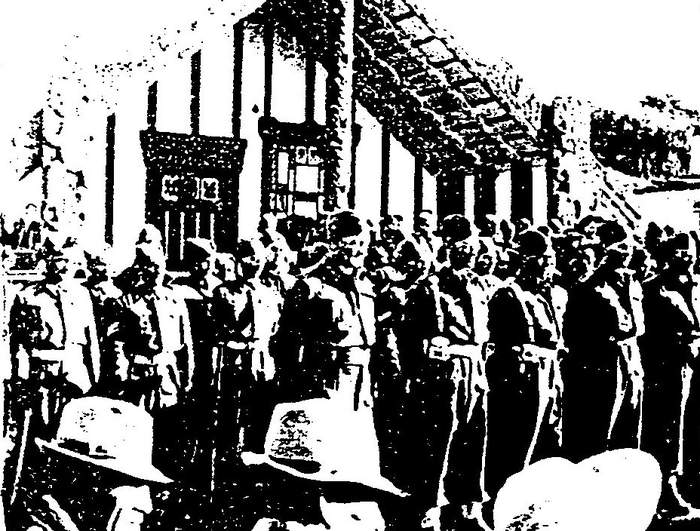 W.W.1 & W.W.2 Maori armed forces. 1914–1918, Arawas fought in all main battles in Europe. Prominently involved were Capt. Roger Dansey & Capt. Te Reiwhati. 1915, at Gallipoli against the Turks — quote: ‘The Maoris went into attack with bayonet alone and whenever they dislodged or destroyed the enemy, they celebrated with a tremendous haka, almost enough itself to send more Turks into retreat.’
W.W.2, 1939–1945, 28th Maori Battalion, with leaders Capt. Rangi Royal, Lieut. Werohia, Lieut. Vercoe, Capt. Chaplain K.T. Harawira, farewelled at Whakarewarewa. 1941, heavy losses in Greece & Crete. 1943, the Battalion distinguished itself and Colonel Charles Bennett was awarded the D.S.O. A Nth. Rotorua pioneer farmer who served with distinction in W.W.1 became commanding officer of the Maori Battalion — Lieut.-Colonel G. Dittmer.