
Edwin Robertson and Ned Douglas. Tarawera Eruption, June 10, 1886 Printed Article Source Rotorua Centennial Issue 1980
|
Rotorua transport pioneer Edwin Robertson was asleep in bed at 2a.m. on June 10, 1886, when he was awakened by the frightening sounds and shakings of the Tarawera eruption. And though scores of Rotorua people fled the fearful sights and sounds, Edwin Robertson chose to stay, and to use his expertise with horse and vehicle in a mission of mercy. With the only man who would volunteer to go with him – partially blind Ned Douglas, Edwin Robertson drove out toward Te Wairoa and the eruption centre, to look for survivors. Using a two-seater buggy and his best horses Muggins and Jimmy, he drove into the gloom, into the ash fall and into the mud. |
At the Blue Lake, records Ross Annabell, former feature writer for the “Daily Post,” Edwin and Ned met a party of Maori and Pakeha fugitives coming from Te Wairoa in pitiful state. “The refugees were plastered with mud and ash, exhausted and half hysterical after their night of terror in eruption-blasted Te Wairoa. “Edwin Robertson vacated his seat in the buggy and piled the three pakeha women aboard. |
|---|---|
|
“Then he climbed on to the front and set off driving with a foot astride each of the shafts, and his back braced against the front of the buggy. “Gritty ash was still falling from Tarawera as Edwin drove his buggy down the Te Wairoa hill. Grit got in the horses’ ears and they bolted. “The buggy plunged and lurched down the greasy track with Edwin clinging grimly to his perilous perch as the horses took off at full gallop. “With the handbrake out of reach behind him, all he could do was pull hard on the reins and yell to the woman nearest the brake to apply it. “But the women were all screaming at top pitch and they could not hear him, and the buggy took the hill at break-neck speed. Somehow it reached the bottom still on its wheels, and with Edwin’s feet still balanced on the plunging, swaying shafts.” |
Edwin Robertson made it to Rotorua and later returned to Tikitapu (Blue Lake), with a larger vehicle, and walked further on to assist in the rescue of survivor Mrs Hazzard. Edwin helped carry the 90kg woman to the coach on an iron bedstead, and Mr Annabell recorded the fact that he carried a mark of that carry, a deep scar on his shoulder, to his death. The Tarawera eruption was not all bad for Edwin Robertson however – once the initial rescue work was completed, he made a small fortune ferrying tourists and sightseers to the buried village of Te Wairoa, which had taken the brunt of the eruption. The development of Waimangu as a tourist resort was also due to Edwin Robertson, who built the road in after the Rotomahana area cooled down. |
|
Mother Tough Too It seems from the early stories that the Rotorua transport pioneer Edwin Robertson was not the only tough one in the family – Ann Robertson, who came with him to Rotorua, was also a force to be reckoned with. She had, it seems, bought land at Ohinemutu but subsequently she found she did not have title to it, following the 1881 Thermal Springs Act. This misfortune led to her bankruptcy, but Mrs Robertson was not beaten by any means. Mr Annabell wrote that the doughty old lady campaigned tirelessly for her rights, and finally she walked most of the way to Tauranga, went by ship to Auckland and then headed to Wellington. There she had a go at Parliament, undaunted by the male world it represented. |
“Ann Robertson, it is said, harangued Parliament, and though her case dragged on, she was told in 1892 that it was settled in her favour, that she had a gratuity of £300 coming. “She also got a lease for 99 years at peppercorn rental of some of the most prized blocks in the heart of present day Rotorua, and for good value, a 17 hectare rural estate,” wrote Mr Annabell. The full 99-year rental of £44.10s was paid in advance and Mrs Robertson sub-leased the land for £150. |
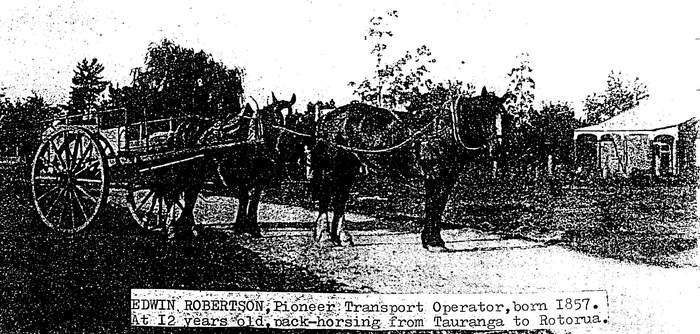
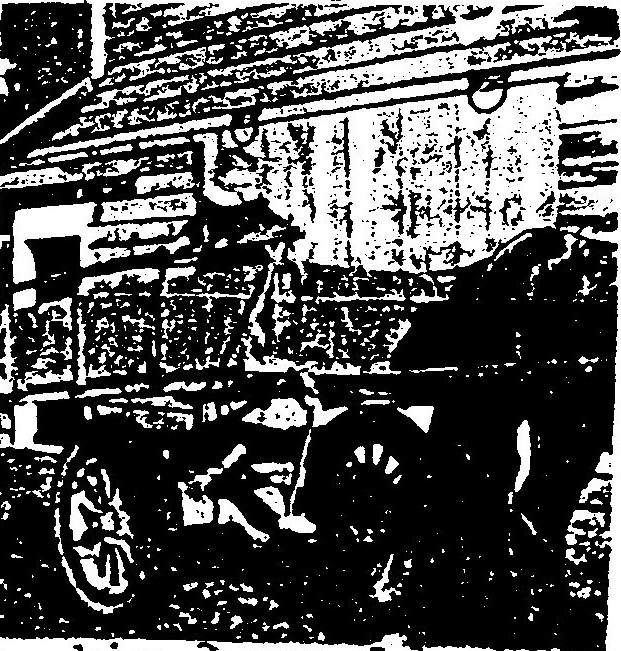
Edwin Robertson, Pioneer Transport Operator, born 1857. At 12 years old, pack-horsing from Tauranga to Rotorua. Hitched to their master’s wagon, these horses wait patiently for his return in Lake Road, Rotorua, about 1909.
An 11-year-old boy, whose mother could not afford the shilling a week needed for his education, left school one day in 1868 to become one of Rotorua’s most important pioneer transport operators.
A year later, slim and strong, Edwin Robertson was taking a string of pack-horses through hostile country between Tauranga and Rotorua. By age 15 he was employing a number of men and 25 horses on a contract packing telegraph wire between Maketu and Cambridge, and by 1880 he was operating his own coach line out of Rotorua. He retired in 1902 when he saw that the “horseless carriage” was to spell the death-knell of the coaching trade. A year later Edwin Robertson married and took up a new career – that of family man.
Such was the career of tough, determined Edwin Robertson, a man who played a vital role in the early days of Rotorua, and indeed, of the Bay of Plenty, and who was a first pioneer in the tourist industry, which was synonymous with Rotorua.
According to a series of articles by former “Daily Post” feature writer Ross Annabell in 1966, Edwin Robertson came to New Zealand in 1864 at the age of seven years with his father and mother.
His father James was a seaman of Scots descent, who in the 1850s found himself in Melbourne, the mate of a ship without a crew. The crew had deserted to the call of the Victorian gold rush, and James Robertson soon joined them, and it was on the gold-fields that he met Ann, a Scots girl who became his wife. By 1864, with a family of four young children, James Robertson, disillusioned with the gold fields, made the decision to come to New Zealand, and shipped out from Australia to land at Onehunga.
He came to the colony as a soldier, having joined the Army on the promise of a 17 hectare farm in return for his services.
According to Mr Annabell the Robertson family walked from Onehunga to Auckland and to their first home in this country, a sod hut.
James Robertson was quite soon sent to join the Tauranga garrison and his wife and family joined him there shortly after the bloody battles at Gate Pa. And though James Robertson had his farm, his family had to spend their nights in the redoubt.
It was still war-time and it seems that James Robertson was a poor provider, and there was little money in the family purse.
In those days education was in the hands of commerce, and it cost a shilling a week to send a child to the little school at Tauranga.
 This was an expense Ann Robertson could ill-afford so young Edwin’s education was a catch-as-catch-can affair, and finally came the day when Mrs Robertson just did not have the Monday morning shilling. Edwin went to school with a promise from his mother that she would pay later in the week. But commerce is commerce, and the teacher would give no credit – not even for one shilling.
So that was it for young Edwin. Told to go home and return when he had a shilling, he went job-hunting instead. Capitalising on his ability as a horse-man Edwin got work on a farm where the town of Mt Maunganui now stands. He rode herd on a mob of cattle, and in addition milked 25 cows by hand. That did not last too long, and Edwin’s farm career ended when he clouted his hard-to-please boss with a rake.
And as Mr Annabell wrote, that was the end of Edwin’s “first and last job, and from that day he never had another real boss.”
It was “business” from then on, and his first venture was to borrow some horses and ponies, which he hired to customers for rides along the Strand at Tauranga. It was not too long before Edwin had saved enough to buy horses of his own, and his chance came when troopers at the Armed Constabulary camp needed a “runner” for a trip to Te Puke, a 50 km ride.
The job successfully completed, Edwin was paid his five shillings and within a short time, his courage, bush-craft and reliability proved, he had his own pack-horses and was contracted to carry mail and stores to Army outposts.
It is difficult for us today to understand how a boy of 12 years could achieve what Edwin did, or how he could carry through his next big adventure. He was contracted to make a journey from Tauranga to Rotorua, a journey which took eight days.
Mr Annabell wrote that the year was 1869, and the country between Rotorua and Tauranga was still hostile, and Maori rebel Te Kooti was still running, the Army and the Armed Constabulary raged through the central North Island.
Edwin Robertson very nearly did not make it to Rotorua. Short of food, and in the difficult country behind Kaharoa and the Mangarewa Stream, he became lost while looking for a stray pack-horse, and he owed his life to the folk at a Maori pa he found in the bush.
The Maoris fed and cared for Edwin and showed him the easiest way out of the bush and so to Rotorua. Edwin may have been only 12, but he knew how important was the service the Maori people at the pa had rendered, and Mr Annabell recorded that Edwin’s gratitude was expressed in many ways through the rest of his life.
By the time he was 15, Edwin had made the trip Tauranga to Rotorua many times, but as Mr Annabell wrote, he did not do it alone very often, as by the age of 15 years he had men and horses expanding his tracks across the Bay of Plenty.
Edwin was contracting for the Post Office, carrying stores to the early store-keepers at Ohinemutu, and at 16, in the year 1873, Edwin took the step which really set the seal on his future – he added a buggy to his list of assets, and when the road was put through from Oropi to Rotorua he was in the haulage and coaching business.
Photographs of Edwin Robertson show him as a bearded figure, and it is evident from Mr Annabell’s story that the beard was an early and distinctive feature. He wrote that in Edwin’s early years the beard was often waist length, and that its owner was often referred to by local people as the “Old Man Boy.”
The record shows that Edwin Robertson had few vices – he neither smoked nor drank, but he did love the illegal sport of “cock-fighting,” and a fighting bird was a regular member of many of his pack-trains, and ever ready to meet any challenger.
By 1873, the young Edwin moved to Rotorua and set up his base near the Lake Hotel on the banks of the Utuhina Stream. He established stables there and began to establish his coaching routes outward from the infant town.
“He was,” wrote Mr Annabell, “one of New Zealand’s first pioneers of tourism, establishing a lucrative business carrying tourists to such famous attractions as the Pink and White Terraces and Te Wairoa before the Tarawera eruption.
“By 1880 he was running coaches as far afield as Opotiki, Taupo and the Thames goldfields.”
By 1902, Edwin Robertson saw the writing on the wall as cars began to appear on the roads of New Zealand. By then his coaches covered the Bay of Plenty and in his years of operating he had bought out 13 opposition firms.
Seeing the end, and feeling that he could not start a new venture using the new mode of transport, he sold out to Carr and Walker, who it appears were the fore-runners of the R.M. Coaching Company, and in that sale, wrote Mr Annabell, 250 of the Bay of Plenty’s best horses went under the auctioneer’s hammer.
With the work of 35 years disposed of, he became, at 46, a husband and later father. The girl, 20 years his junior, was Australian missionary Elizabeth Ann Jeffries, in Rotorua on mission work with the Maori people.
They had first met at Edwin’s stables when she had hired horses from him, but the friendship met difficulties when Miss Jeffries returned home to Melbourne.
Thinking then to reward the hard work of his life till then, Edwin decided on a world trip, including a visit to Scotland, the home of his forbears.
He did not make it. Seasickness forced him to opt out of the trip at Fremantle, and from there he made his way to Melbourne, where, in the classic terms, as used by Mr Annabell, “he wooed and won the fair Elizabeth,” and returned with her to Rotorua.
They lived out their lives in the burgeoning town, had a family of two sons and two daughters (one died in infancy), and as Mr Annabell put it, “Edwin died in 1931, after nearly 30 years of quiet and contented retirement in the town he helped to found.”
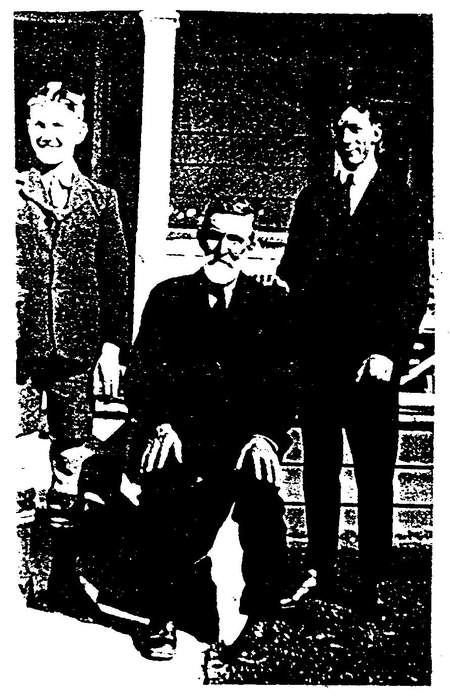
Photo, left to right: William Erick Robertson, Edwin Robertson Snr., Edwin James Robertson, on steps of “Westvale” when Edwin J. leaving for King’s College. (Photo from Kath Whitney, née Robertson.)
1873 onwards, Edwin Snr. made his fame for expanding horse tracks outwards from Rotorua across the Bay of Plenty, thus becoming one of N.Z.’s first pioneers of tourism. This was essential for the growth of Rotorua.
He acquired areas of land suitable for horses in his coaching business from Tauranga and near thermal attractions.
“Westvale” home, Pererika St., had stables behind it, pulled down recently by new owner, Peter Spurdle, for a garage built at side-front in similar villa style.
The Robertson family benefited from Ann’s gratuity of land, although swampy, in the Robertson St. area between Arawa Race Course and Glenholme School area. She re-leased a prime town block to a pawnbroker to finance her Palestine trip.
Ann Robertson, of the Presbyterian Church, was honoured to lay the foundation stone for the first St. John’s in Rotorua, Pukuatua, 1896, and in 1897, at the opening, she gifted a handsome organ and also a clock. Her town block was Fenton St. east, with Whakaue, Pukaki & Arawa Sts.
Elizabeth Robertson was prominent in Red Cross, Women’s Club, and Church. She taught Sunday School at the hospital in the mid-1920s to Polio victims. Her imposing personality and size over-awed her junior assistant, Alison Worrall (now Bailey) of Phillip St., who drove with her to hospital.
Elizabeth, when widowed, lived at the corner of Pererika & No. 1 Phillip St. Her husband Edwin Snr. bought land for their 2 sons: Edwin on Clayton Rd., and Erick’s farm on the south side of Springfield Rd. near the Utuhina River.
He married Vivien Hale and their 2 sons, Keryn and Lyn, have the business Robertsons’ Home Appliances Ltd. The Hale Bros. were plumbers, Haupapa St.
Edwin Jnr. married a Matamata farmer’s daughter; their one child, Kathleen. In W.W.2, he spent six years overseas in 2nd Echelon, Munitions Corp.
Both of these Robertson men re-married. Depression & War years were hard!
Kathleen Mywrhina Robertson (now Whitney) & mother lived then in Phillip St. near Grandmother Elizabeth. Nearby in No. 6 Elizabeth St., a tall 99 yr. old gentleman lived, Grand-dad to all, next door to the Council Pump. His swinging of scythe made peaceful sounds as swathes of grass fell.
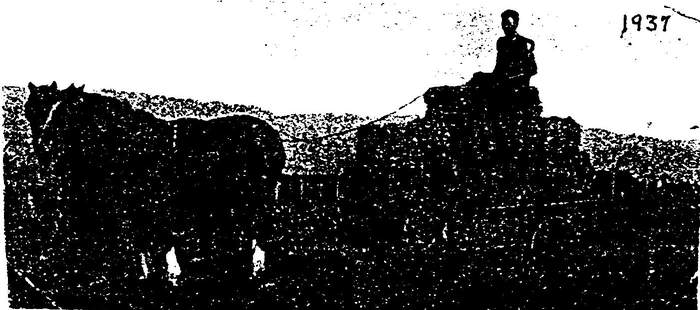 1937 – Edwin J. Robertson Jnr. on hay bales, Clayton Rd., with his 3 yr. old girl Kathleen (Mernie), by the barn where Gordon & Island View Rds. meet, now |
 |
|---|
In this part:
- The New Township and Ohinemutu's Early Hotels
- Fenton St
- Judge Francis Dart Fenton
- William Kelly
- Old Taupo Road
- William Seddon
- York Street
- From “Post Personalities” by C. Worthington — Royal Visits
- The Duke of Gloucester
The New Township and Ohinemutu’s Early Hotels
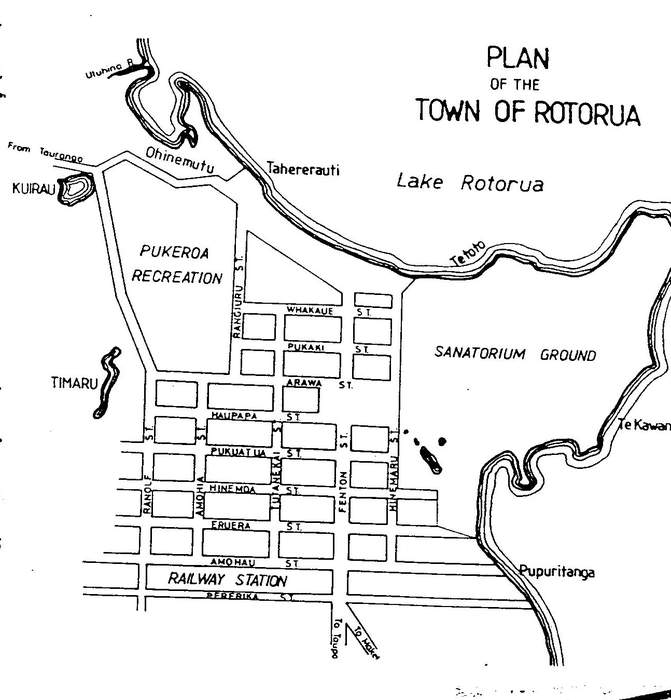 Judge Fenton, 1882, after Thermal Springs Act of 1881 was passed, had the new township of Rotorua set out in blocks, and the outer area south of Victoria St. was laid out in roughly 40 acre blocks.
The streets named after Maori Chiefs, Haupapa, Pukuatua, Eruera, Amohau, Pererika, were those whose names were on the title deeds of township blocks. Tutanekai and Hinemoa are from the famous Maori legend, and Rangiuru and Whakaue from the mother and father of Tutanekai. It was Chief Whakaue who gave his name to one of the strongest hapus of Te Arawa, the donors of reserves and bequests to Rotorua. Ranolf and Amohia were names from a love poem set on banks of Lake Rotorua, and written by Alfred Domett.
Ohinemutu was where the first Europeans came, like traders, missionaries, Govt. Officials. Nearly all had homes in Maketu 1850s as there was no other direct route till 1870 when Maori War caused the Tauranga Oropi Gorge route to open up.
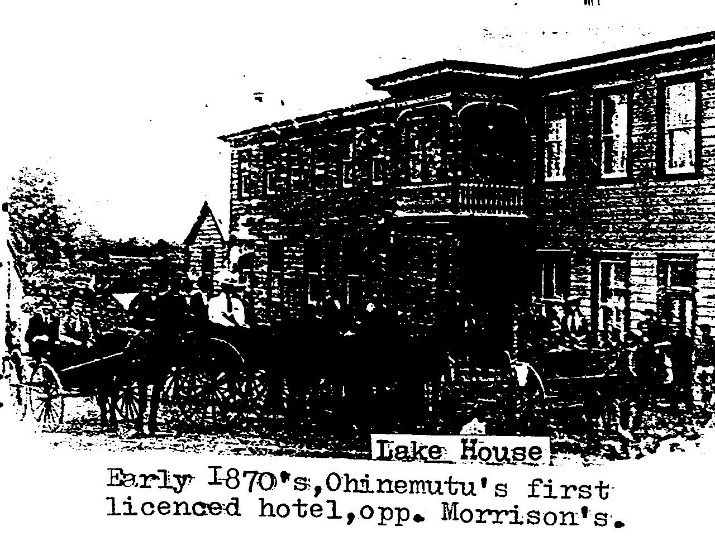
1872, Ohinemutu’s 1st. hotel, of T. Bennet, sold to J. Morrison in 1874. About the same time, 1st. licenced hotel at Ohinemutu was Lake House. New Rotorua’s first hotel (temperance) was S. Brent’s, cnr. Hinemaru–Eruera Sts., opened 1885, now Kingsgate Hotel.
1883, 1st. Rotorua Town Board of 3 members, resident magistrate H.W. Brabant, resident medical officer T.H. Lewis, a prominent Maori Arawa Chief – Rotohiko Haupapa, all appointed by Govt.
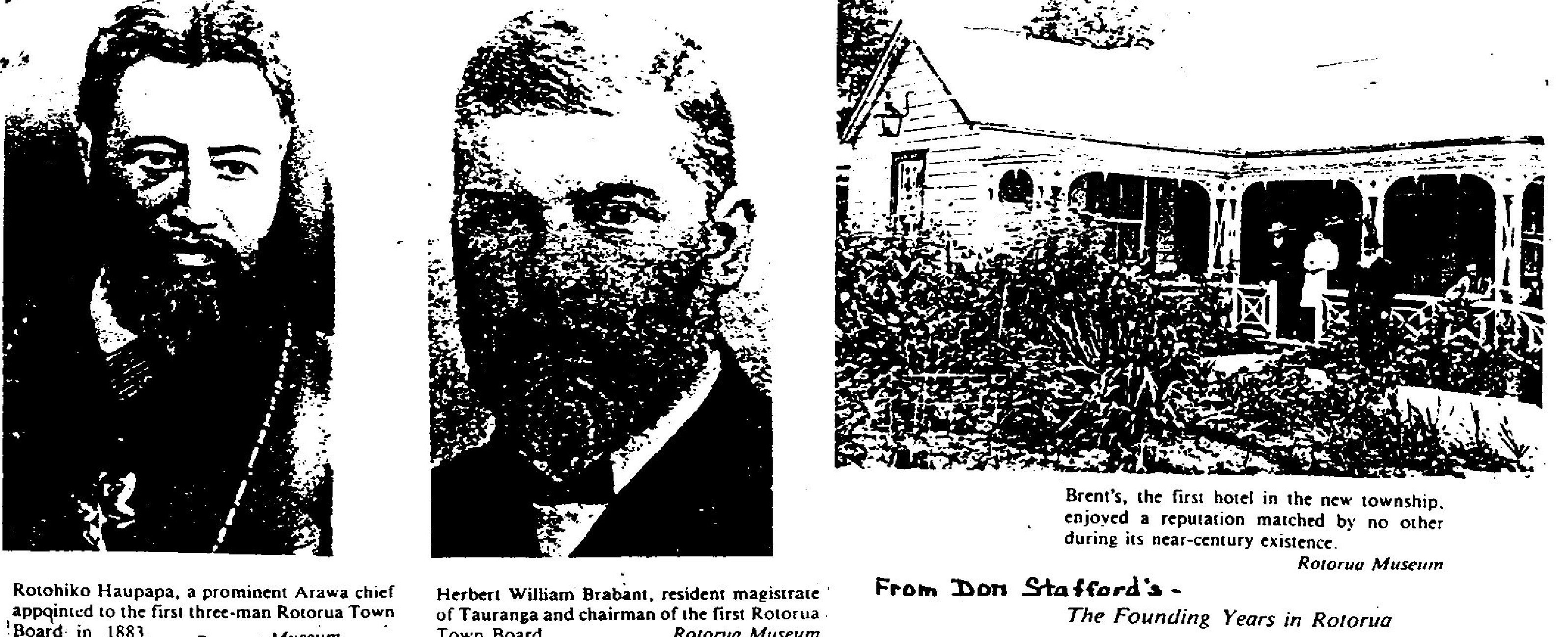
Rotohiko Haupapa, prominent Arawa chief and member of the first Rotorua Town Board, 1883; Herbert William Brabant, resident magistrate of Tauranga and chairman of the first Rotorua Town Board; and Brent’s, the first hotel in the new township. (Rotorua Museum; from Don Stafford’s “The Founding Years in Rotorua”.)
Fenton St
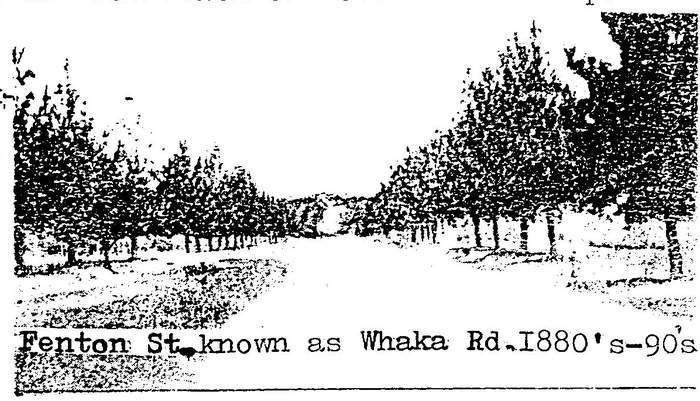 Fenton St., Rotorua’s most renowned stretch of road, well named after Judge Fenton for his part in the formation of Rotorua township.
Fenton St. stretches straight from the old Post Office at Arawa St. all the way to Whakarewarewa, with the view of Pohutu Geyser steaming up at the end. Old timers remember when it was known as Whaka Rd. from the railway yards. It opened up early sections for residents south of the township with streets leading off it, some Glenholme area.
Nowadays tourist accommodation stretches all the way.
Judge Francis Dart Fenton
Te Arawas made magnanimous provisions, 1,047 acres, for Public Reserves, 1880. As Chief Justice of the Maori Land Court, he met in 1880 Nov. with the Great Committee of Arawas whereby the Ngati Whakaue Arawas retained freehold of land in an agreement. Any disposal of land would be lease. Judge Fenton signed on behalf of the Govt.. Leases were for 99 years.
1881, Sept. Thermal Springs District Act became legal, incorporating the 1880 agreement mentioned above with Judge Fenton and the Arawas.
Sir George Grey, Governor of N.Z. had appointed Judge Fenton commissioner, to arrange an agreement with the Arawas as to which land would be made available in Rotorua for settlement. Grey had agreed with the Arawas’ request that all private land agents be removed and arrangements be left in the hands of the Govt. which would have such lands surveyed and put up for public auction, the proceeds to go to Natives.
1881, 12th Oct., Rotorua was proclaimed a township.
1882, 7th March, first sale of land by auction, held in Auckland. Land was based on 99 year leases.
There was much conjecture beforehand by interested Europeans as well as the Arawa chiefs as to the outcome of the sale and prices for land. Great relief was felt after the sale which had proved a great success and it was reported in the newspaper that there was jubilation amongst the Ngati Whakaue Arawas who could expect a good income as a result. The report added that at the close of the sale, a disturbance was observable at the end of the room – it was Fenton (maybe James Fenton, carrier Tauranga to Rotorua), vigorously in an ecstasy of delight performing a haka with two old Rotorua Maoris.
1883 Native Committee Act enacted to make preliminary enquiries and investigations of titles, as well as being constituted a petty debt court (for the Maoris), in conjunction with resident magistrate court.
1884, May, the first Committee of 12 Chiefs elected – reduced from the Great Committee numbers which was too cumbersome. The 12 Chiefs – Tauranga 1, Matata 1, Galatea 1, the rest from the Rotorua Arawas.
Judge Fenton showed respect to the Ngati Whakaue Chiefs for their support and generosity in the formation of Rotorua township, in the naming of the first streets such as Arawa St., Haupapa St., Pukuatua St., Eruera St., Amohau St., Pererika St., (Pererika, Chairman of Great Com.) The eastern end of Pererika St. was later taken over for the railway.
After the 1882 successful 99 year land leases, unfortunate circumstances forced many lessees into arrears on their payments. The depression of the 1880s in N.Z., and Tarawera Eruption ruining the great tourist draw of the Pink and White Terraces, made it necessary for the Crown to purchase from the Ngati Whakaue 2770 acres of lease land.
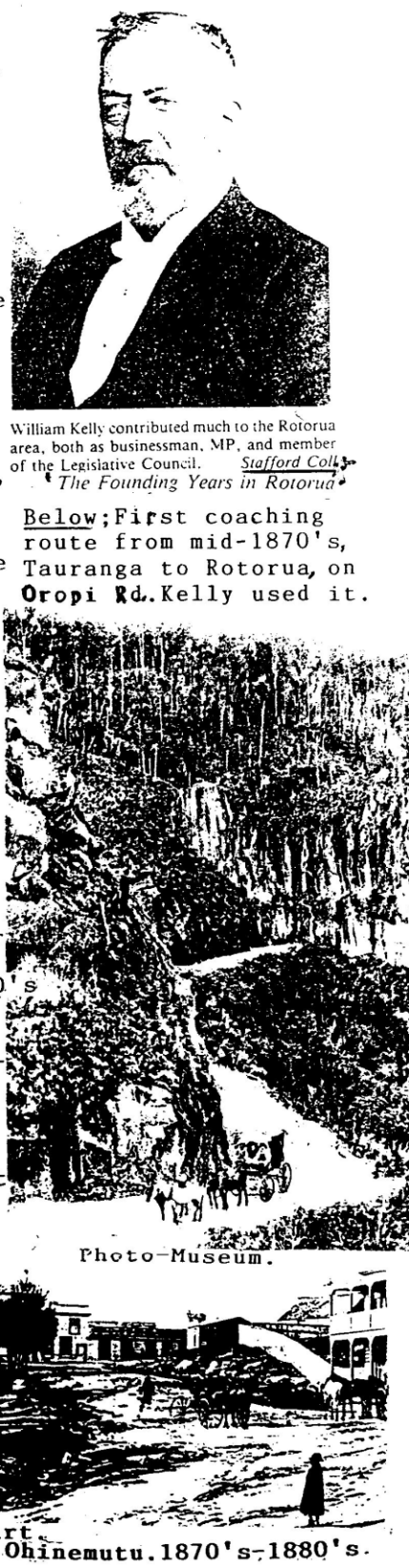 William Kelly
, 1870s–1890s, benefited the development of Rotorua. Tauranga at first was his base from which he operated one of the first stores at Ohinemutu, then new Rotorua’s tourist hotels, timber mill, farmlands, on Town & County Councils, Parliament Representative.
1875. W. Kelly established a trading store at Ohinemutu, managed by John H. Taylor, also to become deeply involved in Rotorua’s affairs. Before Kelly, 1873, Scott & Philips had store, also, 1874, Thomas Bennett’s store.
1878, W. Kelly’s coaching line, “Cobb & Co’s Royal Mail”, Tauranga to Ohinemutu and Tauranga to Napier. His Rotorua stables were about where Rotorua Primary School stands.
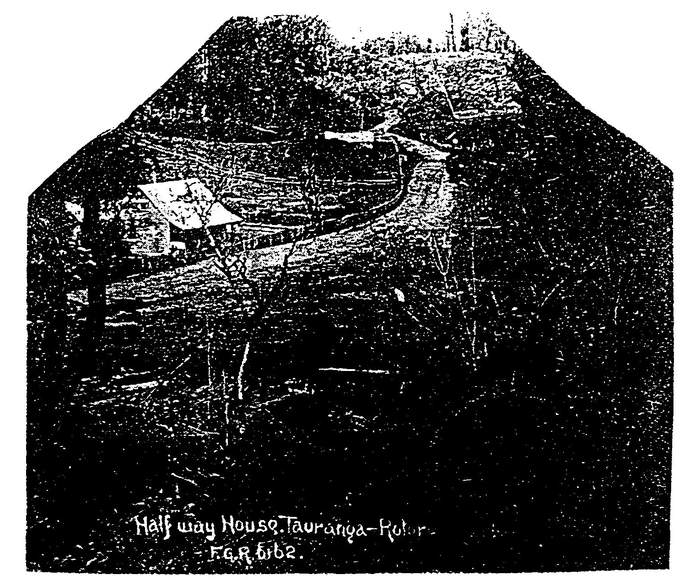
1880, he rebuilt the stables, mid-way in the bush, keeping another coach there and change of horses. Next he followed new development, 1882, of steamer landing Tauranga goods at Maketu. He established an agency at Maketu to receive goods brought from Auckland by his own vessels, but Maketu bar was hard so this was partly overcome that same year by a bridge being completed over Kaituna River, at Waitangi (Okere area) making it possible to transport from Tauranga, Te Puke, Rotorua.
1882, W. Kelly, with Graham, established a fine tourist promotion for Rotorua, under world famous organisation, “Thomas Cook and Son”, for conducted tours, Rotorua to Auckland and return including steamer vessel, sight-seeing coaches, hotel and baths.
1885. W. Kelly built grand brewery where Girls’ High Sch. is, on rise at the back, on Old Taupo Rd., drawing water from the Utahina River. 1891, brewery was removed to the township. W. Kelly’s farm stretched from Old Taupo Rd. to the Utahina. He leased it to J. Stanley & in 1891 he disposed his lease to J. Dalbeth who sold dairy produce to town until 1896. D. Sherriff next farmed this, having slaughter house along Malfroy Rd. up on the rise, this then being owned by Smallbone, late 1920s–30s.
Note: About 1889, from Kelly’s farm trout from Utahina R. were being caught. Brook trout were first released by Mr. Taylor who received, 1884, from an American in Christchurch.
1885, W. Kelly, Chairman of 1st. County Council. 1885, dreadful depression at its worst – 1890. 1886, W. Kelly, elected to 1st. Rot. Sch. District Committee, under jurisdiction of Auckland. 1885, beginning of new Rotorua township, as apart from original stores at Ohinemutu.
1885, sales by auction were made in town to several well known residents of Ohinemutu, commercially involved there already. W. Kelly, Henry Mitchell, Wlm. Seddon, Mrs. Ann Robertson, Thomas Corbett – Crown Lease Land. Arawa & Fenton Sts. were main development. No free-hold land available by Govt. law. Ohinemutu was the ‘Old Town’ till 1885. 1881, leases became null & void because they had not passed through Native Land Court.
 |
 |
|---|---|
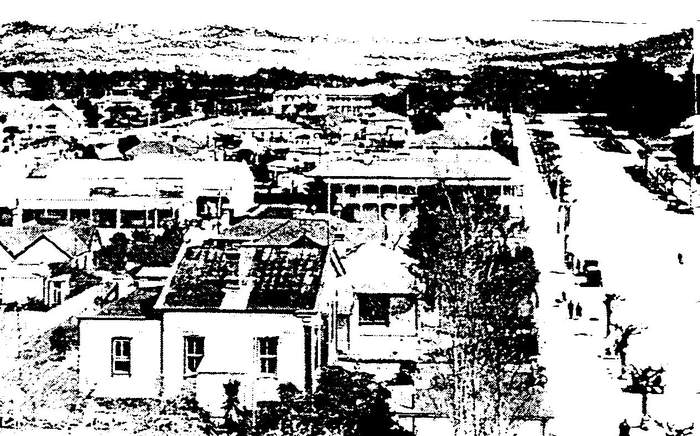
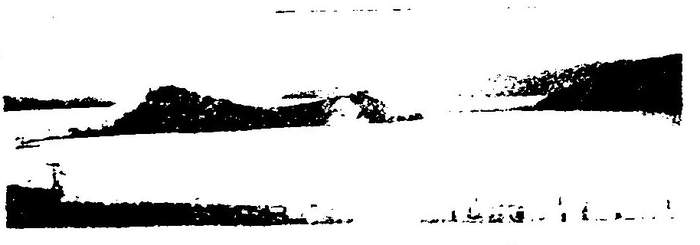
| New Rotorua town, 1885–1915: thirty years of development, looking up Arawa St. from the Fenton St. corner. In the forefront is the Police Station, next to the Victoria Institute housing the Rotorua Town Board and then the Courts. Further back, opposite the Hospital drive, is a private hotel since 1896, Arawa House, originally Rev. F. Spencer’s; halfway down on the corner of Arawa–Tutanekai Sts. is the Palace Hotel | Bush-clad hills at Lake Rotoiti. (Photo – Museum.) |
1887, W. Kelly was elected to Rotorua Town Board, to 1891.
1887–1896, W. Kelly was the Parliamentary Representative for the Tauranga Seat which also represented Rotorua township.
1895, W. Kelly sold his Ohinemutu Hotel to the owners of Rotorua’s new Grand Hotel, cnr. Fenton–Hinemoa Sts. so they could get a licence.
1887–1890, W. Kelly, as Town Board member, 1887–1891, and as Rotorua’s Representative in Parliament.
1887–1896, tried to get Town Board changed from being under Govt. nomination to a locally elected body, so as to enable residents to have a voice in administration of local affairs. 1900, Town Council Act changed Town Board to seven members, 3 elected, 4 Government appointed, until 1906. 1907, taken over by Dept. of Tourism and Health Resorts, until in 1923, it became the Rotorua Borough Council.
1889, W. Kelly purchased the ‘Rotoiti Sawmill Company.’ He had it running by 1893 at Tapuaekura Rotoiti bush, supplying timber to Ohinemutu and the new township of Rotorua. 1893, sawn timber was barged to Rotorua, his barge being called “Home Rule.” Sometimes it sailed in favourable winds. Sometimes the barge was towed by the steam launch “Alice”, belonging to Boord and MacDonald. Later, in 1895, the name was changed to the Rotorua Sawmill Company.
1896, the sawmill was destroyed by fire at great loss to W. Kelly. The salvaged engine and boiler were loaded onto the barge and headed for Rotorua. At entrance to Ohau channel, the boiler listed in choppy conditions, turning the barge over, almost drowning the terrified crew, who did manage to get to the dinghy in tow. Kelly watched in absolute despair.
1896, W. Kelly used his influence with Govt. to help Mamaku during its 1890s struggle to gain roading access to the Rotorua–Tirau highway. The 1893 arrival of train was only to the north, and the 1894 railway to Rotorua only made Mamaku residents dependent on rigid time-tables. They needed connecting roads. Two Petitions were sent, one to Commissioner of Crown Lands, one to W. Kelly, M.P., 1896. 1897, district engineer completed the construction, road opened.
1897, W. Kelly attended a gold prospecting meeting in Rotorua, after gold find at Horohoro. This was soon abandoned, the Rotorua Company then looking to take over a Te Puke claim, found encouraging in 1896.
1900, D. Tilsley, was employed gold prospecting at Kaharoa, by Hamilton firm, working with Rangi Douglas and Stanley Robinson. Note: Tilsley Street, off Ranolf St. near Glenholme School, Rotorua.
Old Taupo Road
 From Don Stafford’s collection, Daily Post, 19-12-1979:
Old Taupo Road mentioned above is a name which goes back more than 100 years. The main route from Auckland into the thermal springs area in the middle of last century was by ship to Maketu and thence overland by an old Maori trail. Soldiers in the 1860s and 1870s needed a more direct route from the port of Tauranga, and one was opened up through the Mangorewa Gorge. This became the start of the main route down the island to Taupo and thereby to Napier.
The town of Rotorua did not exist at that time. The stopping place for soldiers and the increasing stream of tourists who used their road was Ohinemutu. Coaches from Tauranga would follow the path of the Taupo Road and deposit visitors across the only bridge over the Utuhina, almost where the bridge is today an Old Taupo Road.
From there they would walk through the manuka to their lodgings at Ohinemutu. In 1875 what we know now as Lake Road was developed, and a bridge built over the Utuhina to allow coaches to travel directly into Ohinemutu.
An old watering trough for horses — and dogs — which stands outside the Rotorua Boys’ High School is a reminder of the days when Old Taupo Road was a major route for coaches and horses bringing visitors to the district.
William Seddon
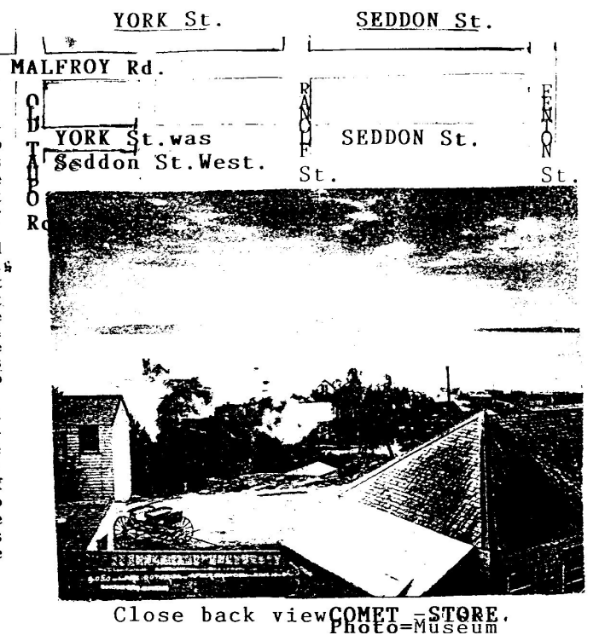
William Seddon, early 1880s, settled in Ohinemutu, owning the “Comet Store”, was Bennett’s originally. The leaden heavy clouds are result of Tarawera eruption in this photo, in 1886. That same year, Seddon built a fine store in the new Rotorua township. During 1885 he was one of the Ohinemutu residents who procured Crown land at the Sale-by-Auction so that they could move their businesses from Ohinemutu. The land had first to be cleared of thick Manuka scrub and then fenced off. His new store was N.W. cnr. opp. Post Office, of Arawa & Fenton Sts.
W. Seddon was an active community worker for this new town. He, on 29th Jan. 1890, Jubilee Day, worked with 10 others up Ngongotaha Mt. for 4 hrs. slashing a track, as a patriotic effort, through the bush to summit. 1895, a surveyed road for buggies was cleared to the summit and a new platform erected, but road usable for sightseeing, not till 1897. Alf Clayton, from early 1880s, was a surveyor & resident. Clayton Rd. Kuirau Park project, about 1896, saw paths cut through scrub, to pools.
York Street
-
Queen Victoria’s reign, 1837–1901, with Prince Albert. Son George:–
-
Duke and Duchess of York, visited Rotorua in 1901. They became King George V and Queen Mary. Sons Edward and George:–
-
Prince of Wales, a brief reign as:– King Edward VIII, before abdicating. Visited Rotorua in 1920.
-
Duke and Duchess of York, visited Rotorua in 1927. They became King George VI and Queen Elizabeth, now called “Queen Mother”. Daughter:–
-
 Queen Elizabeth II and Prince Phillip the Duke of Edinburgh made a coronation visit to Rotorua in 1953.
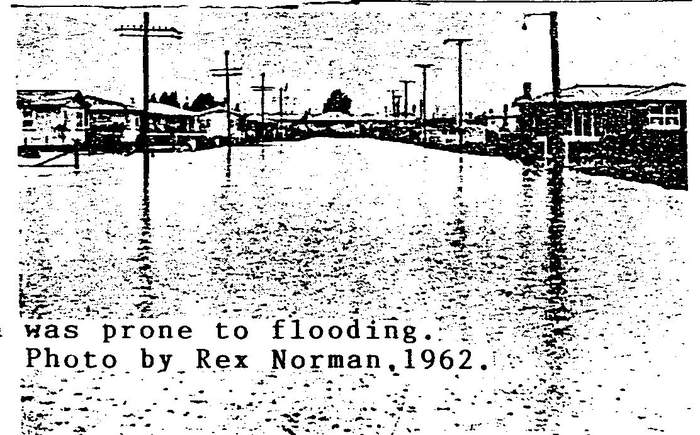
York Street in 1930s, was gradually accepted in name in place of “Seddon St. West.”
The early lease of the York St. block of land, was T. Sloan’s, which he named ‘Golfington’, according to Mrs. Stan King who lived there round the 1930s.
 1901, after the Duke and Duchess had visited Whakarewarewa, they went to Arawa Park racecourse to watch a magnificent display for an hour of haka and dancing by tribes from throughout N.Z. – 3000 spectators.
Rotorua electricity had been installed only weeks before so evening illuminations were spectacular, also fireworks display at racecourse.
Final gathering next day at racecourse where the Royal Party watched a great Maori pageant of 2,000 in war party costume, each tribe carrying distinctive flags, with their spears and weapons. Chiefs gave priceless gifts. Several motion pictures for exhibition were taken — A.J. MacDermott, one of N.Z.’s earliest operators, Rotorua’s 1st. in 1889.
From “Post Personalities” by C. Worthington — Royal Visits
|
First of the Royal Family to visit New Zealand was the late Duke of Edinburgh. He saw more of the Maori race and of the country than any succeeding Royal visitors. His first visit was in April, 1869, when he landed in Wellington from H.M.S. Galatea. On the second visit, he arrived in August, 1870, on an unofficial call as a naval captain, also in the Galatea. The last and most extended visit was to Auckland on December 8, 1870. On this occasion, he was invited by the Arawa tribes to visit the thermal regions. Landing at Tauranga, the Arawas cut a bridle track through to Te Wairoa from Maketu and the Duke and his numerous party reached Ohinemutu, where camp was pitched on Pukeroa Hill. After enthusiastic greetings and ceremonial hakas and pois, the party, enormously augmented by a guard of honour of some hundreds of horsemen, rode to Wairoa, where the Tuhourangi tribe gave a tumultuous welcome. Canoe racing on Lake Tarawera, where some 40 canoes competed, and a night out on the Terraces were features of this journey. The Duke, a great personality, splendid athlete and fearless horseman, won the hearts of all who met him. On the occasion of landing at Tauranga, Henare Te Pukuatua, the magnificent chief of the Arawas, held the post of honour, “Wera,” at the reception by the tribes. As an outcome of this visit, in fulfilment of a promise to the Ngati-Whakaue, Queen Victoria sat for the famous sculptor, Boehm, for the monumental bust that stands on the marae at Ohinemutu. The full record of this memorable visit was written by Capt. Gilbert Mair, who was a guest of the Duke on board the Galatea. |
Visit of the Duke and Duchess of York In 1901, on June 21, the Maori welcomed at Arawa Park the Duke and Duchess of York, when 6457 Maoris from all over New Zealand attended the ceremony. The ground shook beneath the tremendous impact of a thousand feet in welcome. The aged chief of the Arawas, Pokiha (Major Fox), Sir James Carroll, Native Minister, Sir Apirana Ngata and many other chiefs and leaders took part in the ceremonies, where gifts were given and received. The whole gathering passed without a hitch. It was a wonderful feat of organisation and striking demonstration of loyalty and goodwill. Visit of the Prince of Wales Though the visit of the Prince of Wales, in 1920, was marred in the opening by a railway strike, heavy rain and bogged roads, it was a wonderful demonstration, full of colour and romance. Incidents that will pass down to history occurred, and names, now famous, put on record. From the moment of his arrival the Prince kept an exacting time-table, and everywhere he gave a friendly greeting. The aftermath of war was still apparent. At the station were gathered veterans of the Maori War under Capt. Gilbert Mair, and Maori Pioneer battalion under Major Ray Vercoe, D.S.O., D.C.M., and Lieuts. H. Kerauti and H. Leaf, M.C., and returned men and wounded under Major W. Sumner. The company included Sir William Herries, Sir William Fraser, Sir Joseph and Lady Ward and the Hon. Dr. Maui Pomare and the Hon. Te Heu Heu Tukino, M.L.C. |
|---|---|
|
They were received by Messrs. W. Hill, resident officer, F. F. Hockley, M.P., B. M. Wilson, Tourist Dept., and J. N. McLean, president of the Rotorua Chamber of Commerce. The Hui The occasion will be remembered by many for its dignity and splendour. The Prince moved freely among the people. Sir James Carroll controlled the order of proceedings, which opened with Tuhourangi poi dances, led by Bella Papakura. Then the Ngati-Whakaue, 80 strong, led by Nataria. Tau Henare led the Ngapuhis, while Sir Apirana Ngata, M.P., led out the East Coast tribes in a magnificent display at Arawa Park. Sir Apirana has celebrated this hui in a poem which deserves greater recognition. A scholar and statesman he will leave behind a record of which his race may be proud and the pakeha, envious. During his brief stay, the Prince was enabled to see much of Maori life. On the historic maraes of Ohinemutu and Whakarewarewa, he was given Royal welcomes. At Ohinemutu, Rangi Te Aorere and Kiwi Amohau gave tribal greetings in their native manner, the interpreter being Lieut. Kepa Ehau. At Whaka, Guides Bella and Miriam conducted the Royal party to the bridge, where the “wera” was grandly given by Dick Thom. At the meeting house, Mitu Tsupopoki made the speech of welcome, which report at that time credited with “native embellishments.” Capt. Ray Vercoe interpreted. Rear-Admiral Sir Lionel Halsey, Lord Louis Mountbatten and Lord Claude Hamilton were among the distinguished train, whose names are now familiar words. |
On departing from Rotorua, the Prince expressed his pleasure and gratitude to all who contributed to make the visit so great a pleasure. He would ever remember the kindness and loyalty of his hosts, the Arawa people. Their beautiful gifts would always remind him of New Zealand, he said. The Duke of GloucesterThe visit of the Duke of Gloucester is so recent that it will be remembered by most of our readers. Time Was Good guides never die. If they pass, their memory remains and their good works live after them. Many thousands of visitors have passed over the marae to witness the fine geyser displays and have been kept out of danger through their kind offices. Guide Sophia, the heroine of that fateful night in August, 1886, when Tarawera destroyed the people who lived under its shadow; Maggie Papakura, who promoted guiding to a science; Eileen, Georgina, Kathleen, Marion, Susan (still evergreen), Bella and Rangi are some of those who have advertised their race and the wonders of New Zealand throughout the world. Though the spout bath has gone to ground and other glories have faded, “Whaka” still holds a unique record. In the beautiful home of Guide Rangi is the only pound note that is not straw value outside the Dominion. It carried the autograph of the Prince of Wales, now Duke of Windsor, and commemorates an unofficial visit to the village in 1920. |
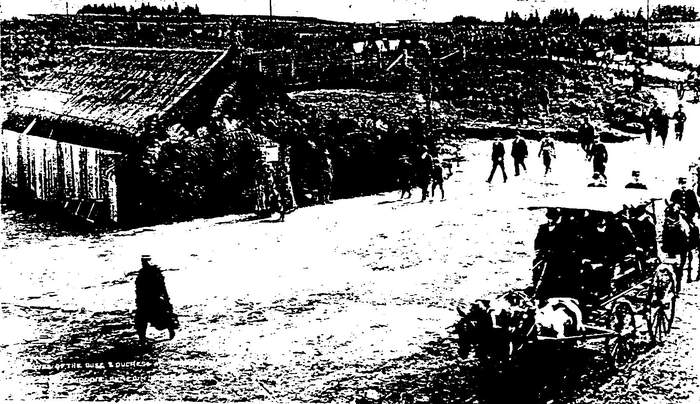
1901, Duke & Duchess of York – later King George V & Queen Mary, visited Rotorua, 13th to 15th June, arriving 4.30 pm from Auckland to a tumultuous welcome. Next day, 3 official ceremonies took place. At 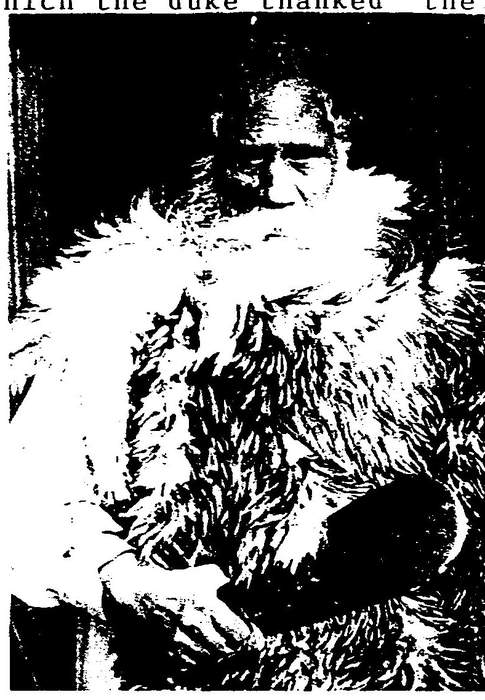 10am the Royal Party were escorted by coach to Ohinemutu by a party of Mounted Rifles from Wairarapa, several hundred warriors, and “every vehicle in Rotorua”, to where 2–3000 Maoris awaited them, with such great chiefs at the marae as Te Heuheu of Taupo, Te Keepa Rangipuawhe, Pokiha Taranui (Major Fox) who was brandishing the sword presented to him by the duke’s grandmother, Queen Victoria. At the foot of Victoria’s statue the gifts of Ngati Whakaue & Tuhourangi were displayed. Then Pirimi Mataiawhea, a chief of great standing, offered gifts from the assembled tribes, his presentation speech, being interpreted by Gilbert Mair, after which the duke thanked the Arawa people.
The duke went to Chief Pokiha Taranui, the old veteran, now frail in a chair, who acknowledged the allegiance of himself and his people to the throne of England. He presented an ancient and elaborately carved toki with a fine greenstone blade which the duke carried throughout all remaining celebrations. At the final one next day, the model of Te Arawa canoe was presented by Pokiha Taranui but lifted by four rangatiras. When the duke pinned one of the medals on Pokiha, sustained cheering burst out.
 Note: This was Pokiha’s final public appearance, at which he caught a severe cold and went into Auckland Hospital. Fearing to die away from his ancestral Maketu home of the Arawa people, and lands they retook from Ngaiterangi in 1836, he returned via Rotorua–Taheke in a buggy. Gilbert Mair, following his old friend, saw Pokiha climb the steep hill to the pa, where he leaned back in his wife’s arms, and giving a sigh of satisfaction, said, “Kua kiti ahau i taku mokopuna, ka haere ahau”, and immediately passed away. At Rotorua he always addressed the Duke of York as his “mokopuna” – grandson.
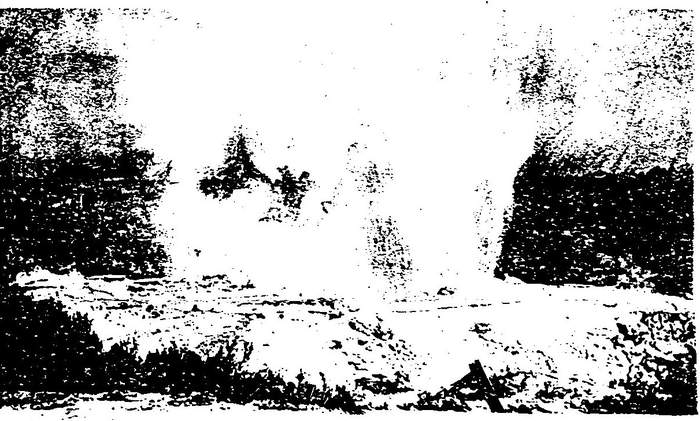
Whakarewarewa, that morning, after Ohinemutu, welcomed the Duke and Duchess of York, officially met by Te Keepa Rangipuawhe, Mita Taupopoki and other noted chiefs. The royal couple were escorted by two famous guides, Sophia and Maggie Papakura. Famous Wairoa Geyser was primed by soaping it, causing boiling fountain to shoot up 100 ft. Before leaving, they watched children diving for pennies at the bridge of the stream. After a final song and poi dance by a party of young Tuhourangi women, the royal couple drove off to the racecourse reception.
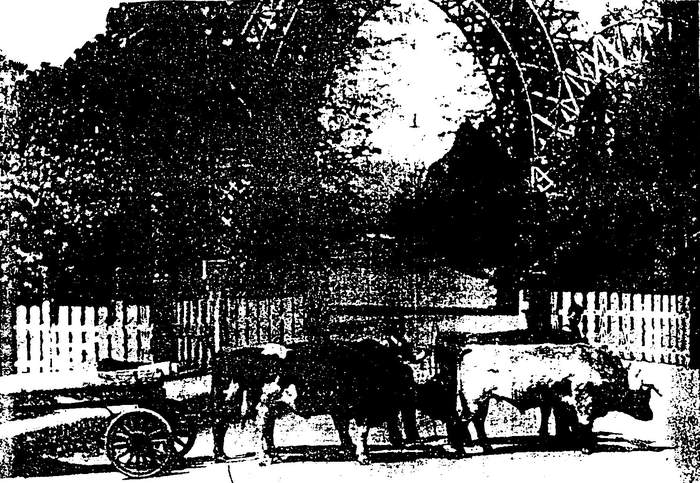
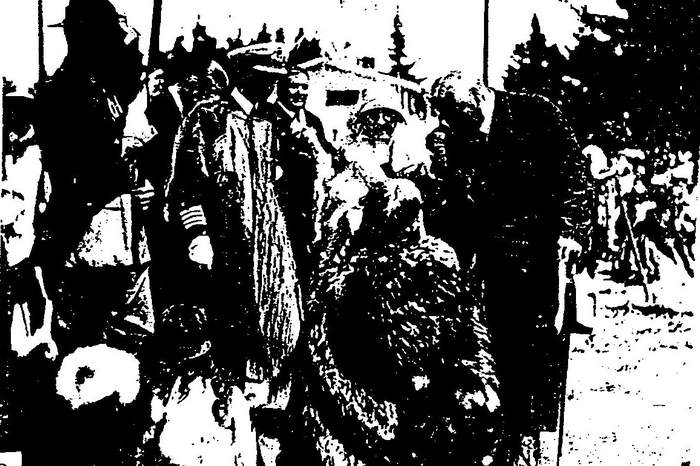
Princess Gate, constructed 1901 at the entrance to the Govt. Gardens; bullock team, 1920s, of Phil Waugh’s, Harry Mita driver, in festival (Photo – Kaharoa booklet). Below: Duke and Duchess of York at the reception in Arawa Park, 1927 (Stafford Coll. / I. Muir).